
Disruptions To Digital Communications Persist In The Democratic Republic Of Congo

By Edrine Wanyama |
Internet access and Short Message Services (SMS) were interrupted in the Democratic Republic of Congo (DR Congo) on January 20, 2018 ahead of a peaceful protest march organised by the Catholic Church to compel President Joseph Kabila to step down following the expiry of his final term in office. The country remains caught in a cycle of instability since the postponement of the November 2016 elections to December 2017, and then to April 2018.
The first interruption of digital communications in the vast central African nation occurred in December 2011 in the aftermath of general elections, before the announcement of the election results. The shutdown affected SMS, and lasted 25 days.
In the seven years since then, DR Congo has experienced at least five communication disruptions amidst growing concerns about surveillance of the digital communications of opposition leaders, journalists, and activists.

See: The Evolution of Internet Shutdowns in DR Congo

Affronts to internet access hurt human rights, and undermine political stability and economic growth. According to the new framework for calculating the economic impact of internet shutdowns, DR Congo loses at least USD 1,936,911 per day of an internet disruption.
The regular communication disruptions bring into focus the role of intermediaries in advancing internet freedom in the country. Specifically, telecom companies and other Internet Service Providers (ISPs) are being challenged to dissociate themselves from censorship, by declining to effect the government’s orders to cut off communications. Such a move would arguably be in accordance with the UN Guiding Principles on Business and Human Rights which require businesses to proactively address all adverse human rights impacts directly linked to their operations, products or services. However, many telecommunications services providers fear reprimand and termination of their licences for failure to comply with directives from the state to interfere or block digital communications.
Government directives to shut down the internet or interrupt communications are usually issued under the guise of “national security” or “public order”. In a letter ordering network disruptions in August 2017, an official of the national communications regulatory body, the Autorité de Regulation des Postes et Télécommunications du Congo (ARPTC), instructed service providers to take preventative measures to reduce the capacity to transmit “abusive messages.”
Internet penetration in DR Congo remains low at 4.2%, supported by a 55.7% mobile penetration. To-date, there are two primary laws governing the telecommunications sector, both of which were passed in 2002: the Framework Law 013/2002 on Telecommunications, and the Law 14/2002 on the Regulations – the law that established the national regulator. However, rather than advance internet access and usage, these laws have often been used against the media and critics of the state. Meanwhile, there are limited meaningful avenues for citizens to provide inputs to proposed new laws related to the telecommunications industry.
President Kabila’s government should boldly work to stop the abuse of rights which the country’s 2005 constitution guarantees . Abuse of free expression and access to information has continued in Congo despite the recognition of access to the internet as a human right by African and International Human Rights instruments. The UN Secretary General has previously called and continues to call upon the Congolese government to uphold her citizens’ freedoms to speech and peaceful assembly.
It is thus imperative that Congo government authorities desist from interrupting digital communications and guarantee citizens’ access to the internet and to the full enjoyment of their digital rights. Further, the Congo government should recognise the relationship between access to the internet and citizens’ livelihoods and work to grow the number of its citizens that meaningfully access and use digital tools and services.

Online Chat On Internet Shutdowns

Online Chat |
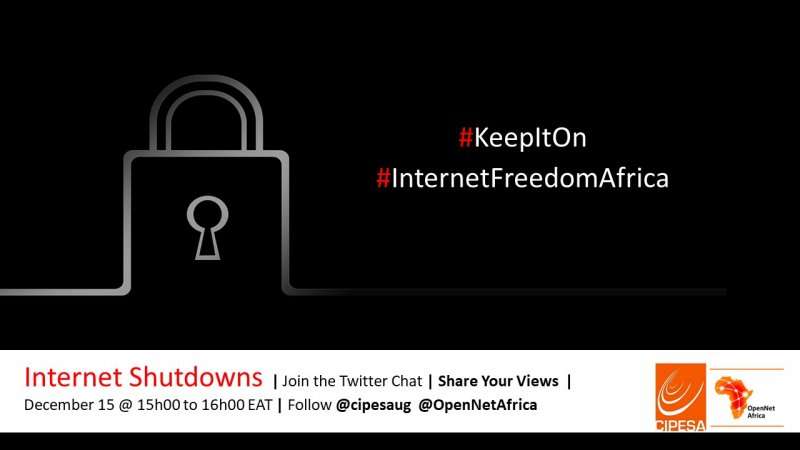
On Friday December 15, 2017, the Collaboration on International ICT Policy for East and Southern Africa (CIPESA) will spend some time sharing insights on internet shutdowns. Between 15h00 and 16h00 East African Time (EAT) we will explore the spate of shutdowns affecting Sub-Saharan Africa and the efforts to navigate them.

Have you experienced an internet shutdown? Are you experiencing a shutdown? What work or insights would you like to share around this issue? What is the way forward?

We will also share insights on the economic impact of internet shutdowns with reference to a new framework we developed on calculating the Economic Impact of Internet Disruptions in Sub-Saharan Africa
A few of the documented cases of deliberate interruption of digital communications in sub-Sahara Africa in December thus far include an ongoing shutdown in Anglophone regions of Cameroon which as of today has run for 75 days. An earlier shutdown in the same region lasted 93 days. This week also Ethiopia experienced interruptions to its communications – primarily Facebook, Whatsapp and Twitter due to protests in the Oromia region. Further afield, in Yemen, there were reports of some internet filtering, blocking, throttling, and social media shutdowns.
Join the discussion and share your views on how we can #KeepItOn and protect #InternetFreedomAfrica 

Analysis of Tanzania’s Electronic and Postal Communications (Online Content) Regulations 2017

Policy Brief | The proposed Electronic and Postal Communications (Online Content) Regulations, 2017 join the catalogue of legislation related to online content in Tanzania that threaten citizens’ constitutionally guaranteed rights to freedom of opinion and expression and the right to seek, receive and impart information. The regulations were developed pursuant to section 103(1) of the Electronic and Postal Communications Act, 2010 (EPOCA), which empowers the Minister of Communications to make regulations on content related matters. Enacted in March 2010, the EPOCA aims to keep the communications sector abreast with developments in the electronic communications industry by providing for a comprehensive regulatory regime for electronic communications and postal communications service providers.
The regulations specify obligations of service providers and users of online platforms including social media, discussion forums, and online broadcasts (radio and television). They also confer powers upon the Tanzania Communications Regulatory Authority (TCRA) to regulate online content, including through registration of users and platforms, and taking action against non-compliance with the obligations, such as ordering the removal of “prohibited content.”
The regulations have some important provisions and set minimum standard requirements with regards to the protection of children online, fighting hate speech and extremism online, and promoting user responsibility and digital security practices. However, the regulations should to reviewed and amended to have clear, unambiguous definitions and wording, and quash the requirement for registration of bloggers and users of similar online platforms. It is also essential that not too much power is vested in TCRA with regards to content take-downs and that diversity in content availability online is promoted. The obligations set out should not turn content service providers and publishers into monitors, by handing them responsibility such as use of moderating tools to filter content, conducting content review before publication, and undertaking mechanisms to identify sources of content.
Moreover, there should be a clear appeal mechanism against orders to remove or block content, and such remedial measures should also be applicable once an order for blockage or removal has been issued but not yet been effected. Overall, the regulations should uphold citizens’ rights to privacy, access to information and free expression. Furthermore, TCRA, pursuant to EPOCA’s objectives of promoting a developed telecommunications sector in Tanzania, should ensure that the regulations foster internet access and affordability without placing undue requirements on service providers or making costs prohibitive, which would act as a barrier to market entry, including for public access facilities such as internet cafes.
Read CIPESA’s analysis of the implication on access to the internet, intermediary liability, user privacy, censorship, surveillance and freedom of expression of the proposed regulations in Tanzania.

Digital Security And Privacy Practices In Context For Human Rights Defenders

Workshop |
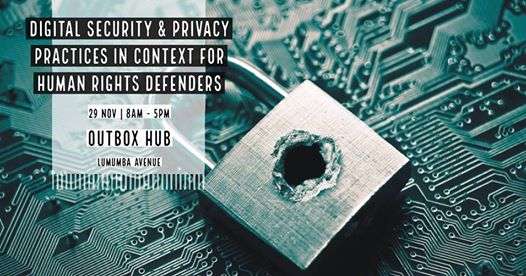
The Collaboration on International ICT Policy for Eastern and Southern Africa (CIPESA) in partnership with Outbox, a Kampala based tech hub are hosting a workshop aimed at  building  digital rights knowledge as well as the digital security and capacity of human rights defenders, media, vulnerable women organisations in Uganda.
Despite the importance of digital security and privacy for human rights defenders in carrying out their work, the development of effective digital security strategies still present a numerous challenge. Human rights defenders have to contend with an ever shifting landscape of technologies and threats, limited understanding of behavioral factors and the lack of customisation for a number of the tools, among others.
The one day workshop will be hosted  at Outbox on the November 29, 2017 and is aimed at targeting human rights defenders, software developers, media and other civil society actors.  Use this  link to register.

Rapport alternatif sur la liberté d'expression en ligne au Rwanda

La “Collaboration on International ICT Policy for East and Southern Africa”  (CIPESA) a soumis à la Commission Africaine des Droits de l’homme et des Peuples (CADHP) un rapport parallèle sur l’état de la liberté d’expression en ligne au Rwanda.
Le rapport décrit les mesures législatives et connexes prises par le Rwanda pour promouvoir et protéger la liberté d’expression en ligne et fournit à la Commission des informations impartiales sur l’état de la liberté d’Internet au Rwanda, ainsi que des recommandations d’amélioration.
L’article 62 de la Charte Africaine des Droits de l’Homme et des peuples (La Charte Africaine) exige que tous les Etats parties à la Charte présentent tous les deux ans des rapports sur les mesures prises pour réaliser les droits et libertés garantis par la Charte. Le Rwanda a soumis des rapports pour la période de 2009 à 2016 en date du 22 mars 2017. Ils ont été examinés par la commission cette semaine, avec des groupes de la société civile tels que CIPESA fournissant des rapports alternatifs et des questions pour informer la commission.

Dans son rapport, le gouvernement rwandais a déclaré que la liberté des médias et la liberté d’information sont reconnues et prévues par la loi, ajoutant que tout journaliste a droit à la liberté d’opinion et d’expression, y compris le droit de rechercher, recevoir, et diffuser des informations et des idées à travers tous les médias. Cependant, selon le rapport alternatif du CIPESA, diverses lois et pratiques étatiques continuent de contrevenir à ces libertés, limitant notamment leur jouissance en ligne. La surveillance et l’interception des communications, le blocage et le filtrage du contenu sont parmi les questions problématiques soulevées par le rapport parallèle du CIPESA.
Le gouvernement Rwandais a déclaré que la loi relative à l’accès à l’information est un point d’entrée pour améliorer la participation des journalistes aux affaires politiques et reconnaît l’importance d’une presse indépendante et professionnelle, ainsi que celle d’un accès facile à l’information comme composantes essentielles de la bonne gouvernance,  du développement économique et politique durables. Il a ensuite précisé les lois nationales et les institutions statutaires qui garantissent le droit à l’expression et la liberté d’information.
Cependant, le rapport alternatif note que la loi n ° 24/2016 du 18/06/2016 sur les TIC, la Loi n ° 60/2013 réglementant l’interception des communications, le Code de procédure pénale n ° 30/2013 du 24/05/2013, la loi régissant l’enregistrement de la carte SIM de 2013,  contiennent des dispositions qui portent atteinte à la liberté d’expression en ligne et aux droits à la vie privée et contreviennent à l’article 38 de la Constitution, aux normes internationales et aux meilleures pratiques en matière de liberté d’expression et d’accès à l’information.
En juin 2017, le taux de pénétration de l’Internet au Rwanda était estimé à 36,6% (3 724 678 connexions), les utilisateurs de Facebook étant estimés à 490 000, sur une population totale de 12 159 586 personnes. Cela représente une amélioration par rapport aux statistiques enregistrées par le “Rwanda Utilities Regulatory Authority” ( Agence de réglementation des services publics du Rwanda : RURA), qui indiquait un taux de pénétration du téléphone mobile de 79% et une pénétration d’Internet de 33%, en juin 2016.
Le rapport du CIPESA demande une révision complète de toutes les lois et politiques régissant  l’interception et la vie privée afin de les mettre en conformité avec les garanties constitutionnelles, les normes internationales des droits de l’homme et les meilleures pratiques en matière de surveillance des communications et de respect de la vie privée.
Pour plus de détails, voir le rapport alternatif complet produit par le CIPESA,  sur l’état de la liberté d’expression en ligne au Rwanda.