
Leveraging the Digital Space to Combat Human Trafficking in DR Congo, The Gambia and Mauritania

By Ashnah Kalemera and Simone Toussi | 

The growth in usage of digital technologies in Africa is fuelling technology-enabled human trafficking activities in the region. But these very technologies can be leveraged to fight the vice that is sweeping across the continent..

With support from the Africa Digital Rights Fund (ADRF), the African Legal Think Tank on Women’s Rights (ALTOWR) has studied the role of the internet in fuelling human trafficking, including online recruitment and advertisement in Democratic Republic of Congo (DR Congo), The Gambia and Mauritania. Besides the results being enlightening, the project has produced a curriculum for skills and knowledge building on how the internet can be used to fuel or to combat human trafficking.

According to the annual Trafficking in Persons Report, many African countries experience diverse forms of human trafficking. In 2020, for every 10 victims of trafficking, five were adult women and two were girls. DR Congo, The Gambia and Mauritania  are among the countries on the continent where the vice is rife. 

The Global Slavery Index, which measures where modern slavery (forced labour, human trafficking and forced marriages) occurs and how governments are responding, ranked the three countries 12th, 58th and 6th respectively, out of 167 globally. With national internet penetration rates of 19.2% in DR Congo, 63% in Mauritania and 19% in The Gambia, human trafficking networks in these countries are increasing relying on the internet and social media platforms to recruit victims.

In the DR Congo, there are over one million estimated victims, with most trafficking involving “forced labour in artisanal mining sites, agriculture, domestic servitude, or armed groups recruiting children in combat and support roles, as well as sex trafficking.” 

Indeed, ALTOWR’s study found that population displacement due to the conflict in the DR Congo had created a favourable environment for exploitation of vulnerable communities. The study details cases of sexual slavery and forced marriages in the country’s capital Kinshasa, as well as in neighbouring Rwanda; illegal migration to South Africa via Burundi and Tanzania; and abductions, resulting in sexually transmitted diseases, including HIV/ AIDS, unwanted pregnancies, and hefty ransom payments. In all case studies, the perpetrators used social media platforms including Facebook and Whatsapp to lure victims. 

Read more: Le Rôle de l’internet dans la Croissance de la Traite des Etres Humains en République Démocratique du Congo

In The Gambia, an estimated 11,000 individuals are victims of modern slavery, out of a total population of just under two million. Gambian women, girls and to some extent boys are subjected to sex trafficking and forced labour fuelled by the country’s thriving tourism sector. 

Gambia’s law against human trafficking was passed in 2007 and the country established the National Agency Against Trafficking in Persons, whose operations commenced in 2013 but are restricted by limited resources. As such, According to the ALTOWR study, efforts to prosecute perpetrators of human trafficking are “minimal.” Among the cases investigated, particularly for Gambians trafficked to the Middle East, travel logistics are arranged online.

Read more: The Role of the Internet in Fueling the Growth of Human Trafficking in The Gambia 

Meanwhile, despite reforms against trafficking and smuggling of persons in Mauritania, modern slavery “is entrenched in society with slave status being inherited and deeply rooted in social castes and wider social system” in the country where there are an estimated 90,000 victims, out of a population of four million. Located between North Africa and Sub-Saharan Africa, with a long and porous border, Mauritania is a transit route for smugglers and traffickers between Africa, Europe and the Middle East. 

Read more: Le Rôle de l’internet dans la Croissance de la Traite des Etres Humains en Mauritanie

In Africa, human traffickers use the Internet to identify, recruit, coerce and control victims as well as to  advertise the services or products resulting from their exploitation. They also use it to launder the illicit revenue earned from their activities. Migrant smugglers use the Internet for similar purposes. Online African Organized Crime from Surface to Darkweb, 2020

The studies recommend that government, civil society and other stakeholders in the three countries leverage online platforms for prevention and protection campaigns as well as outreach, including on risks, avenues for reporting and access to support services (psychosocial, mental, physical and legal including referrals). On prosecution, recommendations include the need for skills and knowledge building for enforcement authorities to understand human trafficking via the internet. The studies also recommend leveraging technology for witness protection during criminal proceedings and the enactment of specific legislation on online sex crimes and cyber trafficking. 

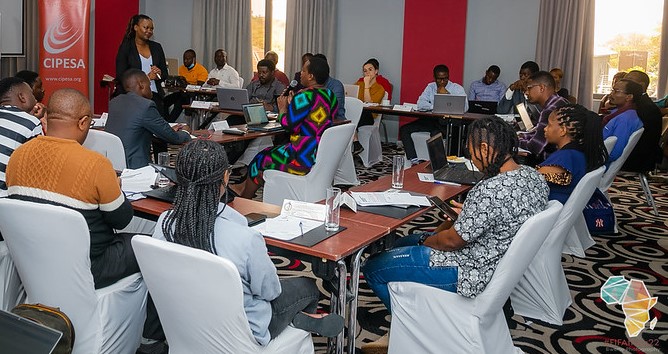
The findings and recommendations of the studies fed into the development of country-specific curriculums that informed three in-country trainings targeted at survivors and networks working to combat human trafficking. The  aim was to equip them with tools to influence prevention and protection strategies. The trainings reached a total of 63 beneficiaries including youth groups, women’s rights organisations, and civil society organisations, and were preceded by a Trainings of Trainers (ToT) in each country. 

The discussions at the trainings fed into two regional roundtables [French and English] which explored ways to improve and implement the existing legal frameworks, strengthen border controls, and multi-stakeholder efforts to eradicate socio-cultural constraints and practices that undermine victims’ rights. Representatives in the roundtables were drawn from the African Union, the North-South Center Council of Europe, the Counter Trafficking Unit of the International Organization for Migration, alongside several think-tanks, networks, and civil society organisations. 

The engagements resulted in the establishment of country task forces to support the development of collaborative action plans that leverage the internet to push back against human trafficking. The study results will continue to inform the work by ALTOWR and CIPESA in understanding how digital technologies can best be leveraged to combat human trafficking in Africa.

A Call on TECNO to Uphold Users Privacy and Security

Open Letter |

Strengthening the digital security of at-risk groups and organisations amidst growing digital rights attacks in Africa has become increasingly crucial. However, inadequate device security is undermining such efforts.

Investigations by Privacy International have revealed that TECNO – a phone manufacturer with an estimated 47% market share in East Africa and widely used across other regions on the continent – is putting users’ privacy and security at risk. 

Based on testing of a TECNO device – the Y2 – purchased in Uganda, the investigations reveal that the phone’s operating system was outdated, having not received updates since 2013. Further, pre-installed applications that users can not uninstall were using up space on the device. Whereas the specific model of phone with the vulnerabilities was discontinued from production by TECNO back in November 2019, it remained on sale as recently as 2020. 

In response to the revelations, Privacy International, the Collaboration on International ICT Policy for East and Southern Africa (CIPESA), together with nine other civil society organisations have submitted a letter to TECNO calling on the Chinese manufacturer to make changes to their practices and protect users’ privacy and security.

The letter urges TECNO to make three key changes to significantly improve their users’ privacy and security:

  1. TECNO should ship phones with a supported version of the Android operating system.
  2. TECNO should do their best to support the longevity of their devices and therefore combat e-waste. They must tell consumers, at the point of sale, how long their device will be supported, provide regular updates to the device, and notify users when continuing to use a device poses a risk to their privacy or security.
  3. TECNO should minimise the amount of bloatware, superfluous apps and other extras that come pre-installed on their phones. Whenever bloatware is included, it should exist in the user partition and therefore be removable by the user.

“It’s vital that TECNO listen to civil society and make these small changes to protect their users. TECNO users across Africa and the world deserve to know what they’re buying, especially when their phone will no longer receive security support,” said Caitlin Bishop, Privacy International’s project lead on work around low-cost technology.

Skills in digital security and safety are lacking among some of the most at-risk groups in many African countries. Surveillance schemes by state and non-state actors leverage this skills and knowledge gap. It is important therefore that leading device manufacturers, such as TECNO, guarantee privacy and security by design in order to ensure the safety of users,” said Ashnah Kalemera, CIPESA’s Programme Manager.

A copy of the letter can be accessed here.

Digital Rights Advocacy Training for Human Rights Actors

Call for Applications |

The Collaboration on International ICT Policy for East and Southern Africa (CIPESA) is calling for applications from suitably qualified individuals interested in the nuts and bolts of digital rights advocacy to apply for a two-day virtual training. The training, which is scheduled for August 25th and 26th 2021, targets human rights defenders, academics, media, activists, technologists, and private sector actors from Lesotho, Mozambique, Tanzania, Uganda, Zambia, and Zimbabwe.

Topics to be covered will include:

  • Introduction to Digital Rights and Internet Freedom in Africa.
  • How State and Non-State Actors Curtail Internet Freedom.
  • Laws and Policies Governing Internet Freedom in Africa.
  • Internet Freedom Advocacy for Human Rights Defenders.
  • Researching and Communicating Digital Rights Issues in Africa
  • Developing an Internet Freedom Advocacy Strategy

CIPESA will cover participants’ internet connectivity costs.

Please send your application to [email protected]. The application should include;

  • Name
  • Organisation
  • Country
  • Experience in digital rights and internet freedom work.
  • Why this workshop is relevant to your work.
  • Also attach a CV (maximum 2 pages)

Deadline for application is 18th August 2021

Successful applicants will be notified on 20th August 2021

CIPESA Supports Impactful Digital Rights Media Advocacy in Africa

By Apolo Kakaire |

Civic space continues to shrink across Africa. In recent years, disruptions to the internet and social media applications have emerged as a common trend of digital repression especially in authoritarian countries in Africa. While the Covid-19 pandemic has reaffirmed the immense importance of digital technologies for government and citizen interactions, public services provision, employment, education and commerce, some governments on the continent used the pandemic as an excuse to impose further clampdowns.  

For full realisation of the potential of digital technologies to transform society and economies in Africa during the pandemic and beyond, there is need for continued advocacy to uphold and protect freedom of expression, access to information, and equitable participation online. 

It is against this background that between July 5-9, 2021, the Collaboration on International ICT Policy for East and Southern Africa (CIPESA) in partnership with the African Centre for Media Excellence (ACME) conducted an intensive training course on Digital Rights and Impact Communication for grantees of the Africa Digital Rights Fund (ADRF). The ADRF was launched in April 2019 to offer flexible and rapid response grants to select initiatives in Africa to implement activities that advance digital rights, amidst rising digital rights violations.

The training  equipped civil society organisations (CSOs) with skills, knowledge and tools to effectively communicate digital rights issues and inspired them to approach communication systematically so as to increase the visibility of digital rights issues in different media and to promote public discussion on digital rights issues.

According to Ashnah Kalemera, the Programme Manager at CIPESA, “the training was the result of the realisation that organisations working in the digital rights arena have inadequate skills to effectively and proactively engage the media and to conduct effective public communications.” She added that, as a consequence of this skills gap, “digital rights issues are poorly covered, commonly with limited depth and sensitivity.” 

“Digital rights are a fairly new area of interest, so it is prudent that CSOs working in this space are skilled in pitching appropriate messages in clear language and in making concrete calls to action, especially given that the media is not well-versed or always keen on this subject,” said Kalemera.

The training was preceded by a capacity and training needs assessment which established ADRF grantees’ preeminent training needs as using social media as a tool of influence, communicating research and hard-to sell-subjects, and developing media advocacy strategies. The findings of the assessment informed the development of the curriculum and training resources featuring a mix of trainer-led discussions, experience sharing, case studies, guest lectures, plenary discussions and assignments. 

Sessions during the training included on topics such as Impactful communication and Advocacy, which was led by ACME’s Executive Director, Dr. Peter Mwesige; and Civil Society Relations: Breaking the Barriers, a lecture by Daniel Kalinaki, General Manager, Editorial Nation Media Group in Uganda.  John Baptist Imokola and Dr. Gerald Walulya, both lecturers at Makerere University’s Department of Journalism and Communications, alongside Agnes Tumuheire, Content Manager at Ultimate Media Consults, led the sessions on Communication Planning,  Communicating/ Disseminating Research and Hard-to-Sell Subjects, and Taking Advantage of the Power of Digital/Social Media, respectively.

The 25 trainees, who included the executive leadership, programme and communications officers from ADRF-supported organisations operating in Cameroon, Côte d’Ivoire, Democratic Republic of Congo (DR Congo), Ghana, Kenya, Rwanda, Somalia, Somaliland, Tanzania, Uganda and Zimbabwe, worked to develop internal communications strategies and drafted campaign materials.

Experience from such communication-related training shows that having the right mix of senior staff and implementers from an organisation is a prerequisite for success. Communication being a management function, it helps that the key decision makers share the same vision, outlook and attitude to communication with those that handle the day-to-day communication functions. 

Select participant testimonies“I was very interested in understanding how the media works.  Since I don’t have experience working in media houses, it was a good opportunity to discuss how to engage with the media.” Blaise Ndola, Rudi International – DR Congo.

“I am happy to have participated in this training. The delivery method was well thought-through, the materials were easy to access and understand and the mentors were amazing. Many important questions were answered as a result of this training. [I am] grateful for the opportunity to learn from experts in those fields!” Ayaan Khalif, Digital Shelter – Somalia.

“What l really enjoyed were mostly issues to do with how communities have to embrace digital rights so that they see the benefits that come with digital rights, and the roles CSOs have in ensuring our communities are aware of their rights. And also on issues of media relations strategies how best to come up with a working strategy for the diverse communities we serve.” Michelle N. Q Mulingo, Zimbabwe Centre for Media and Information Literacy (ZCMIL).

Going forward, digital rights advocacy CSOs would benefit from investing in the journalism they want to see. Possible avenues include offering reporting grants to facilitate higher quality research than that done by journalists through media houses’ limited resources.  Follow ups with the trainees/grantees is also necessary to ensure application of acquired skills and knowledge. Moreover, given the fairly high staff attrition rate in CSOs it would be useful to regularly conduct these kinds of training if impact communication is to gain traction in the digital rights arena.

Digital Taxation Doing More Harm than Good for Access and Rights in Africa

By Evelyn Lirri |

When Uganda introduced a tax on social media use in 2018, the government hoped the new source of revenue would help widen the country’s tax base. Instead, internet subscriptions fell drastically and the government did not raise the anticipated revenue as most users turned to Virtual Private Networks (VPNs) to access social media platforms. 

Three years later in July 2021, Uganda abandoned the levy on social media access and instead introduced a 12% tax on internet data. Still in its early days, the effects of the new tax are yet to be seen. Nonetheless, like its predecessor, the tax is likely to affect internet access, the country’s fledgling digital economy, and digital civic space. 

Yet Uganda is not alone in the growing trend of digital taxation. From South Africa in the south, Kenya and Tanzania in the east, through to Nigeria in the west, as the Information and Communications Technology (ICT) sector grows across the African continent, several countries are turning to the sector as a target for new revenue streams.

But there appears to be no stakeholder consensus on digital tax rules, with activists, economists, technologists and innovators at loggerheads with tax bodies and communications regulators on how to overcome economic downturns while driving digital transformation and upholding digital rights.   

This balancing act formed the basis of a recent workshop on the impact of digital taxation on digital rights in Africa organised by the Collaboration on International ICT Policy for East and Southern Africa (CIPESA). The workshop brought together 66 participants from across the continent and beyond to deliberate on good digital taxation practices and the impact of taxation on users and national ecosystems. The workshop featured perspectives from platform operators, national and regional regulatory bodies, tax authorities, and policy makers. 

Speaking at the workshop, Professor H Sama Nwana, a technology and telecommunications consultant affiliated with the UK-based Cenerva, said digital taxes in various forms are not only regressive, they disenfranchise poor and marginalised groups such as women and the youth. “If you apply a flat tax, it is going to affect the less privileged and people who need the internet the most, such as women in rural areas. The social media tax in Uganda impacted some of the poorer provinces more than people in urban areas such as the capital Kampala,” he explained.

According to Nwana, countries which have introduced digital taxes have registered a subsequent decline in the number of people accessing and using the internet and other ICT-related services, ultimately leading to less revenue generated for the government. “This is paradoxical because when you try to drive up your tax revenue by putting up more taxes onto the system, people stop using data services to transact or carry out other businesses such as agriculture and financial services,” said Nwana.

Access to affordable internet is still a challenge for many across the continent. With just over a quarter of the population online, additional costs including taxes deepen the affordability challenge. Indeed, as the Alliance for Affordable Internet (A4AI) Africa Regional Coordinator Onica Makwakwa argued, “taxes that are passed on to consumers further burden those who are already struggling with the cost of access” and it is thus crucial to “guard against over-taxation” especially in light of the Covid-19 pandemic which has made the need to be connected and have access to affordable internet even “more urgent”. 

“What we have in Africa is an affordability and accessibility gap which needs to be closed,”  said Dr. Christoph Stork, a telecommunications expert with Research ICT Solutions. “To be able to provide e-services such as health, education and fintech, we need increased connectivity. ICT taxes make these services either too expensive or less attractive to invest in.”

Taxation, according to Stork, should be broad-based, easy to enforce, provide incentive for competition and investment, and be progressive. “The [Uganda] Over the Top Services (OTT) tax, for example, is regressive because everyone pays the same amount regardless of whether they are rich or poor. These kinds of taxes in general prevent the poor from participating in tomorrow’s internet society,” Stork said. 

Reducing or eliminating sector-specific taxation therefore becomes critical to encourage investment in mobile connectivity, improved affordability, increased uptake, and ultimately, economic growth.

The CIPESA Programme Manager, Ashnah Kalemera, cited the example of Chad, a country with one of the lowest internet and mobile penetration rates on the continent and a history of restricting citizens’ access to internet platforms, which in January 2020 eliminated an 18% excise duty on mobile internet to facilitate increased access and usage of data by citizens. On the other hand, in countries such as Malawi, where telecommunications operators have over recent months made strides in lowering the cost of data services, Kalemera said the government maintains various ICT-related taxes that continue to affect affordability. 

Nwana said research shows that for every 10% increase in mobile broadband penetration, there is an increase of between 0.82 to 1.4% in Gross Domestic Product (GDP) of developing countries in Africa. He added: “Why do we want to forego this growth by increasing taxes which drops the number of people using broadband data services, which clearly adds significant value and GDP growth to our economy?”

The digital tax debate has also featured discussions around how African governments can derive revenue from big multinational companies such as Facebook which are domiciled abroad but have a significant number of users on the continent. 

Jacob Puhl, Manager of Tax Policy at Facebook, noted that while the social media platform generates about 98% of its revenue from advertising, only about 8-9% of that revenue comes from emerging economies in Africa and Asia. “People keep asking, ‘you have users here, why don’t you pay taxes?’ Because users of our platform are all over the world, there is a lot of misunderstanding about where our revenues come from as well as our advertisers. Advertisers pay more to reach markets where e-commerce is robust,” said Puhl.

Audience Q&A

Participant: It is true that Facebook is an advertising company based in the USA and that most users are not Facebook customers. However, take an advertiser like Coca-Cola. Their product is consumed in most countries in the world and so they advertise with Facebook because of those users who pay nothing to Facebook.

Response: In the 80+ countries where VAT is applied to ads purchased from non-resident companies, Coca-Cola would pay VAT to Facebook and we would remit it to the tax administration.

Indeed the impact of taxation on e-commerce platforms was highlighted as part of the workshop’s deliberations. For instance, according to Ron Kawamara, the Chief Executive Officer (CEO) Jumia-Uganda, the introduction of the OTT tax led to a decline in the number of vendors and customers on their platform despite the potential that e-commerce presents for the country and continent. 

“Before the tax, we had a reach of about 11 million users on Facebook. That dropped by 35% with the introduction of OTT. And with users turning to VPN, it becomes difficult to reach customers with one service or the other,” said Kawamara.

Jumia Uganda is a subsidiary of the pan-African e-commerce company Jumia Group, which is Africa’s largest online retailer. Launched in 2012, it currently has operations in 11 African countries as well as China, United Arab Emirates and Portugal. 

While e-commerce platforms can be catalysts for revenue generation for governments, the lack of visibility of some of the platforms has made it difficult for tax bodies to properly track and ensure tax compliance. This, according to Milly Nalukwago Isingoma, the Assistant Commissioner Research, Planning and Development at Uganda Revenue Authority (URA), has impacted how much revenue the government is able to generate from online platforms and businesses. 

“With the previous model of taxation, you had to have a physical address where you could reach the taxpayer. Now transactions are happening online with no visibility and our collections have remained low. This is what forced us to come up with taxes such as the OTT tax,” said Isingoma. 

Isingoma acknowledged that implementing the tax was difficult and less revenue than had been projected was collected. “We do acknowledge that we got it wrong with the OTT tax. That is why we decided to work with the telecom companies to come up with the 12% excise duty that cuts across. This way, we are also able to protect the revenue base of the telecom companies,” said Isingoma. 

Dr. Peter Mwencha, Director at Consumer Unity & Trust Society-Africa Centre, called for an update to tax laws on the continent in order to protect consumers and integrate the digital economy. Similarly, James Mutandwa Madya, the Director for Policy and Strategic Planning at the ICT ministry in Zimbabwe, noted that in order to address some of the challenges and limitations of digital taxation, tax models should be reviewed with the interests of governments and consumers taken into account. 

Creating this balance requires collaboration between regulators and tax bodies, according to  Anthony Marufu Chigaazira, the former Executive Secretary of the Communications Regulators Association of Southern Africa (CRASA). “Collaborative regulation should be at the forefront otherwise we end up with tax authorities who do not understand the sector proposing taxes that infringe on digital rights and impact the majority of the population,” said Chigaazira. 

Indeed, as noted by Pria Chetty, Director of the South Africa-based EndCode, it would be instructive to understand the trajectory of models informing specific digital tax approaches in different countries. According to her, “it would be too simplistic” to consider the motivation for digital taxes as merely a government “grab” for new taxation sources. 

Chetty added that instances where digital taxes have been withdrawn, including outside the continent, should offer learning to African regulators. “Regional and continental guidance on taxation that accounts for the unique costs of connectivity and unique value chains should also be a priority. National approaches should account for the state of the digital economy, existing tax structures, fundamental rights and competition dynamics,” said Chetty.

Resources: