
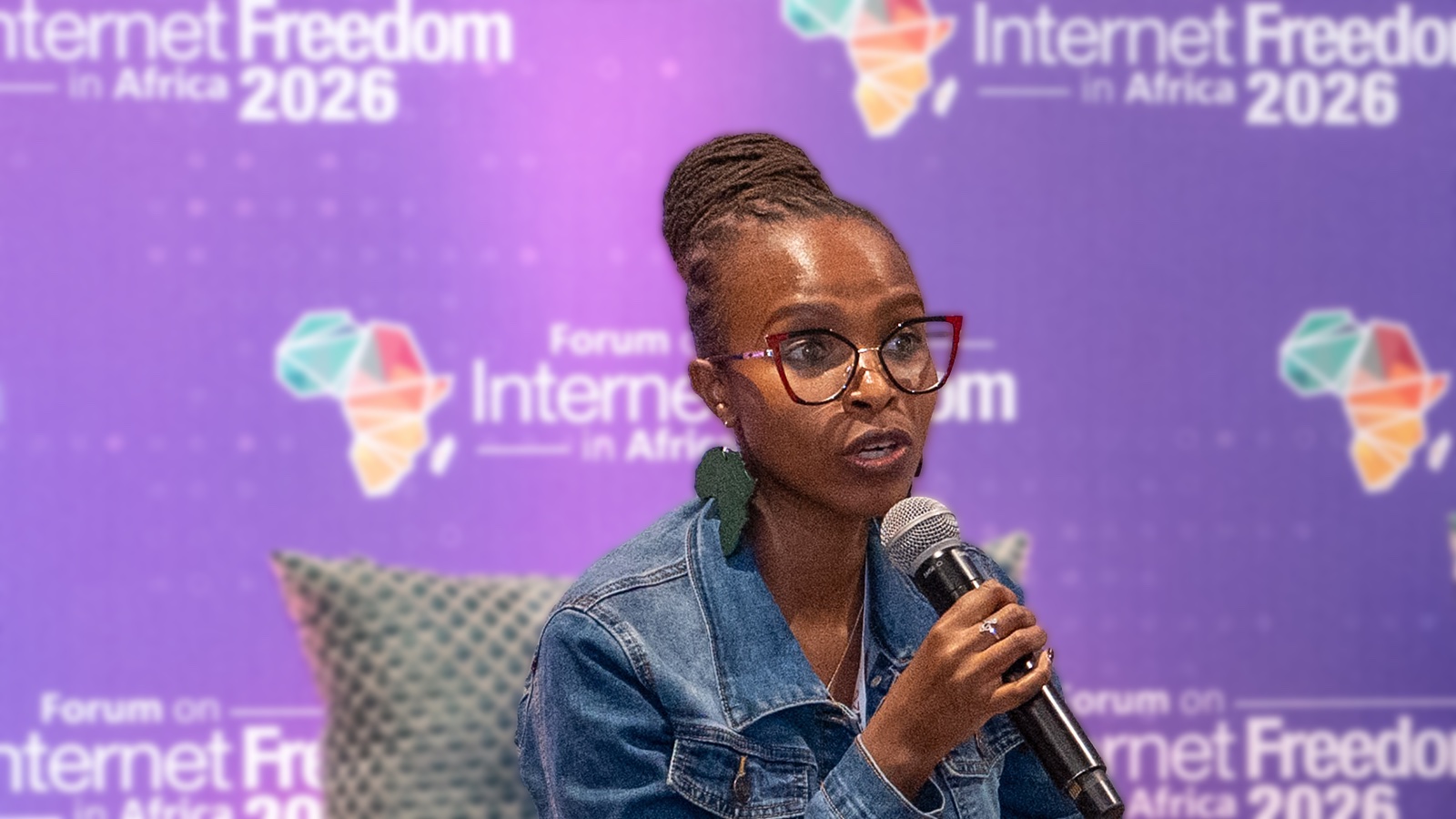
Q&A with Joy Kirigia |
Joy Kirigia is a multi-award-winning journalist who also works with Africa Uncensored. She was one of the facilitators at a Climate Change and Information Integrity Masterclass co-hosted by UNESCO and CIPESA. In this Q and A with Juliet Nanfuka, she narrates her insights from the session and highlights various warnings about disinformation. She points out how African journalists build a climate investigation from the ground up.
1. You noticed participants were curious but often unaware of the tools and datasets already available to them. Why does that gap matter for the stories African newsrooms aren’t telling?
One of the most encouraging things about the masterclass was the level of interest and curiosity around the subject. There was clearly an appetite to understand how climate change stories can be investigated, particularly where data, accountability and information integrity intersect. However, we also noticed that while the interest was there, many participants were not fully aware of the resources, datasets and practical tools available to help them pursue these stories.
That observation was important for us because it highlighted a gap in how we approach climate storytelling. We often focus on the finished product: the documentary, the investigation, the article or the visualisation. But there is an entire process behind getting to that final product, and that process is not always visible or accessible to other journalists.
We therefore made a deliberate effort to take participants through the storytelling journey, using both raw and refined data to demonstrate how an investigation develops. We looked at where journalists can find evidence, how to interrogate documents and datasets, how to verify what they find against what is happening on the ground, and how to turn that evidence into a compelling and understandable story.
One of the important insights was that journalists do not necessarily have to begin with climate change as the subject of an investigation. Sometimes, a better starting point is a concrete decision, a business deal, a promise made to a community or a harm that people are experiencing. These can provide an entry point into much bigger questions about climate change, environmental accountability, land rights and the people affected by these decisions.
We also explored how information that appears credible on paper, including information contained in official registries and project documents, still needs to be independently verified. For instance, a carbon registry may tell you what a project has submitted or what has been certified, but it cannot, on its own, establish whether communities have been adequately consulted, whether their rights have been respected or whether promised benefits have reached them.
This is where climate reporting and information integrity intersect. It is not enough to repeat figures, project claims or official statements. Journalists have to interrogate where the information comes from, what it actually establishes and what may be missing.
The appreciation participants showed for the process was particularly encouraging. It reminded us that there is value in making investigative methods and resources more accessible, not just sharing the final findings. If journalists can access the underlying data, understand how it was analysed and see how evidence was built into a story, they are better placed to develop their own investigations and independently scrutinise claims.
2. What are some of the key gaps in climate change reporting in Africa? In particular, where are journalists and media organisations falling short in reporting climate change issues and responding to disinformation narratives?
One of the key gaps we see in climate reporting in Africa is that many stories remain focused on the visible effects of climate change, while some of the decisions, interests and financial arrangements behind those effects receive less scrutiny.
Reporting on droughts, floods, food insecurity and the loss of livelihoods is important. These are real experiences that deserve attention. However, there is also a need to investigate the systems and decisions shaping these outcomes. Who is making decisions about land and natural resources? Who is financing climate-related projects? Who stands to benefit? What promises are being made to communities and are those promises being fulfilled?
Take carbon projects, for example. There is considerable room for more reporting on the agreements behind these projects, how communities are involved, how benefits are shared, who controls the money and whether the outcomes match what project promoters claim. These are questions that require journalists to go beyond the press release or the official project description and examine contracts, company records, payment records, community agreements and what is happening on the ground.
Another gap is access to, and the ability to work with, data. There are useful resources available, but knowing that they exist, understanding how to navigate them and knowing how to interpret the information they contain are different things. Some journalists may have access to datasets but lack the technical support or confidence to interrogate them. Others may not know where to begin looking.
There is also a challenge around how climate information is communicated. Technical language, complicated datasets and scientific findings can make stories difficult for audiences to understand. At the same time, oversimplifying these issues can leave out important context. We need reporting that is accurate but also accessible and that helps audiences understand how climate issues connect to their everyday lives.
On disinformation and information integrity, we need to be more deliberate about interrogating claims rather than simply repeating them. Climate-related projects, policies and investments often come with claims about environmental benefits, restoration, community livelihoods or economic opportunities. Those claims need to be tested against evidence. We should also be careful not to treat every disagreement, criticism or unanswered question as disinformation. Sometimes the problem is incomplete information, poor communication, a lack of transparency or genuine public concern. Journalists need to establish what is inaccurate, what is misleading, what is unverified and what remains unknown before making those distinctions.
Ultimately, the gap is not simply a lack of climate stories. It is the need for deeper, more evidence-led reporting that connects environmental issues to governance, money, power, accountability and the lived experiences of communities.
3. Climate change cuts across land, finance, governance and human rights yet it’s still treated as a separate beat. What would it take to turn that intersection into an advantage, and who needs to be in the room for it to work?
We see a significant opportunity in making climate reporting more investigative and collaborative. Climate change is not an isolated subject. It intersects with land, finance, governance, public policy, business, health and human rights. This means journalists do not have to approach it as a completely separate beat. There are opportunities to bring existing investigative skills and areas of expertise into climate reporting.
There is also an opportunity to make better use of data that is already publicly available. Resources such as Climate TRACE, Carbon Majors, carbon project registries and the World Bank’s Climate Change Knowledge Portal can provide useful starting points for investigations. Satellite imagery, historical maps, company records and public documents can also help journalists test claims and identify gaps between what is promised and what is happening on the ground.
But having access to data is only one part of the equation. We need to invest in helping journalists understand how to use it, question it and combine it with traditional reporting. A dataset may point to a possible finding, but it is the interviews, documents, field visits and independent verification that help establish what that finding actually means.
Collaboration is another major opportunity. Climate stories can be technically demanding and often involve information that sits across different institutions, sectors and countries. Journalists can work more closely with data analysts, researchers, climate scientists, fact-checkers and civil society organisations to strengthen their investigations. Newsrooms can also collaborate across borders, particularly where projects, companies, financing arrangements or environmental impacts extend beyond national boundaries.
Each stakeholder has a role to play. Journalists need to ask difficult questions, independently verify claims and make complex information understandable to the public. Researchers and climate scientists can help journalists interpret technical findings and identify areas that require further investigation. Civil society organisations can provide community perspectives, research and access to information that may otherwise be difficult to obtain. Public institutions and project developers also have a responsibility to make relevant information accessible and explain decisions that affect communities.
There is, equally, an opportunity to bring communities into the centre of climate reporting. People living with the consequences of environmental decisions often have information, records and experiences that are not reflected in official accounts. Their perspectives should not simply be used to illustrate a story; they can help journalists identify what needs investigating in the first place.
For us, strengthening information integrity also means being transparent about how we arrive at our findings. Journalists should be willing to explain where their data came from, how they analysed it, what they could and could not verify, and where uncertainty remains. This is particularly important in climate reporting, where inaccurate figures, misleading comparisons or claims presented without context can distort public understanding.
4. What are some of the approaches, tools or collaborations that participants should take forward following the masterclass?
One of the things we hoped participants would take away from the masterclass was that they do not need to wait until they have advanced technical skills or expensive equipment to begin investigating climate-related issues. They can start with the resources available to them, ask better questions and build their capacity as they go.
A practical starting point is to identify a specific decision, project, promise or problem that can be investigated. Rather than approaching a story with the broad question of climate change, journalists can ask more focused questions: What was promised to this community? Who signed the agreement? Where is the money coming from? Who is receiving the benefits? Has the project delivered what it said it would?
From there, they can begin building an evidence trail. This could involve collecting contracts, memoranda of understanding, meeting minutes, land records, environmental impact assessments, company records and other relevant documents. They can then compare what the documents say with what communities and other affected parties are experiencing.
We also encouraged participants to explore some of the available datasets and tools. These included:
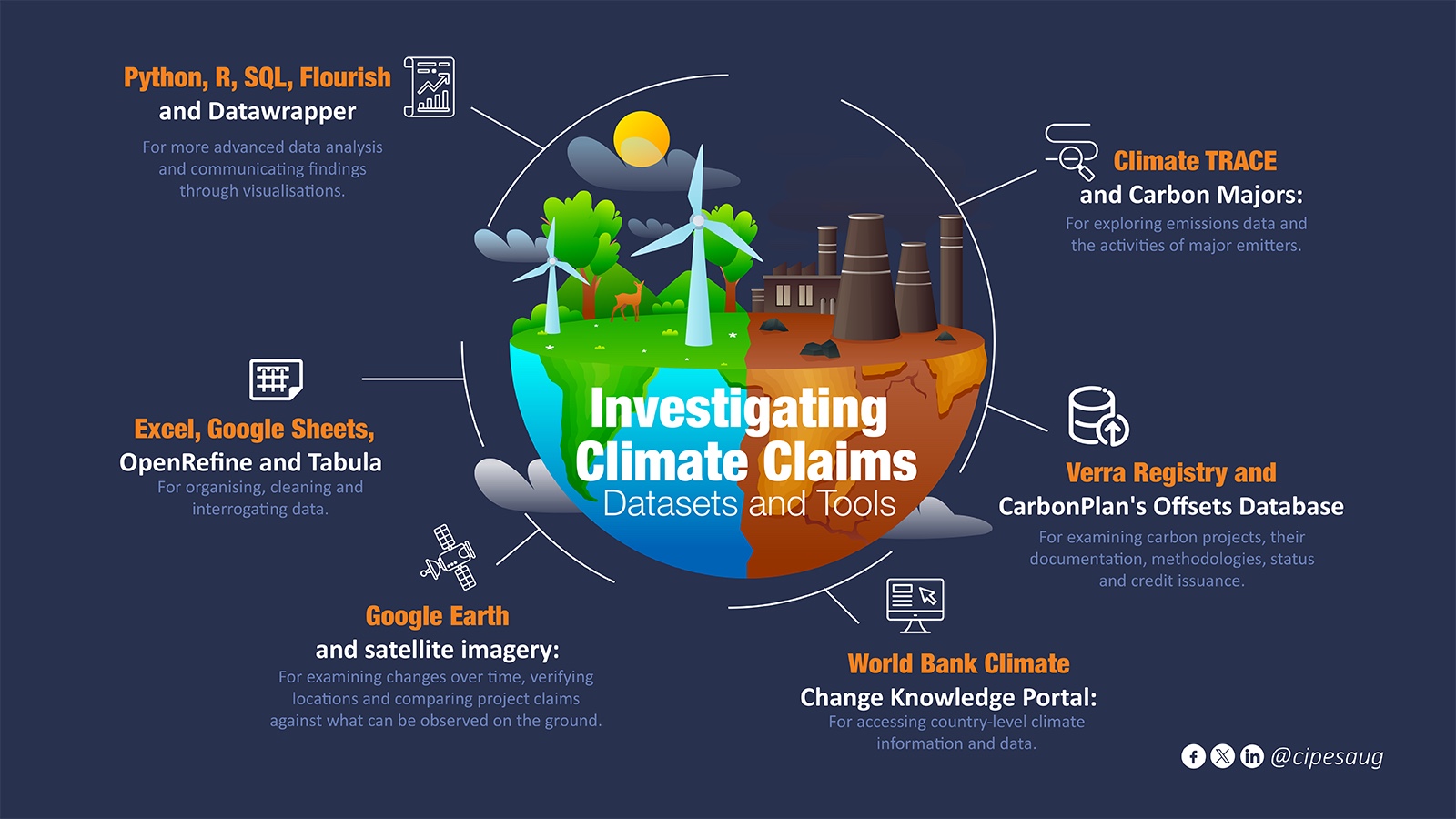
Importantly, we encouraged participants to start simple and scale up as the investigation demands. Not every story requires coding or sophisticated data analysis. Sometimes, a well-organised spreadsheet, a timeline, a comparison of documents or a carefully annotated map can reveal something significant.
Another practical takeaway is the importance of collaboration. Journalists should not feel that they have to possess every technical skill themselves. Building relationships with data journalists, researchers, analysts and fact-checkers can help strengthen the reporting process. Editors also need to be part of this process early enough to help interrogate the evidence and identify gaps before publication.
Finally, we emphasised the importance of verification and responsible storytelling. Data should support the story, not dominate it. Journalists should reproduce their analysis, double-check calculations, explain their sources and methods, avoid misleading visualisations and take care not to expose sensitive personal information or put individuals at risk.
Perhaps most importantly, participants should carry forward the understanding that data is a starting point, not a conclusion. It can reveal patterns, raise questions and point journalists towards possible findings, but those findings must still be questioned, verified and tested against the realities on the ground.
The real value of the masterclass will be seen in how participants apply these methods to the stories they pursue after leaving the room. We hope they leave with not just a list of resources, but a clearer sense of where to look, what to question and how to build a climate investigation from the ground up.
Details: The Climate Change and Information Integrity Masterclass was part of a project by the Collaboration on International ICT Policy for East and Southern Africa (CIPESA), in partnership with UNESCO aimed at addressing the growing challenge of climate change disinformation and strengthen information integrity in the public sphere.