
By Anna Kompanek |
The internet is the lifeblood of a modern economy. From a tech company bringing innovative solutions to the market, to a farmer using his mobile phone to check current crop prices and receive payments, connectivity has become key to unlocking economic opportunity. Building affordable infrastructure remains a challenge in many places. But connectivity now raises an equally daunting question: how to keep that access both available and rights-preserving.
New challenge of the internet era
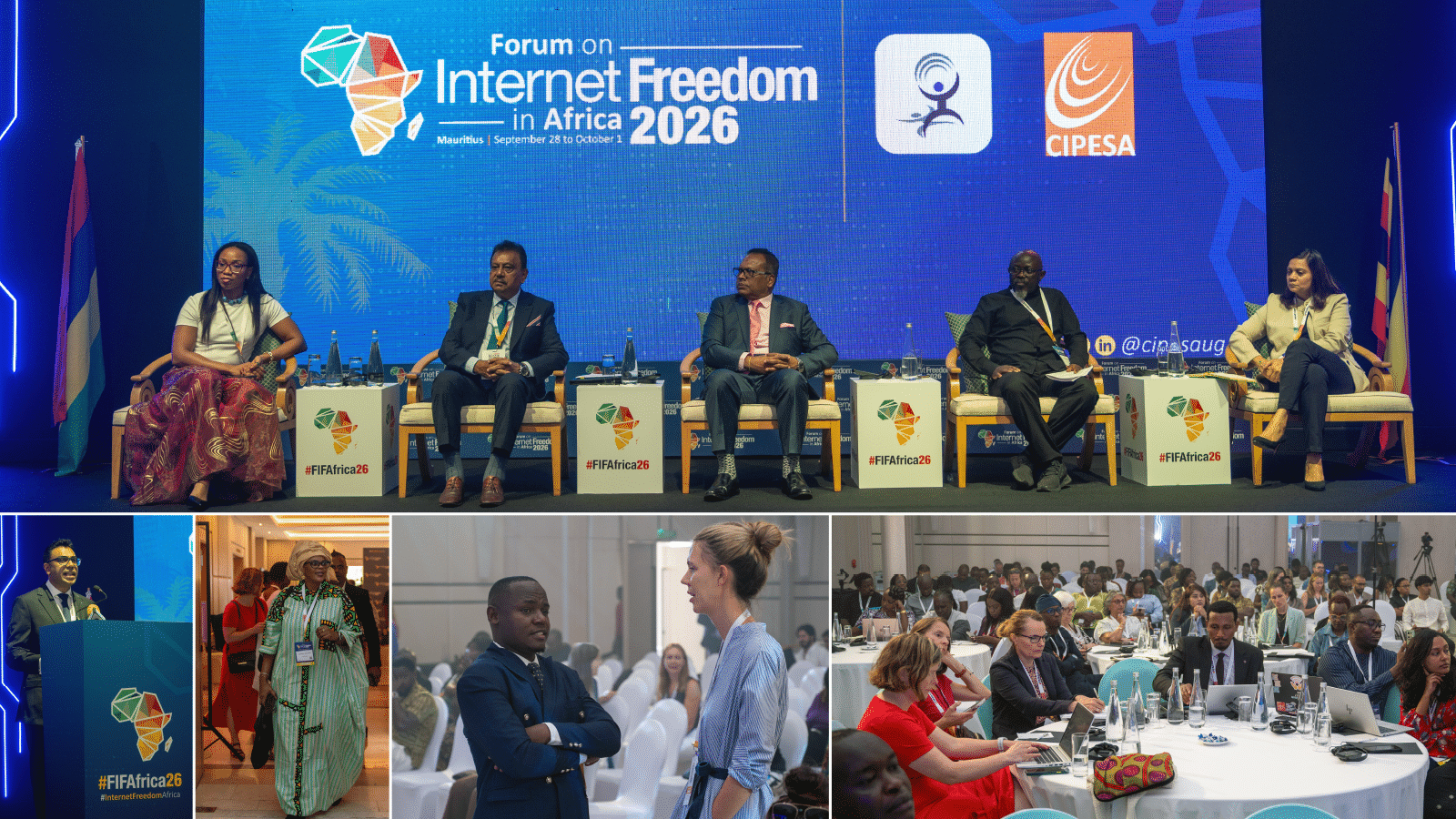
At the 2026 Forum on Internet Freedom in Africa (FIFAfrica), co-hosted in Mauritius by the Collaboration on International ICT Policy for East and Southern Africa (CIPESA) and Halley Movement, Executive Director Dr. Wairagala Wakabi described a shift: when the Forum began in 2014, connectivity was the leading challenge. Today, the questions concern not just getting online but data privacy, governance, and the risks of being online. In Africa and beyond, the key issue is how that vital access can be denied by actors ranging from authoritarian governments to hackers – and, increasingly, bots or misused agentic artificial intelligence (AI).
On the government side, internet shutdowns and throttling remain a persistent reality in many places. While they are often seen through the perspective of suppressing human rights, there is an important economic dimension as well. When an internet disruption stops a merchant from advertising her goods, a small exporter from contacting buyers, or a chamber of commerce from reaching its members, digital repression becomes an economic issue. The question is no longer just how to connect entrepreneurs to the digital economy, but how to keep them connected when that access becomes fragile or politically contested.
I came to this year’s FIFAfrica to explore how emerging technologies can help digital rights advocates and local businesses defend their shared online space. As in past years, the Forum brought together an impressive group of open internet advocates, researchers, technologists, and policymakers. My main practical lesson: tools that help civil society operate under pressure might also protect local businesses and their independent associations.
When efficiency can become dependency
CIPESA’s State of Internet Freedom in Africa 2026 report examines digital public infrastructure (DPI) across 11 countries, focusing on identity, payment, and data sharing systems. Such systems can lower transaction costs, widen inclusion, and improve public services, but weak safeguards can entrench exclusion and enable intrusive surveillance. As the report explains, their shared dependence on connectivity means a cable cut, power failure, cloud outage, or internet disruption can interrupt identity, payments, and public services, affecting both socio-economic and civil-political rights.
The response – like with all new technologies – is not to reject DPI advancement, but to demand transparency, data protection, due process, accessible appeals, and practical alternatives.
Tools from the digital rights’ front lines
This year, FIFAfrica’s Digital Reality Walk showcased tools relevant to civil society and local businesses, including OONI Probe, Orbot, Tor Browser, and Butter Box. Custom VPNs offer another promising application. Bitcoin and other decentralised payment arrangements, while not without their own risks, have helped civil society groups retain channels for funding when conventional banking is constrained. Such tools empower users to monitor internet restrictions, anonymise mobile traffic, browse the web securely, share digital resources offline, use private encryption servers, and retain financial freedom. These civil society applications may also help businesses in challenging environments.
What businesses are already doing
Local businesses, chambers of commerce, and business associations around the world have a direct stake in privacy, free expression, and an open digital economy. This business case for digital rights, as outlined by the Center for International Private Enterprise, provides a foundation for connecting digital rights advocacy to economic opportunity.
Leading business organisations are also paying attention to these issues. The International Chamber of Commerce advances the digital economy agenda through its Digital Standards Initiative (DSI), which promotes a globally harmonised digital trade environment; its Global Digital Economy Commission, which advocates trustworthy, risk-based AI governance and responsible cross-border data flows; and its cybersecurity and internet governance positions, which emphasise security without excessive fragmentation or restrictions on legitimate use.
The U.S. Chamber of Commerce also supports an open and competitive digital economy. Its U.S.-Africa Business Center’s Digital Economy Task Force has championed affordable connectivity, enabling regulations, cross-border data flows, and digital entrepreneurship; Africa Digital Innovation Competition has supported African startups developing solutions in fintech, cybersecurity, and digital supply chains; and Global Connect initiative advocates against forced data localisation and other restrictions that fragment digital markets, while promoting privacy, cybersecurity, and sound regulation of emerging technologies.
These initiatives demonstrate the business community’s recognition that digital openness underpins economic opportunity. They focus on trade regulatory ecosystems that promote competitive markets and innovation rather than digital rights explicitly. Yet, they reinforce the same principle: businesses, like civil society, need open, dependable, secure digital systems governed by predictable rules.
A shared economic freedom agenda
In November, global business leaders will gather in Washington, DC for the B20 Summit where digital transformation will feature prominently. An equally important question is what happens when technologies that connect businesses to customers, finance, and global markets become instruments of surveillance, censorship, or economic control.
The B20’s focus on innovation, trusted digital systems, small business participation, and resilient supply chains offers an opening. Businesses need more than reduced economic barriers and better digital infrastructure: they must be able to communicate securely, access information, receive payments, and organise independently.
Digital rights defenders have spent years developing technologies to preserve these freedoms under pressure. Entrepreneurs in challenging environments can learn from them to defend the basic capacity of businesses to communicate, associate, access markets, and transact.
My main takeaway from FIFAfrica is that economic freedom and internet freedom are inseparable. Digital freedom organisations bring experience operating under pressure; chambers and business associations bring knowledge of members’ operational needs and the economic costs of politically motivated restrictions. Connecting their advocacy and resilience strategies could particularly benefit smaller businesses and independent local associations facing similar challenges as civil society organisations.
Anna Kompaneck is an International Development Consultant.