La “Collaboration on International ICT Policy for East and Southern Africa” (CIPESA) a soumis à la Commission Africaine des Droits de l’homme et des Peuples (CADHP) un rapport parallèle sur l’état de la liberté d’expression en ligne au Rwanda.
Le rapport décrit les mesures législatives et connexes prises par le Rwanda pour promouvoir et protéger la liberté d’expression en ligne et fournit à la Commission des informations impartiales sur l’état de la liberté d’Internet au Rwanda, ainsi que des recommandations d’amélioration.
L’article 62 de la Charte Africaine des Droits de l’Homme et des peuples (La Charte Africaine) exige que tous les Etats parties à la Charte présentent tous les deux ans des rapports sur les mesures prises pour réaliser les droits et libertés garantis par la Charte. Le Rwanda a soumis des rapports pour la période de 2009 à 2016 en date du 22 mars 2017. Ils ont été examinés par la commission cette semaine, avec des groupes de la société civile tels que CIPESA fournissant des rapports alternatifs et des questions pour informer la commission.
Dans son rapport, le gouvernement rwandais a déclaré que la liberté des médias et la liberté d’information sont reconnues et prévues par la loi, ajoutant que tout journaliste a droit à la liberté d’opinion et d’expression, y compris le droit de rechercher, recevoir, et diffuser des informations et des idées à travers tous les médias. Cependant, selon le rapport alternatif du CIPESA, diverses lois et pratiques étatiques continuent de contrevenir à ces libertés, limitant notamment leur jouissance en ligne. La surveillance et l’interception des communications, le blocage et le filtrage du contenu sont parmi les questions problématiques soulevées par le rapport parallèle du CIPESA.
Le gouvernement Rwandais a déclaré que la loi relative à l’accès à l’information est un point d’entrée pour améliorer la participation des journalistes aux affaires politiques et reconnaît l’importance d’une presse indépendante et professionnelle, ainsi que celle d’un accès facile à l’information comme composantes essentielles de la bonne gouvernance, du développement économique et politique durables. Il a ensuite précisé les lois nationales et les institutions statutaires qui garantissent le droit à l’expression et la liberté d’information.
Cependant, le rapport alternatif note que la loi n ° 24/2016 du 18/06/2016 sur les TIC, la Loi n ° 60/2013 réglementant l’interception des communications, le Code de procédure pénale n ° 30/2013 du 24/05/2013, la loi régissant l’enregistrement de la carte SIM de 2013, contiennent des dispositions qui portent atteinte à la liberté d’expression en ligne et aux droits à la vie privée et contreviennent à l’article 38 de la Constitution, aux normes internationales et aux meilleures pratiques en matière de liberté d’expression et d’accès à l’information.
En juin 2017, le taux de pénétration de l’Internet au Rwanda était estimé à 36,6% (3 724 678 connexions), les utilisateurs de Facebook étant estimés à 490 000, sur une population totale de 12 159 586 personnes. Cela représente une amélioration par rapport aux statistiques enregistrées par le “Rwanda Utilities Regulatory Authority” ( Agence de réglementation des services publics du Rwanda : RURA), qui indiquait un taux de pénétration du téléphone mobile de 79% et une pénétration d’Internet de 33%, en juin 2016.
Le rapport du CIPESA demande une révision complète de toutes les lois et politiques régissant l’interception et la vie privée afin de les mettre en conformité avec les garanties constitutionnelles, les normes internationales des droits de l’homme et les meilleures pratiques en matière de surveillance des communications et de respect de la vie privée.
Pour plus de détails, voir le rapport alternatif complet produit par le CIPESA, sur l’état de la liberté d’expression en ligne au Rwanda.

11Nov

 Another key take away from these two sessions was the need to empower women and girls with information about their rights through access to the internet so they can recognise when those rights are being threatened or violated by another person. Often, women and girls are socialised and conditioned to think that they cannot make decisions without the approval of their male relations because from time in memorial, the power lies with men and women are constantly subjected to finding ways of not upsetting this hold on power and in effect remaining silent in the face of violence.
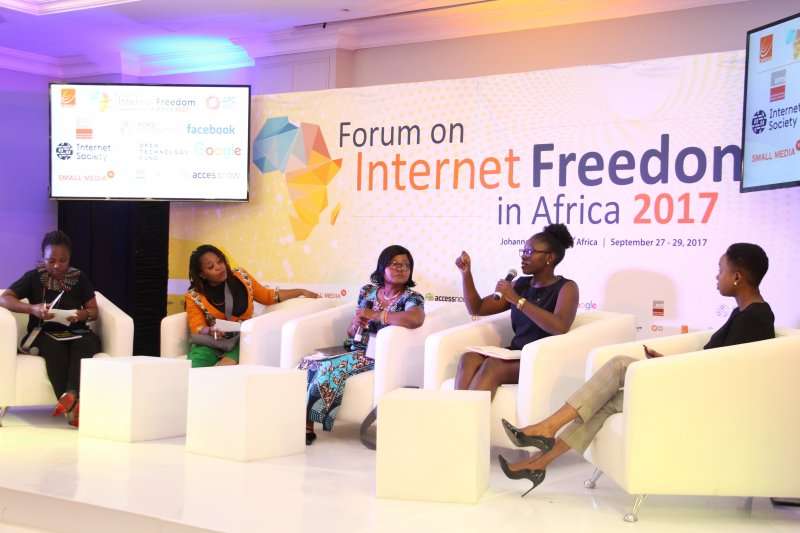
 In a panel on privacy and freedom of expression, a representative from Zimbabwe’s Ministry of ICT, Postal and Courier Services asserted that the country will not shutdown the internet. Neither will they disrupt social media. The official stated that the negative effects of shutdowns initiated in other countries were clear and limiting access to the internet stifles expression, causes more harm than good. For an otherwise autocratic regime, this is telling of its appreciation of the impact technology has on the lives of citizens; social-economic and political.

 I walked away from #FIFAfrica17 pondering how successful strategic litigation against an African government which has shut down the internet might be. In my mind, this would be an attention-grabbing test case which just might be a solution and deterrent to errant African governments. Such a case would be argued before a court such as the African Court of Human and Peoples Rights. The legal basis for this challenge would be that the government in question has violated its citizens’ fundamental rights such as the right to access to information, right to freedom of expression, and the right to freedom of assembly. These rights all enjoy protection under the African Charter on Human and People’s Rights and their violation is a violation of this continental instrument. Furthermore, private sector players can even act as amici curiae and provide proof of the economic prejudice they have suffered as a direct result of being cut off from the Internet. Time will tell whether such strategic litigation will prove effective in the fight against Internet shutdowns in Africa.