Botswana ICT Challenges: In Quest For A Knowledge-Based Society

By Hopeton S. Dunn |

During his inauguration in November 2019, Botswana’s President, Mokgweetsi Masisi, declared his intention to diversify Botswana’s economy and transform it into a knowledge-based one. President Masisi was acutely aware that Botswana’s rapid rise to become an upper middle income country was largely based on earnings from diamond exports and, to a lesser extent, high-end tourism, industries that are either volatile or unsustainable in the longer run.

Botswana has a record of economic transformation which saw Gross Domestic Product (GDP) grow at an average  rate of 8.78% between 1991 and 2014. In the same period, literacy levels moved from 68.58% in 1991 to 87.7% by 2014, having been at 34% in 1981. However, job creation has not kept pace with population growth or the increasing literacy levels. According to Statistics Botswana, while unemployment stood at 10.75% in 1981, by 2013 it had grown to 20%.

Between 2015 and 2019, GDP grew by an average of 2.59 %, a significant fall from the preceding decades.

To move  from a minerals-led to a knowledge-based economy, the government undertook to implement reforms to expand employment and make Botswana’s products and services more competitive on the world market. The Information and Communication Technology (ICT) sector was expected to contribute to this effort. As an indicator of its prospects, cellular phone subscriptions moved from 13 per 100 inhabitants in 2000, to over 169 per 100 of inhabitants in 2014. There was a distinct possibility of ICT opening up new jobs and development opportunities, especially for youth in new occupational areas such as digital design, online content production, and data analytics. According to the Youth Empowerment Minister, Tumiso Rakgare: “We want to move with new trends and best practices in the content creation industry.”

This would require improved internet access, new e-government strategies, and expanded use of ICT as measures towards job creation and ICT-enabled development.  As is shown below, it has been a mixed record.

Amazing Infrastructure

Over the last decade, Botswana invested extensively in infrastructure to support the vision of a digital-enabled development, with USD 32.3 million pumped into the Trans-Kalahari Fibre Network. The network was intended to deliver 2,000 kilometres of optical fibre across the land-locked country’s southern regions and to link into nearby countries such as Namibia and South Africa.

Another fibre-optic loop links the capital, Gaborone, in the south, to the northern population hub of Francistown. The country is also linked to the rest of Africa through the Eastern Africa Submarine Cable System (EASSy) and the West Africa Cable System (WACS).

Against the background of these major investments, Botswana’s ICT policy and regulatory arrangements were to be repurposed to help translate this elaborate infrastructure into advanced levels of corporate communication, citizen access and high-speed connectivity for national development. The current national strategic masterplan, dubbed Vision 2036, aims to realise these goals by transforming Botswana from an upper middle-income country to a high-income country by 2036. Its implicit aim is to use ICT as a transformational tool towards creating a knowledge-based society.

Deficits and Challenges

While the broad provisions of the strategic plan remain relevant and admirable, it is evident that a foundation of technological transformation was not explicitly embedded in the Plan’s published descriptors. A dedicated ICT pillar, as a necessary component of the sought after knowledge society, seems to be missing. While there has been progress in implementing such laws and policies as the Cyber Crime and Computer Related Crimes Act (2018) and the Botswana National Cyber Security Strategy (2020), other approved policies and laws remain in abeyance. These include the Data Protection Act, which was approved by Parliament in 2018 but has not yet implemented. This is because the establishment of some key institutional structures and regulations are awaited. The same is true for Botswana’s controversial Media Practitioners Act 2008, which is now facing revocation and a possible re-write.

If the noble objectives in Vision 2036 are to be realised, Botswana’s policy and implementation structures will need to be more agile in order to meet the commitment for a knowledge-based society. This goal will also remain challenging given the economic setbacks caused by the Covid-19 pandemic.

Despite the high levels of infrastructure investment, there is little evidence of an expected incoming flow of ICT-related foreign direct investments, or of innovative local investors preparing to build out digital platforms and offer new creative services. It is these initiatives and hoped-for investments that would generate the increased employment levels that the Youth Empowerment Minister had envisaged. In reality, expanded career opportunities such as those in content development services, animation, film production and digital design appear slow to emerge, but are necessary catalysts. Hopefully, the expected early fruits of the vast infrastructure investment in an intended diversified knowledge economy will emerge soon.

One of the agencies that could help to drive the process of renewal is the Botswana Communications Regulatory Authority (BOCRA), whose function it is to oversee a converged ICT and Broadcasting environment – key building blocks of the digital, knowledge-based economy. BOCRA’s roles include oversight over the electronic media, regulation of internet service provision and promoting the broader telecommunications network systems that are needed to power the development of data intensive services.

Established in 2013, the well-resourced BOCRA inherited considerable experience from its predecessor, the Botswana Telecommunications Authority. The institutional restructuring that gave rise to BOCRA was clearly part of a process of telecoms liberalisation that spawned several small internet service providers (ISPs) and new radio broadcasters. The regulatory restructuring also led to the creation of Botswana Fibre Networks Limited, BOFINET, the infrastructure provider, and to the emergence of a separate privatised BTC mobile telephony offshoot called BeMobile. These too should be playing a more dynamic and visible part in building the knowledge society. This new BeMobile company has become a cell phone competitor to its more established incumbents, Orange and Mascom.

This liberalised competitive framework was undergirded by some key legislative reforms that were meant to give legs to the country’s strategic development plan, Vision 2036, and no doubt to the new drive for knowledge society status. The liberalisation process and its outcome were given context by Botswana’s earlier  National ICT Policy of 2004, widely known as ‘Maitlamo’, that foreshadowed many of the current regulatory and legislative changes.  The Communications Regulatory Authority Act of 2012 that established BOCRA as a converged regulator, was also meant to help streamline the country’s ICT strategies, but key challenges remain.

Poor Network Service

Contrary to BOCRA’s 2015 User Survey, which indicated that almost 80% of internet users were satisfied with service quality, there appears to be deepening concerns about effective internet access and network service quality by a growing community of smartphone users. Stats Botswana indicates that while mobile broadband subscription was at 3 per 100 of inhabitants in 2000, this had grown to 67 per 100 of inhabitants by 2017. Despite this dramatic growth in mobile cellular subscription, there are complaints that prices on mobile airtime and on data bundles are challenging for lower income users, including students and some educators who have been forced to migrate online in the face of the Covid-19 pandemic’s effect on educational service delivery.

A February 4, 2018 report in the Sunday Standard newspaper said BOCRA, the regulator, had released a report on recent consumer complaints against telecoms service providers. The newspaper report said that, according to BOCRA, the complaints concerned, among others, billing, missing airtime and data bundles, faulty telephone lines, slow internet speeds, mobile money and termination of contracts. In an  earlier report  in The Gazette newspaper of March 30, 2017, it was alleged that consumer prices were inflated. The newspaper posed questions to operators, including,  “why do all mobile operators charge almost similar – between 60 thebe and 1.50 (pula) per MB?” The Gazette also inquired about what operators thought of “consumer complaints about the high prices in the market”. The report suggested that to some users, internet service provision in Botswana was expensive, spotty and way too slow for promised package speeds.

In light of these challenges, a key question for policy-makers is how regulation of internet prices and mobile service quality will be carried out in order to facilitate innovation among youthful ICT enthusiasts and digital business ventures. Should there be more consistent oversight over mobile termination rates and more aggressive monitoring of service quality?

Yet, getting to the coveted ‘knowledge society’ threshold cannot be based primarily on improved ICT service delivery and reduced pricing alone. It must also include reforms in broadcasting policy, provisions for cost-effective management of big data, training in cultural and creative industries, and competitive regional marketing for design and production services. While the critical issues of digital access, network quality and affordable prices remain central to successfully driving buildout of the future knowledge society, other factors, such as incentives for private investments, wide-scale ICT training and agile policy implementation are also crucial in transforming one of Africa’s most peaceful and prosperous countries.


Hopeton S. Dunn is a a Professor of Media and Communications at University of Botswana. As a   CIPESA Fellow, he is interested in communications policy reform, digital literacy and inclusion, effective internet access and equity, especially as they relate to people in the Global South. His work spans media regulation, technology policy-making, and new theoretical constructs for development. 
One Year In: Covid-19 Deepening Africa’s Democratic Regression

By CIPESA Staff Writer |

In September 2020, our research on the State of Internet Freedom in Africa established that the ultimate effect of the measures instituted in fighting Covid-19 was that they had deepened the democracy deficit in several African countries. This was because, increasingly, more states in the region had fallen short of living up to their citizens’ democratic expectations as they implemented measures to fight the pandemic.

Prior to the Covid-19 pandemic, Sub-Saharan Africa (SSA) was faring badly in its democratic credentials, fighting for bottom position with the Middle East and North Africa (MENA) region. Of the 44 African countries included in the Economist Intelligence Unit Democracy Index for 2019, half were characterised as authoritarian regimes and many of the others were semi-authoritarian.

As anticipated, it has gotten worse. According to the Democracy Index for 2020, the number of authoritarian regimes in Sub-Saharan Africa last year rose from 22 to 24 – more than half of the 44 countries in the region that the index covered. Burkina Faso and Mali were the new entrants to the unsavoury ranks of authoritarian regimes. Many Sub-Saharan African countries are concentrated at the bottom of the index, and the region boasts just one “full democracy” – Mauritius. During 2020, 31 countries in the region were downgraded, eight stagnated, and just five scored better.

“After experiencing two consecutive years of significant setbacks, democracy in Africa appears to be in a perilous state,” notes the index. The region’s overall average score “fell to by far the lowest score for the continent since the index began in 2006.” The fight against Covid-19, muddled and stolen elections, and insecurity (including Jihadist insurgencies in west Africa), all played their part in the democratic regression experienced in the region.

As is shown in the 2020 edition of the State of Internet Freedom in Africa report, a plethora of regressive measures were introduced in fighting the pandemic, and they had starkly undermined democracy, marked by a dwindling respect for rights to expression, information, assembly, and privacy. In many instances, these measures resulted in a lower level of stakeholder engagement in public affairs and a decline in governments’ transparency and accountability.

Deepening the Democracy Deficit: The democratic regression in a number of countries in the region could persist beyond the Covid-19 crisis, unless the measures imposed are reversed and deliberate efforts are taken to promote greater respect for fundamental rights and freedoms.

While the Arab Spring was a turning point on digital rights in the region, Covid-19 could be another profoundly negative watershed moment. The Arab Spring, during which social media aided organising against autocratic regimes, some of which were overthrown, opened the eyes of many African authoritarian regimes to the power of digital technologies, and they went ahead to make laws to prescribe cyber crimes, to enable interception of communications, to control use of online platforms, and they started instituting measures such as website blockages, censorship of short messaging services, and disruption of networks. – State of Internet Freedom in Africa 2020

According to the index, world over the biggest regressions during 2020 occurred in the most authoritarian countries, where regimes took advantage of the global health emergency caused by the coronavirus pandemic to persecute and crack down on dissenters and political opponents.

Full democracy Flawed democracy Hybrid regime Authoritarian regime
Mauritius Cape Verde Malawi Mali Eswatini
Botswana Madagascar Mauritania Guinea
South Africa Senegal Burkina Faso Togo
Namibia Liberia Angola Cameroon
Ghana Tanzania Gabon Djibouti
Lesotho Kenya Mozambique Guinea-Bissau
Uganda Ethiopia Eritrea
Zambia Niger Burundi
Sierra Leone Zimbabwe Equatorial Guinea
Benin Congo Brazzaville Chad
Gambia Rwanda CAR
Ivory Coast Comoros DRC
Nigeria

The index states that the decline in Africa’s overall democracy score in 2020 was partly driven by coronavirus-related lockdowns, which had a negative bearing on civil liberties, including stripping citizens of their freedom to assemble and travel, and causing severe interruption to livelihoods. There was high-handedness of the police in enforcing curfews, in such countries as Nigeria (where police killed people in enforcing the lockdown), Kenya and Senegal.

Africa’s deterioration was also precipitated by declining scores for many countries in the category of electoral process and pluralism, with disputed elections in Tanzania and Guinea cited as examples. Of note, Malawi’s standing improved on account of a smooth election held during the year, in which the incumbent president was defeated by an opposition candidate.

Yet some countries saw Covid-19 as an opportunity to stifle opposition campaigns during election times. The index states: “Constraints placed on political activity – applied disproportionately for the opposition – ahead of January 2021 elections in Uganda illustrated how autocrats use the excuse of new threats such as coronavirus to crack down on the opposition and hold on to power during a time of crisis.”

Covid-19 control measures have chipped away at many of hallmarks of a democratic society, such as the ability by citizens to participate in civic matters and the conduct of public affairs. In the countries where civil liberties have been eroded the most, growing hostility of governments to dissenting opinions, including on their handling of Covid-19, has contributed to the adoption of stringent measures and the enactment and enforcement of repressive laws on surveillance, fake news and criminal defamation and practices such as legal threats, intimidation, arrests, detentions, prosecutions, and state surveillance.

These measures have, in turn, forced human rights defenders, journalists, activists, the political opposition, and ordinary citizens to self-censor, disengage from participating in public affairs, and refrain from exercising their rights to participate online and offline. This has been the case in countries such as Zimbabwe, Tanzania, Uganda, Burundi, Egypt, Rwanda, Ethiopia, Morocco, Kenya, and Algeria. Yet, in the absence of engaged citizens, the respect for human rights, including the rule of law, suffers. Such a trend, if left unchecked, could persist well beyond the coronavirus crisis.

While Covid-19 could have served as a driver towards improving access and use of Information and Communications Technology (ICT) in Africa, it has potentially widened the digital divide on the continent, yet for the most part the actions of many governments have undermined, rather than promoted, greater access and affordability of digital technologies.

Although technology can play an important role in containing the pandemic, its application should not violate human rights. In most countries, the measures introduced to check the spread of Covid-19 were necessary to address a public health emergency, but some were applied beyond the intended purpose, and need to be revised to imbed human rights principles. As it is, the imposition of unregulated, unchecked and excessive emergency measures by governments in collaboration with non-state actors during the pandemic period raises fundamental questions on their commitment to protecting digital rights. Thus, the debate about the ethics and legality of measures undertaken, and the extent of the associated risks, is imperative in resetting digital rights amidst the Covid-19 fallout.

See more of our work on the impact of Covid-19 in the African digital rights and democracy landscape.

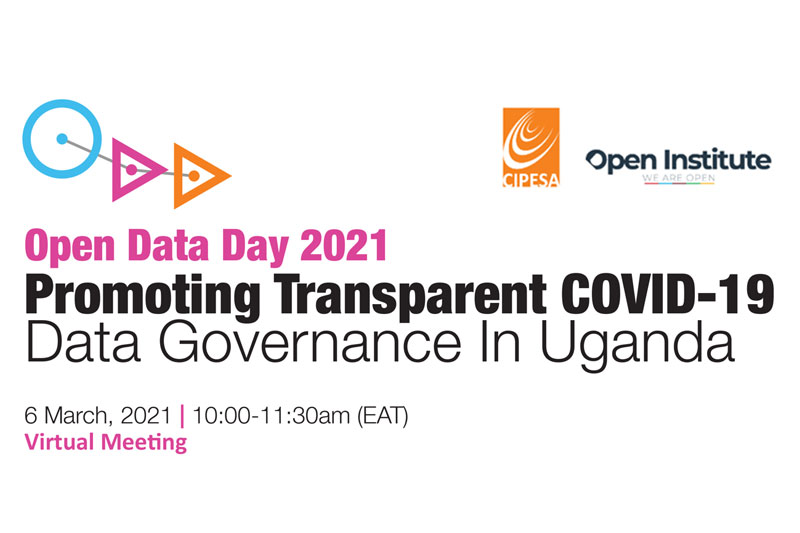
Online Meeting: Promoting Transparent Covid-19 Data Governance In Uganda

Invitation |

March 6, 2021 is Open Data Day, an annual celebration of open data all over the world which provides an opportunity to show the benefits of open data and encourage the adoption of open data policies in government, business, and civil society. This year, the Collaboration on International ICT Policy for East and Southern Africa (CIPESA), in partnership with the Open Institute will convene an online discussion to understand how decisions regarding the access and use of data in Uganda are made. 

Discussion Panel

  • Stella Alibateesa; Director for Regulation and Legal Services at NITA-Uganda
  • Dorothy Mukasa – Chief Executive Officer, Unwanted Witness
  • Bernard Sabiiti – Senior Strategic Partnerships & Engagement Manager,  Development Initiative
  • Atek Kagirita – Covid-19 incident commander at the Ministry of Health
  • Gabriel Iguma – Talk show host, Radio One (Moderator)
Join the online meeting on March 6, 2021 at 10h00-11h30 (EAT)
Register here

Investigation Finds More than 700,000 Barriers Limiting Website Accessibility in Mozambique

By Staff Writer |

In a pioneering data-driven investigation, the Mozambican Disabled Person’s Organisation Forum (FAMOD) has teamed up with UK-based non-profit Data4Change to run automated accessibility testing on 90 of the most important and useful websites in Mozambique.

The result is a publicly-available dataset of 722,053 instances of accessibility ‘violations’. Each violation represents a barrier preventing someone with a visual, hearing, physical or cognitive impairment from fully engaging with the web page.

The investigation revealed that just five types of accessibility violations accounted for nearly 90% of all the violations found. These top five violations were low colour contrast (37% of violations found), lack of landmarks to identify regions of a page (33%), links that aren’t made apparent (11%), no descriptive text for interactive elements (3%) and no ‘alt text’ for images (2%). The violations were defined according to international standards for web accessibility as described under the Web Content Accessibility Guidelines 2.0 and 2.1 (WCAG 2.0 and 2.1).

Cantol Alexandre Pondja, President at FAMOD noted that access to ICT is essential for persons with disabilities, adding that, “It is clear from the results of our investigation that the majority of websites, including those providing public and essential services, remain largely inaccessible for persons with disabilities. As a result, FAMOD plans to strengthen the advocacy work in this area and we look forward to working with political authorities, the private sector, and donors as part of this effort.”

Some of the worst-performing websites include a job ads site, a large telecoms provider and a government tax authority. One screen reader user told FAMOD, “In most websites there comes a stage when it is not possible to use. I finished my studies recently and when I went to the job website, I was not able to apply for a job, because when I get to the end of the first page of jobs I can’t move onto the next. I end up giving up.”

The www.a11y.co.mz platform provides more information about the investigation and invites Mozambican web content creators, designers, and developers to test their existing knowledge with an accessibility quiz; pledge to uphold accessible and inclusive design principles in their work as well as access a free ‘digital toolkit’ containing resources to help with writing, designing and developing more accessible websites.

Bronwen Roberston, Director of Data4Change which works on data-driven projects aimed at solving issues affecting underrepresented and marginalised groups stated that, “a11y.co.mz proves that there’s a long way to go to ensure the internet is accessible for people with disabilities in Mozambique, but that there are some easy and concrete steps that can be taken to improve the current situation.”

The investigation was carried out in the context of the Africa Digital Rights Fund (ADRF) which is an initiative of the Collaboration on International ICT Policy for East and Southern Africa (CIPESA). According to CIPESA’s Programmes Manager, Ashnah Kalemera, Mozambique, like many other African countries, ratified the United Nations Convention on the Rights of Persons with Disabilities, which places significant obligations on state parties for equal opportunities and inclusion of persons with disabilities. “a11y indicates that these obligations remain largely unimplemented and, as a result, a large section of persons with disabilities continue to face digital exclusion. CIPESA is really proud to partner with FAMOD in raising awareness of disability rights issues as they intersect with technology and access to information in Mozambique,” said Kalemera.

In November 2020, CIPESA alongside, FAMOD, Small Media, and the Associação de Cegos e Amblíopes de Moçambique made a joint stakeholder submission on digital rights in Mozambique which in April 2021, will be assessed under the Universal Peer Review (UPR) process at the United Nations Human Rights Council. Indeed, among the recommendations made was a call to the government to implement measures that promote inclusive access for marginalised and vulnerable groups including women, rural communities, and persons with disabilities, with funding from the Universal Service Fund.

How the Covid-19 Fight Has Hurt Digital Rights in East Africa

By Paul Kimumwe |

The fight against the coronavirus (Covid-19) pandemic in Kenya, Tanzania, and Uganda has dealt a blow to the promotion and preservation of human rights in the region. The outbreak of Covid-19 could not have come at a worse time, as the countries were preparing for their respective general elections (October 2020 for Tanzania, January 2021 for  Uganda, and a potential referendum in 2021 and the August 2022 elections in Kenya).

Even before confirmation of Covid-19 cases in the region, the three East African countries had instituted Covid-19 mitigation measures, including the adoption of statutory instruments which quickly suspended constitutional guarantees without reasonable justification or meaningful stakeholder consultation. The measures were accompanied with a problematic onslaught on the media, the political opposition and ordinary citizens, which undermined the enjoyment of the rights to freedom of expression, assembly and association, and the right to access a variety of news and information, which was critical to informed decision-making particularly during electoral processes.

On March 18, 2020, Uganda instituted its first set of measures that included the closure of schools and a ban on all political, religious, and social gatherings. A week after the March 22, 2020 confirmation of the first case in the country, the Ministry of Health issued the Public Health (Control of Covid-19) (No. 2) Rules, 2020 that introduced further restrictions including a dusk-to-dawn curfew, the closure of institutions of learning and places of worship, the suspension of public gatherings, a ban on public transport and the closure of the country’s borders and the international airport to passenger traffic.

In Kenya, the government introduced several measures to curb the spread of Covid-19 that included the suspension of public gatherings and other social distancing requirements; limitation of travel into and outside the country; imposition of a dusk-to-dawn curfew under the Public Order Act, 2003; as well as inter-county travel bans between the capital, Nairobi, and three other high-risk counties of Mombasa, Kilifi and Kwale.

A day after the government confirmed its first coronavirus case, Tanzania introduced a series of measures that included the closure of schools and the suspension of sports events on March 17, 2020. Additional directives, including quarantining travelers from countries with confirmed cases of COVID-19 at the travelers’ own cost, were announced by President Pombe Magufuli.

While many of the restrictions such as the closure of international borders, schools and churches and prohibitions on public gatherings have since been relaxed, the long-term impact of these and other restrictions persist.

In this brief, the Collaboration on International ICT Policy for East and Southern Africa (CIPESA) researched Covid-19 related censorship and surveillance practices and related regulatory responses in Kenya, Tanzania and Uganda that affected people’s’ digital rights, including the right to freedom of expression, access to information, and privacy. It shows that the different measures adopted by the three countries, including enactment and enforcement of repressive laws on misinformation/fake news, as well as intimidation, arrests, detentions, and suspension of media operations, have led to an erosion of civil liberties online and offline.

The brief recommends the amendment of all the Covid-19 legislation that restricts freedoms to bring it into conformity with international standards on the right to privacy, data collection and processing as well as freedom of expression and access to information. Further, it urges governments to improve the affordability of the internet by more citizens, ensure the respect of citizens’ rights; and be transparent, and accountable in the conduct of Covid-19 related data collection and surveillance.