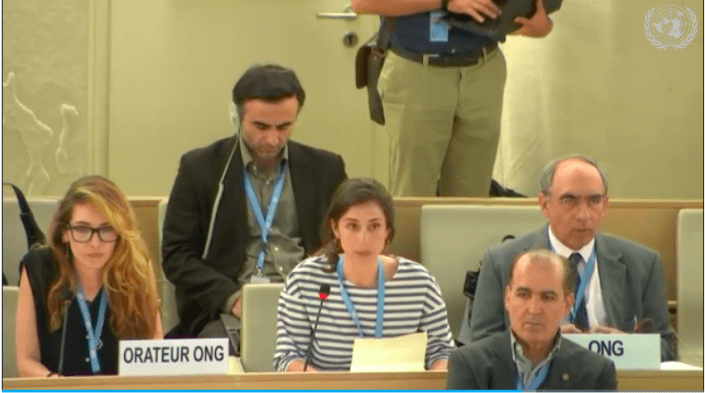
Oral Statement Delivered At The United Nations Human Rights Council

Joint Statement |
Thank you, Mr. President.

This statement is delivered on behalf of the Association for Progressive Communications (APC), the Collaboration on International ICT Policy for East and Southern Africa (CIPESA), Derechos Digitales, and the Women of Uganda Network (WOUGNET).

As organisations committed to maintaining the use of the internet for human rights, social justice and sustainable development, we are concerned about the increase in threats to freedom of expression online. Attacks on freedom of expression online are taking many forms, including internet shutdowns, regressive cybercrime laws, and privatisation of censorship, among others.

We wish to highlight for the attention of the Council the following situations of concern:

In Uganda, the government adopted a “social media tax” in May, which will require users of over-the-top (OTT) services, including messaging and voice calls via WhatsApp, Facebook, Skype and Viber. to pay a mandatory fee of USD 0.05 per day of use. In a context in which social media has served as many users’ initial entry point to the internet, this tax could negatively impact the affordability and broader use of the internet, particularly by low-income Ugandans, as well as stifle freedom of expression, association and assembly online. Similarly, the recent introduction of stringent online content regulations in Tanzania, Uganda and the Democratic of Republic of Congo threaten citizens’ rights to privacy and freedom of expression and promote self-censorship.

In Latin America, we observe a trend by governments in the region to regulate online expression that is critical of dominant political forces or that amplifies dissident voices of traditionally discriminated groups, under the guise of “online hate speech” or “cybersecurity”. Examples can be found in Brazil, Ecuador, Guatemala, Honduras, Paraguay and Venezuela, among others. In some cases, legislative reforms have been introduced just before the start of electoral processes or the rise of social movements; in others, restrictive measures are administratively established, bypassing democratic legislative processes entirely. We also observe efforts in the region to criminalise expression and to require private companies to moderate online content, an issue addressed in detail by the recent report of the UN Special Rapporteur on freedom of opinion and expression. This implies an undermining of due process, as required by international human rights standards, by delegating the function of the judiciary to the private sector. At the same time, it incentivises companies to err on the side of caution and take down content to avoid facing high fines or, in the case of Venezuela, the threat of revocation of authorisation to operate.

We urge the Council with its bi-annual resolution on the promotion, protection and enjoyment of human rights on the internet to condemn and call for the end to such restrictions on online expression, and to adopt human rights-based approaches to internet access and regulation.

Thank you, Mr. President.

Source: Information.
The Growing Trend of African Governments’ Requests for User Information and Content Removal From Internet and Telecom Companies

Policy Brief |
The relationship between communications service providers, users and governments with regards to data protection, requests of user information and content take downs is increasingly taking centre stage in discussions around free, open and secure use of digital technologies.
In February 2017, Millicom issued its second Law Enforcement Disclosure Report. Millicom’s report is one of many by private companies aimed at promoting transparency and accountability, through periodically publishing reports detailing information on government requests for user data, content removals, and compliance with those requests.
Google is credited with being the first internet company to publish a transparency report back in 2009, followed by Twitter in 2012. Facebook and Yahoo have published reports since 2013. Vodafone and Orange were among the first telecommunications companies to publish transparency reports, both in 2014.
These reports have become vital to understanding censorship, surveillance and more importantly the commitment of service providers to protecting the privacy of their users and promoting freedom of expression online. Based on the reports alone, it remains unclear what the true extent of governments’ surveillance of citizens’ communications and censorship of content across the world is. Nonetheless, the reports indicate a growing trend among countries, including African governments, of requests for subscribers’ data and content removal.
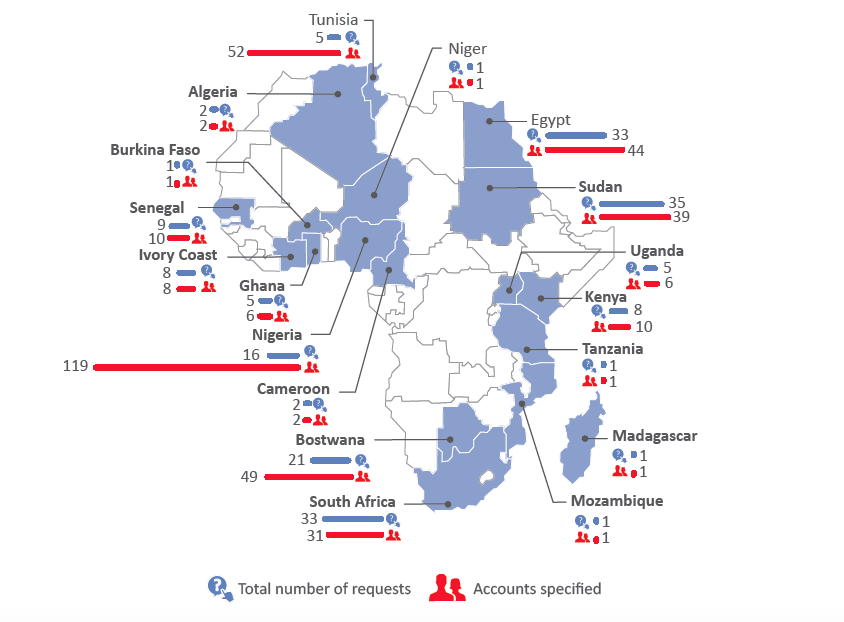
On the social media front, from five African countries being listed by Facebook among those that requested users’ details in the first half of 2013, the number on the continent has grown to 18 as at the end of 2016. Meanwhile, requests to remove content from Google have also grown from only Libya in 2010 and 2011, to four African countries in 2016 alone. Twitter, which only received one user information request from South Sudan in 2012, has since gone on to receive requests from an additional four countries on the continent. The countries which have consistently made requests for user information to Google, Facebook and Twitter include South Africa, Nigeria, Sudan, Kenya and Egypt.
In telecommunications, figures are scanty as only four companies operating in Africa issue transparency reports – one of which, MTN, does not disclose any statistics while Vodafone’s extent of disclosure is limited due to legal provisions in some of its countries of operation that prohibit publishing of such information. Even then, user data requests from five African governments to Millicom have increased from 5,000 in 2015 to nearly 7,000 in 2016. Requests to Orange from the 20 African countries where it had operations as at the end of 2016 have tripled in the past three years – from 22,930 in 2014 to 67,718 in 2016.
In this brief, we provide a summary of the user data and content removal requests which governments in Africa have made to select internet and telecommunications companies in recent years.


Call for Evaluation Consultant: ICT4Democracy in East Africa Network

The Collaboration on International ICT Policy in East and Southern Africa (CIPESA) is seeking an evaluation consultant to establish the achievements, outcome and challenges registered by the ICT4Democracy in East Africa Network during the period November 2013 – October 2015. The evaluation will assess the appropriateness, effectiveness and outcomes of the network in relation to the program objectives.
Closing date for applications: 17:00 hours East African Time (EAT) on Thursday November 19, 2015
Further details on the scope, eligibility and how to apply are available here.

ICT in Governance in Kenya – Policies and Practice

In November 2014, internet statistics source Socialbakers estimated that there were 3.6 million Kenyans on Facebook, with 64% of them male and 36% female. The majority of Facebook users (75%) were aged 18-34 years. As of September 2015, the Kenyan Twitter account with the highest number of followers was @UKenyatta, the Kenyan President’s account that had over one million followers, followed by @ntvkenya with 979,838 followers.”

This report reviews government and non-government Information and Communication Technology (ICT) initiatives in Kenya, and examines how ICT-related policies and other legislation affect citizen participation and democratic governance. Among others, the study covers the link between ICT and political participation, social accountability, public services delivery and citizen engagement. The report is based on policy analysis,
stakeholder interviews and literature review, and aims to inform awareness raising initiatives and advocacy for more progressive policies and practices regarding the use of ICT in governance and civic participation in Kenya.