ToroDev trains rural youth and women in online advocacy for improved service delivery

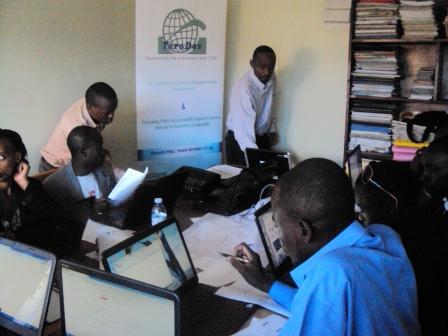
ToroDev has started training rural women and youth leaders in the seven districts of the Rwenzori Region in using online tools to monitor service delivery. The maiden residential 2 days training involving ten participants was held on 16th – 17th of August, 2012 at ToroDev resource center in Fort Portal, Uganda. The training which is supported by ToroDev in partnership with SPIDER/Stockholm University was facilitated by Milton Aineruhanga from WOUGNET.

ToroDev will train 210 rural monitors and advocates in online/ Web 2.0 tools to collect, document and disseminate online public accountability for improved serviced delivery issues. They will particularly oriented on how to interact with the “Ushahidi” online platform and other relevant open-source software. The monitors were also trained in online social media tools, human rights, governance and democratic engagement.
The monitors were highly trained to be independent local citizens that will keep updating the community and project team at ToroDev about the status of service delivery and identifying communities own service delivery needs.
They will further go ahead to mobilize and encourage regular meetings and focus group discussions (FGDs) among the 14 Advocacy Forums in the region on issues of service delivery monitoring.
Rural Monitors will also advocate for quality and timely public accountability from local leaders.  They will use 11 radio stations in the Rwenzori region as a major tool for distributing/disseminating all the information accessed through online/internet and mobile phones.
This information will be converged on the FM radio stations as a way of sharing information with the rest of grass root citizens in the region, who may not necessarily have the skills and afford town or access internet based knowledge tools. The rural FM radio will be used a hub for the convergence of all ICT tools for effective service delivery monitoring in the Rwenzori Region.
Some of the sample articles posted by the rural monitors on the Ushahidi platform.
http://wougnet.org/ushahidi/reports/view/59
http://wougnet.org/ushahidi/reports/view/66
http://wougnet.org/ushahidi/reports/view/62
http://wougnet.org/ushahidi/reports/view/64
http://wougnet.org/ushahidi/reports/view/56
http://wougnet.org/ushahidi/reports/view/51
Documented by Solomon Akugizibwe
This article was published on August 28, 2012, about the ICT4Democracy in East Africa project, which brings together various partners in the region – among them CIPESA.
For more information, visit www.ict4democracy.org

Transparency International Uganda Acquires a Toll Free Line


Transparency International (TI) Uganda has completed the installation of a toll free call centre at its Lira field office. By calling 0800 200 188 toll free from any local mobile phone service provider, citizens can report on corruption and poor service delivery in the health sector in Northern Uganda.
Through the call centre and as part of its ICT4Health Service Delivery project, TI Uganda aims to reduce the rates of health worker absenteeism, increase community participation in monitoring the functionality of health centres and advocate for polices to improve health service delivery in the post conflict region.
This article was published on July 24, 2012, about the ICT4Democracy in East Africa project, which brings together various partners in the region

Kenyan Human Rights Networks Deploy ICT Platforms in their ICT4Democracy Work

Two Human Rights Networks (HURINETS) working with the Kenya Human Rights Commission (KHRC) to improve grass roots based organisations’ and their memberships’ understanding of the commitment to building a human rights society have deployed a crowd map, blogs and social media tools to promote their work.

Laikipia HURINET located in Laikipia in the South Rift Region of Kenya works to empower the Laikipia County Community through promotion of human rights, free information dissemination, training, and networking. The HURINET, also known as the Vision Facilitators Network (VIFANET) in June launched https://laikipiacivicaction.crowdmap.com/.
Meanwhile, Kwale HURINET is documenting its work on child rights at www.genesisforhumanrights.wordpress.com. Kwale HURINET is located in Kwale on South Coast of Kenya. Their work focuses on civic education on the implementation of the Constitution of Kenya 2010 with special emphasis on the Bill of Rights, devolution, leadership and integrity among other constitutional provisions; para-legal services on child rights and labour; security, equality and justice.
Read the full report here.
This article was published on July 24, 2012, about the ICT4Democracy in East Africa project, which brings together various partners in the region – among them CIPESA.

East African Region New Media and Human Rights Institute workshop

In collaboration with the African Human Rights Consortium, the Kenya Human Rights Commission (KHRC) conducted a four-day new media, research and advocacy workshop aimed at scaling-up the use of ICTs in human rights and democracy within East Africa. The workshop attracted 14 participants drawn from civil society and media in Kenya, Uganda, Ethiopia, Tanzania and Burundi. During the workshop, KHRC took the opportunity to share information on the activities of the ICT4Democracy in East Africa network attracting a lot of interest from participants. Emphasis was placed on the importance of involvement of civil society actors in various ICT forums and projects.

Civil society organisations in East Africa were urged to embrace ICTs in their advocacy interventions.

This article was published on July 24, 2012, about the ICT4Democracy in East Africa project, which brings together various partners in the region

How Can ICT Help to Improve Governance

In what ways can Information and Communication Technologies (ICT) be used to the benefit of good governance? How can these technologies enable ordinary citizens to play a role in ensuring there is transparency and accountability in service provision in key sectors such as health, education, and water?
This was the focus the Promoting Good Governance and Accountability through use of ICTs in Uganda conference held at the end of June 2012, organised by the Women of Uganda Network (WOUGNET) and CIPESA.
At the one-day national conference, which attracted participants from government departments, civil society, media and academia, the two organisations disseminated their field and research findings on the use of ICT in enhancing citizen participation in governance and monitoring service delivery. There were discussions on how to use ICT more gainfully, given that there has hitherto been limited national experience and documentation in this area.
The Proceedings of the conference are available here.