A Decade of Internet Freedom in Africa: Report Documents Reflections and Insights from Change Makers

CIPESA Writer |

Over the last decade, Africa’s journey to achieve internet freedom has not been without challenges. There have been significant threats to internet freedom, evidenced by the rampant state censorship through
internet shutdowns, surveillance, blocking and filtering of websites, and the widespread use of repressive laws to suppress the voices of key actors.

However, amidst all this, there is a community of actors who have dedicated efforts towards advancing digital rights in the continent with the goal of ensuring that more Africans can enjoy the full benefits of the internet.

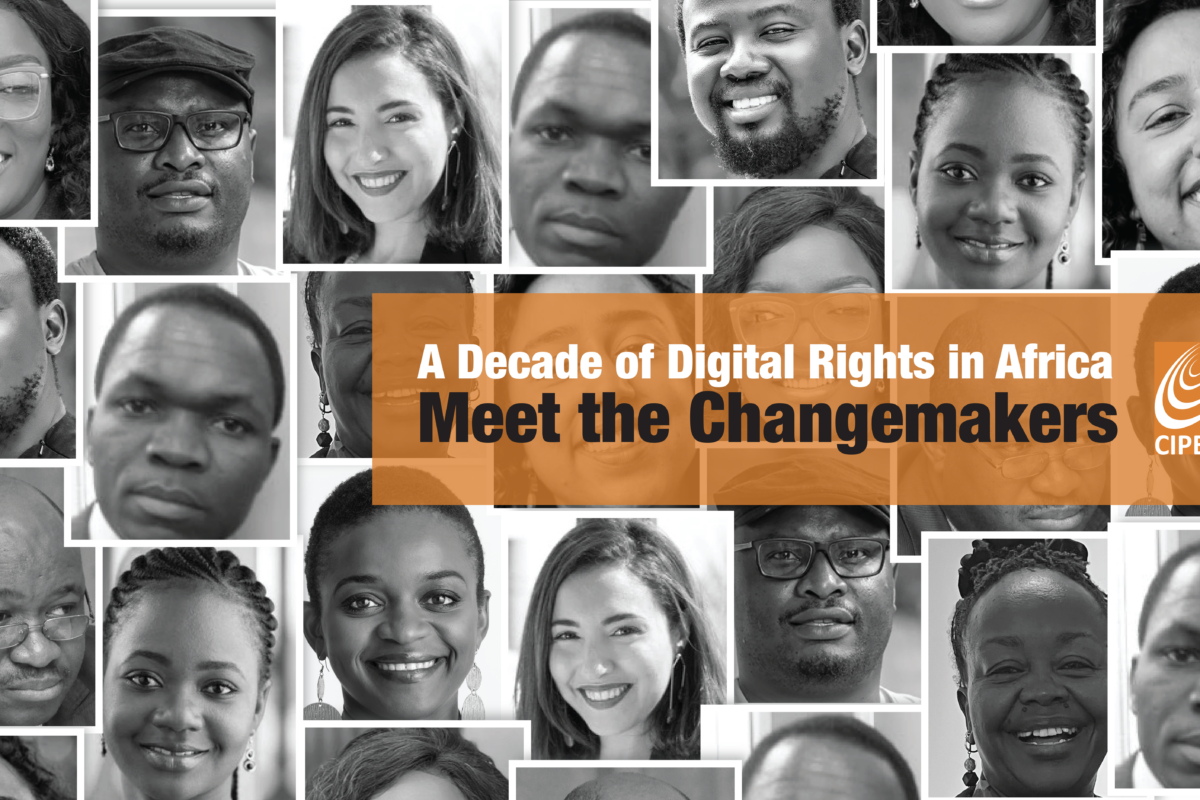
As part of our efforts recounting the work of the Collaboration on International ICT Policy for East and Southern Africa (CIPESA) over the years, we are pleased to share this special edition report: A Decade of Digital Rights in Africa: Reflections and Insights from 10 Change Makers, where we document reflections and insights from ten collaborators who have been instrumental in shaping Africa’s digital and Internet freedom advocacy landscape over the last ten years.

These changemakers have demonstrated change by advocating for a more free, secure, and open internet in Africa and working to ensure that no one is left behind.

Read the full report: A Decade of Digital Rights in Africa: Reflections and Insights from 10 Change Makers!

Meet the Changemakers

‘Gbenga Sesan, the Executive Director of Paradigm Initiative, is an eloquent advocate for internet freedom across the continent, leading efforts to push back against repressive laws and promoting digital
inclusion while speaking truth to power. He continues to champion the transformative power of technology for social good and to drive positive change in society.

Arthur Gwagwa is a Research Scholar at Utrecht University, Netherlands, and a long-standing advocate for digital rights and justice. His work in the philanthropic sector has been instrumental in supporting various grassroots initiatives to promote internet freedom in Africa. Similarly, his pioneering research work and thought leadership continue to inspire and transform the lives of people in Africa.

Edetaen Ojo, the Executive Director of Media Rights Agenda, is a prominent advocate for advancing media rights and internet freedom. Known for his strategic vision and dedication to media freedom, he pioneered the conceptualisation and development of the African Declaration on Internet Rights and has been a key voice in shaping Internet policy-making in Africa.

Emilar Gandhi, the Head of Stakeholder Engagement and Global Strategic Policy Initiatives at Meta, built a strong foundation in civil society as an advocate for Internet freedom. She is a prominent figure in technology policy in Africa whose expertise and dedication have made her a valuable voice for inclusivity and responsible technology development in the region.

Dr. Grace Githaiga, the CEO and Convenor of Kenya ICT Action Network (KICTANet), has been a leading
advocate for media freedom and digital rights in Africa. Her tireless advocacy in shaping internet policy has earned her recognition for her pivotal roles in championing internet freedom, digital inclusion,
multistakeholderism, and women’s rights online.

Julie Owono, the Executive Director of Internet Sans Frontières (Internet Without Borders), is a passionate and respected digital rights advocate and thought leader in the global digital community. She is not only a champion for internet freedom in Africa but is also a symbol of hope for many communities standing at the forefront of the battle for internet freedom and connectivity in Africa.

Neema Iyer, the founder of Pollicy, is well known for her advocacy efforts in bringing feminist perspectives into data and technology policy. Her dynamic and multi-faceted approach to solving social challenges exemplifies the potential of data and technology to advance social justice and promote digital inclusion and internet freedom in Africa.

Dr. Tabani Moyo, the Regional Director of the Media Institute of Southern Africa (MISA), is a distinguished
media freedom advocate and influential leader in guiding a community of changemakers in Southern Africa. He has played an extensive and formidable role in pushing back against restrictive and repressive laws, supporting journalists under threat, empowering young Africans, and shaping internet governance policies.

Temitope Ogundipe, the Founder and Executive Director of TechSocietal, has been a champion for digital rights and inclusion in Africa. She is an advocate for women’s rights online and uses her expertise to contribute to the development of youth and address digital inequalities affecting vulnerable groups across the continent.

Wafa Ben-Hassine, the Principal Responsible Technology at Omidyar Network, is a recognised human rights defender and visionary leader dedicated to promoting human rights and responsible technological
development. Her relentless advocacy and valuable contributions to defending digital rights, civil liberties, and technology policy continue to inspire many across the continent.

Join the Report Launch Webinar:

When: January 31, 2024
Time: 14:00-16:00 (Nairobi Time)
Location: Zoom (Register here)
After registering, you will receive a confirmation email containing information about joining the webinar.

Updated: Watch the report launch webinar.
Job Opportunity: Finance and Grants Manager

Announcement |

We are searching for a Finance and Grants Manager who will be responsible for overseeing financial transactions, maintaining accurate financial records, and ensuring compliance with financial policies and regulations. Applications are being reviewed on a rolling basis.

Job Title/ Position: Finance and Grants Manager

Type: Full Time National Staff

Location: Kampala, Uganda

Reports to: Executive Director

Contract Length: 3 years (renewable)

Start Date: November/December 2023 (To be shortlisted on rolling basis)

Job Summary

The Finance and Grants Manager is responsible for overseeing financial transactions, maintaining accurate financial records, and ensuring compliance with financial policies and regulations of the USAID funds. This role plays a vital part in the organisation’s financial management and supports decision-making processes by providing accurate and timely financial information. Furthermore, the Manager will support the CIPESA management in donor compliance, timely reporting, project document filing, and project management.

Duties and Responsibilities:

Key Result #1 – Financial Planning and Budgeting (20%)

Key Result #2 – Grant Management (20%)

Key Result #3 – Financial Compliance and Risk Management (20%)

Key Result #4 – Financial Reporting and Analysis (20%)

Key Result #5Grants and Funding Strategy (10%)

Key Result #6 – Representation and External Relations (10%)

Education and Experience

  • Degree in Finance, Accounting, or related field (a Masters degree is beneficial)
  • Significant experience in managing and implementing programs in the non-governmental sector, with at least five years in a management position
  • Professional certification (e.g. CPA, CFA) is a plus.
  • Proven experience with USAID regulations and general donor relationships
  • Proven budget management experience coupled with experience in implementing and working in accordance with corporate structures, policies and practices.
  • Experience in proposal-writing, budgeting and financial management.
  • Demonstrated experience with participatory approaches, including capacity building of local institutions
  • Knowledge and experience working with other cultures and sensitive to the cross-cultural issues

Language Skills

  • Proficiency in spoken and written English. Ability to effectively present information and respond to questions from groups of managers, clients, partners, in English.

NOTE:

The Complete Job Description is available here.

Employment with CIPESA offers an attractive package which includes; a good salary commensurate to one’s role, a good medical insurance package for staff and dependents, provident fund, GPA and provision for other statutory requirements.

CIPESA is an equal opportunity employer. All suitably qualified candidates are encouraged to apply by clearly stating the position applied for in the Subject line and submitting only electronic copies in one pdf file not more than 25MB of an application letter, a detailed CV, contact telephone numbers, copies of relevant testimonials/certificates, names/contact details of three referees, addressed to: Human Resource Manager, CIPESA Email: [email protected] not later than Friday, November 17, 2023 (N.B. Extended to November 21, 2023), at 5:00pm. Consider your application unsuccessful if you don’t hear from us by December 22, 2023.

 Standards of Professional Conduct:

CIPESA strives to provide an environment free from Sexual exploitation, abuse, harassment and Fraud. CIPESA holds a zero-tolerance policy against Sexual exploitation, abuse, harassment and Fraud. CIPESA expects its employees and partners to maintain high ethical standards, protect organizational integrity and reputation, and ensure that CIPESA’s work is carried out in honest and fair methods, in alignment with the CIPESA’s anti-fraud, Safeguarding and associated policies. Violations to stated policies will be subject to corrective action up to and including termination of employment.

Note: All offers of employment will be subject to satisfactory references and may be subject to appropriate screening checks, which can include criminal records and terrorism finance checks. A range of pre-employment checks will be undertaken in conformity with CIPESA Safeguarding, Anti-Fraud & HR policy. In line with this we will request information from applicants’ previous employers about any findings of fraud, sexual exploitation, sexual abuse and/or sexual harassment during employment, or incidents under investigation when the applicant left employment. By applying, the job applicant confirms their understanding of these recruitment procedures.

Towards Effective Biometrics and Digital Identity Systems in Africa

By Victor Kapiyo |

In many countries across Africa, identity systems have largely been paper-based. It is estimated by the World Bank that at least 500 million people in Sub-Saharan Africa lack proof of legal identification. In order to bridge this gap, several countries have adopted some form of digital identity (ID) system for civil registration, including birth, national IDs, voting purposes, incorporating biometrics such as fingerprint, facial or iris recognition as a form of authentication. Indeed, the systems have gained popularity given their benefits as part of digital transformation journeys to promote accessibility, efficiency, and transparency in service delivery – in health, migration, education, social security, and elections. 

Within the last decade, Lesotho, Mozambique,  Tanzania, Uganda,  Zambia and Zimbabwe have introduced national biometric digital identity cards.  

Lesotho’s national ID has so far covered 85% of the eligible population. Mozambique has a digital ID card with a Unique Citizen Identification Number (NUIC), assigned during birth registration. This national identification number is used on NID cards, health cards, driver’s licenses, and passports. The country also has the National Immigration Service (SENAMI), for its immigration system for travel documents and residence permits; as well as the Electronic System for Civil Registration and Vital Statistics (e-SIRCEV) for civil registration.  Birth certificates are a prerequisite for obtaining NIDs. The NID is valid for five years for individuals below 40 years of age and valid for 10 years for individuals between the ages of 40 and 50 years.

Tanzania introduced its biometric national ID programme in 2013 and started issuing cards in 2016..  As of 2020, at least 22.1 million individuals or 80% of the adult population had been registered for the National Identification Number (NIN). Also, mandatory SIM card registration requires the collection of fingerprint data in addition to official documentation such as national identity cards, birth certificates, driver’s licenses or passports.

Zambia introduced its National Registration Card (NRC), in 2013. The USD 54.8 million Integrated National Registration Information System (INRIS) replaced the paper-based system introduced in 1965 and would issue biometric-based documents such as national registration cards, birth and death certificates, and facilitate voter registration. 

In the early 2000s, the  Zimbabwean government introduced biometric IDs by the then Registrar General, Tobaiwa Mudede, as a formalised transition to reportedly enhance issues of e-governance. Unfortunately, there was very limited publicity and awareness on this transition, as well as transparency about the tendering and procurement processes. In 2018, the government also adopted a biometric system for the registration of voters, and for the registration of civil servants in 2019. 

It is worth noting that these systems, despite their benefits, present risks which were previously not common in paper-based identity systems. Some common risks to digitalised personal data include data breaches, surveillance, misuse of personal information, unwarranted intrusion, and financial harm. These risks may be amplified in the absence of comprehensive policy, legal and institutional frameworks for privacy and data protection. Notably, even where laws exist, if they are weak, fragmented, outdated, poorly enforced, lack strong and independent oversight mechanisms, or fail to provide effective remedies, the risk of harm to the data collected is heightened. 

Also, the use of centralised databases, weak information-sharing safeguards, and the lack of transparency and accountability in the management of identity databases have been documented as loopholes that could inevitably create opportunities for abuse by state and non-state actors with access to the information. 

Furthermore, the incomprehensive implementation of biometric digital ID programmes could entrench digital exclusion and discrimination of vulnerable groups, such as the elderly and refugees, from accessing government services due to lack of a national ID as the case was in Uganda. In Zimbabwe, the country’s Human Rights Commission’s (ZHRC) inquiry into access to documentation revealed that there is often neglect and marginalisation of people living with disabilities and members of minority groups. In Mozambique for example, studies showed that citizens who live in remote areas are more at risk of exclusion than others, as they have to travel further, and possibly a number of times, to complete the registration, and thus, bear higher costs.

Currently, 30 African countries have enacted data protection laws and policies. One of the early adopters of data protection laws is Lesotho, which adopted its Data Protection Act, in 2011. Uganda adopted its Data Protection and Privacy Act in 2019. Zambia and Zimbabwe adopted their Data Protection Acts in 2021, while Tanzania adopted its Personal Data Protection Bill in 2022. However, not all these countries have adopted the African Union Convention on Cybersecurity and Personal Data Protection (Malabo Convention). So far, only Mozambique and Zambia have signed the Convention and deposited the instruments of ratification. Lesotho, Tanzania, Uganda and Zimbabwe are yet to sign or ratify the convention.

Whereas having data protection laws is critical, African countries should also have in place appropriate policy, regulatory and institutional frameworks for the implementation of their digital identity programmes. Such frameworks are essential for fostering public trust and confidence in the use of digital identity systems, especially in the digital economy. 

However, enactment of the relevant laws and policies (including reviewing the existing ones) is just the first step in harnessing the dividends of biometrics and digital ID systems. States need to ensure that the implementation of digital ID systems meets certain thresholds.

  • Biometrics and digital identity systems should be user-centric, rights-respecting, privacy-respecting by default and by design, and secure throughout their lifecycle. 
  • Developers of such systems should anticipate and recognise potential privacy risks such as data breaches and fraud, and address them within the existing systems and frameworks. In addition, the developers should adopt a distributed and federated approach rather than a centralised approach. 
  • Further, there should be a clear governance framework, with independent oversight, well-defined roles and responsibilities, rules and standards. In addition, the systems should entrench accountability, including compliance with data protection laws and the conduct of data protection impact assessments (DPIAs). 
  • Countries should establish independent and robust oversight data protection bodies to regulate data and privacy protection including biometric data. The bodies should be given a commendable level of autonomy and facilitated sufficiently with the required resources to ensure that they function effectively, independently and with minimal external influence over their mandate.
  • In countries where digital identity systems were implemented prior to the enactment of data protection laws, the existing processes should be reviewed to ensure compliance with data protection laws. Key aspects to be considered include the conduct of DPIAs, review of data-sharing arrangements, compliance with data protection principles on consent, accuracy, purpose limitation, automated data processing, children, lawfulness, fairness and transparency, data minimisation, storage limitation, and security. 
  • In addition, countries should review the emerging best practices in the implementation of digital identity systems, learn from other countries and adopt those suitable for their context. 
  • Countries should build the capacity of government officials responsible for biometric digital ID systems, including data protection bodies, law enforcement, prosecution, regulators, and the Judiciary in effective data protection, with skills and knowledge in key principles of data protection and the rights of data subjects.
  • Programme implementation should proactively plan and ease the accessibility of services by the most vulnerable and marginalised groups – elderly, persons with disabilities, women, those in remote areas. This would include phased implementation of digital ID systems, wide distribution of enrollment centers in disability and poor-friendly environments, as well as cost waivers.  
  • Finally, stakeholder engagement and proactive disclosure of information relating to such programmes should always be integrated into the design and deployment of the programmes. 

Three Years After Al-Bashir Ouster, Sudan’s Internet Freedom Landscape Remains Precarious

By Khattab Hamad |

Over three years since the ouster of long-term authoritarian president Omar al-Bashir, Sudan’s ongoing political crisis continues to present challenges for internet freedom in the country. Initial positive reforms initiated by the transitional government led by Prime Minister Abdalla Hamdok have been clawed back since a  military coup in October 2021. The new military government has weaponised laws, continues to institute network disruptions, and is clamping down on civil society organisations so as to consolidate its grip on power and silence critics.

The political situation in the country has had a marked correlation with the state of internet freedom in the north African state, whose record was largely poor even before the crisis deepened. According to the Freedom On The Net 2022 report, Sudan scored 29 out of 100 on internet freedom, thus continuing its classification on the index as “Not Free”. Developments in 2022 signalled a rapid decline from the progress recorded in 2021 and 2020, when the country scored 33 and 30 respectively on the index, up from a lower score of 25 in 2019.

The Cybercrime Law Continues to Repress

One of the measures adopted by Sudanese authorities has been the use of internet-related laws as a weapon for repression. The cybercrimes law, which first came into force in the final days of al-Bashir’s regime in 2018, and its amendments in subsequent years, appear to be aimed at thwarting mass protests and restricting critical opinion of the government and its officials. The most recent amendment to the law, which contains vague provisions, was first announced in April 2022, with some reports stating that it was intended to criminalise acts such as insulting the leaders of the state and undermining the prestige of the state.

On November 2, 2022, the government spokesperson announced that the cabinet had adopted the amendments. The announcement stated that the law was necessary to address the proliferation of information-related crimes and the concealment of their perpetrators through the use of modern computer applications. Also, it claimed that it was necessary to address the shortcomings of the application of court fines that had failed to achieve complete deterrence. The amendment obliges courts to imprison offenders where the victim of defamation or fake news is a governmental public figure.  As of December 2022, the amendment law is yet to be published and is awaiting the final approval of the President of the Sovereign Council.

Article 21 of the cybercrime law provides that: “Whoever prepares or uses the information or communications network or any information means or any applications to publish or promote ideas, programs, words or actions contrary to public order or morals, shall be punished with imprisonment for a period not exceeding six years”. Under article 24, “Anyone who publishes lies or fake news in cyberspace will be punished [with imprisonment of] four years, fined or both”.

Meanwhile, article 25 states that “Whoever prepares or uses the information or communications network, or any information means or applications to defame any person shall be punished with imprisonment for a term not exceeding six years.” The law also imposes a penalty of up to seven years imprisonment for anyone who obtains data or information that affects the “economy or the national security” of the country, which terms are not defined.

These articles limit access to information and freedom of expression as they fail to provide a clear definition of the acts constituting the offence, are excessive, and use undefined terms such as “public order” and “morals”, which can be interpreted subjectively by security and prosecutorial agencies and applied to punish legitimate expression.

Censorship

The contentious provisions of the cybercrime law have been used to limit press freedom through the blockage of access to online news websites. In September 2022, the public prosecutor ordered the blockage of the website of the Al-Sudani newspaper, one of the most respected dailies in Sudan, without even notifying the newspaper’s management. The Sudanese Electronic Press Association condemned the order, stating: “We reject prior trials and convictions from any party except the judiciary”. Ultimately, the website was not blocked after the leakage of the prosecutor’s order.

In the same month, Abdalrahman Al-Aqib, a journalist, was arrested by police after publishing an investigative article on corruption at the Ministry of Minerals in a local daily and on his Facebook account. Al-Aqib was charged under articles 24 and 25 of the cybercrimes law for publishing lies and fake news. Following his arrest, the Sudanese Journalists Syndicate condemned the actions of the police. It stated: “Al-Aqib was treated in a humiliating manner, and they did not respect his most fundamental rights, amid delays from the police’s duty officer, so as not to obtain his legal right to the guarantee”.

In both cases, the government’s response was primarily reprisal as opposed to offering counter-responses to the allegations raised in the stories. Notably, authorities did not use the press law against the journalist, perhaps because it prescribes less penalties in comparison to the harsh penalties under the cybercrimes law. The press law does not provide for imprisonment of journalists; rather, it stipulates disciplinary sanctions, such as fines and suspending a journalist from publishing for a specific period.

Network Disruptions

Disruptions to internet access and blockage of social media continues unabated, with authorities justifying them as necessary to ensure “national security and emergency state”. Five have been recorded during the past 15 months.

During the October 2021 coup, the army imposed a nationwide internet shutdown to isolate the protestors from mobilisation to resist the coup. The shutdown lasted 25 days, and after access was restored, some social media platforms remained blocked for two more days. On the one year anniversary of the coup, the authorities shut down the internet for eight hours during a public march organised by pro-democracy groups against the coup. Earlier the same month on October 18, 2022, a regional internet shutdown was imposed in Wad Al-Mahi, a governorate in the Blue Nile region. The shutdown was in response to tribal conflict in several villages in the area. It could not be independently verified when access was restored.

Also, on June 11, 2022, the public prosecutor ordered the shutdown of the internet for three hours on a daily basis, over a 12-day period. The reason given was that it was necessary to prevent cheating during the national secondary school exams. Following the 12-day period, the internet was again disrupted for 25 hours on June 30, 2022, during the “Million Man March” to mark the anniversary of the 2019 massacre of protestors by the military.

Catalogue of Internet Disruptions in Sudan Since October 2021

Start dateEnd dateReasonGeo-scaleShutdown typeDuration
October 25, 202118 November 2021CoupNationwideMobile data25 days
June 11, 2022June 22, 2022ExamsNationwideMobile data12 days (3 hours daily internet-curfew)
June 30, 2022July 1, 2022ProtestsNationwideBlackout25 hours
October 18, 2022Could not verifyLocal conflictRegional: Wad Al-mahi (Blue Nile State)Mobile dataCould not verify
October 25, 2022October 25, 2022ProtestsNationwideBlackout8 hours

These recent incidents mirror Sudan’s long history of instituting network disruptions, rivalled only by neighbouring Ethiopia. Crucially, the disruptions are indicative of the current regime’s bias and disregard for freedom of association and assembly. Three of the internet disruptions (October 2021, June 2022 and October 2022) were in response to protests against military rule. In contrast, the military did not implement any disruptions on October 29, 2022, when the Sudan People’s Appeal Initiative held protests. The initiative comprises supporters of former president Al-Bashir’s ousted regime, who protested in Khartoum demanding that the United Nations not interfere in Sudanese affairs.

Crackdown on Civil Society

The government has also led an onslaught against civil society organisations. For example, on October 23, 2022, the Human Aid Commission (HAC), which is the regulator of non-governmental organisations in Sudan, notified the director of the Sudanese Consumers Protection Society (SCPS) of its decision to cancel SCPS’s registration, seize its assets and properties and freeze its bank accounts inside and outside Sudan. The SCPS has been at the forefront of advocating against network disruptions by pushing for the enforcement of contractual obligations of Internet Service Providers (ISPs) to provide services to their customers.

Looking Ahead

The affronts by the Sudanese government on internet freedom and civic space go against its obligations under international human rights law. The design and deployment of punitive laws by authorities to target and silence activists, government critics, journalists, human rights defenders (HRDs), and the political opposition create an environment of fear and self-censorship. Equally, responses such as the deregistration of civil society organisations only serve as a threat to other civil society organisations, of possible sanctions. Lastly, these actions together with internet shutdowns and the repression of digital rights through the cybercrime laws constitute unjustifiable limitations of freedom of expression, assembly, association, access to information, rights of the media, and rights to political participation.

In order to chart a democratic path in the coming years, the Sudanese government must show commitment to uphold media and internet freedom. Policy reforms should repeal regressive provisions such as the cybercrimes law. Sudan should also desist from interrupting access to the internet and social media.

+ Khattab Hamad is a journalist and digital rights researcher who has recently co-founded the Digital Rights Lab Sudan.

CIPESA At the 2022 Internet Governance Forum

By CIPESA Writer |

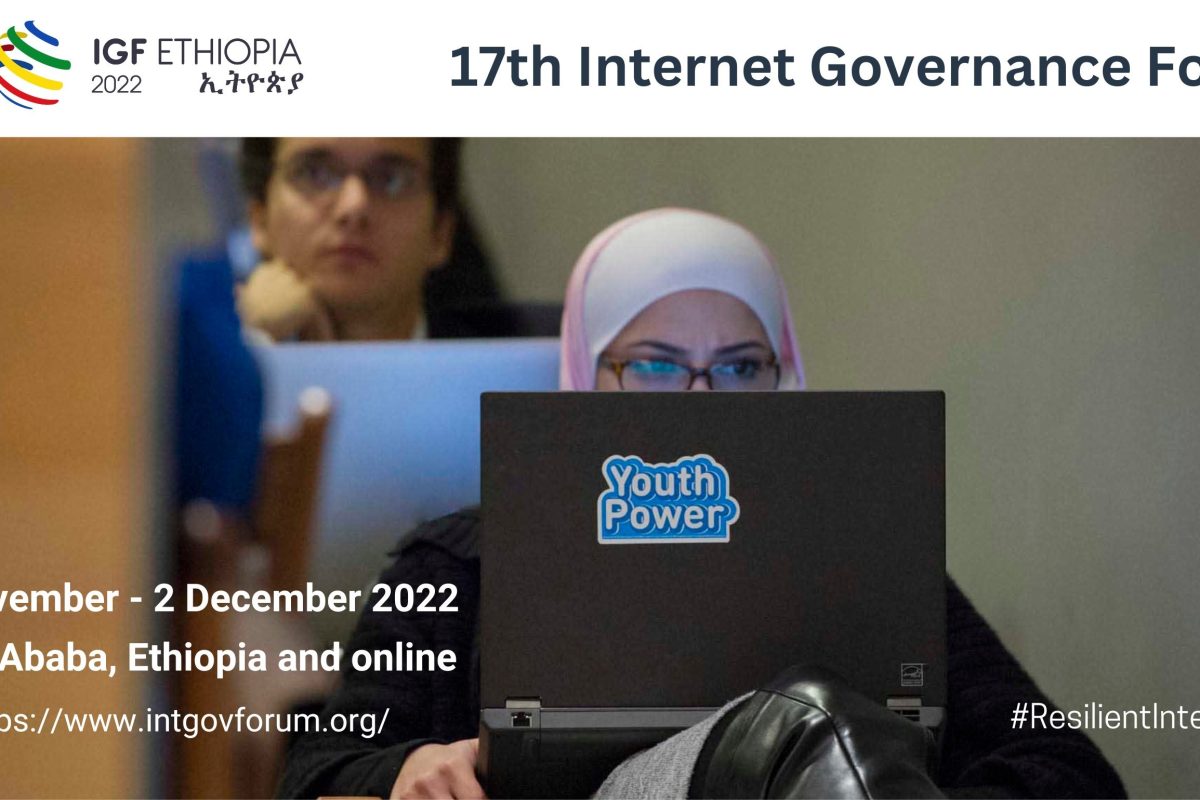
The global internet governance community is set to convene in Addis Ababa, Ethiopia, for the 17th Internet Governance Forum (IGF) from November 28-December 2, 2022. Ethiopia is hosting the IGF 2022 against a backdrop of internet freedom reforms, a recently liberalised telecommunications sector and an ongoing conflict that has seen the Tigray region without internet access for two years. 

The IGF 2022 theme of Resilient Internet for a Shared Sustainable and Common Future, and the five sub-themes which are drawn from the Global Digital Compact (GDC) in the UN Secretary-General’s Our Common Agenda report, resonate with the work of the Collaboration on International ICT Policy for East and Southern Africa (CIPESA).

  • Connecting All People and Safeguarding Human Rights
  • Avoiding Internet Fragmentation
  • Governing Data and Protecting Privacy
  • Enabling Safety, Security and Accountability
  • Addressing Advanced Technologies, including Artificial Intelligence  (AI)

CIPESA will co-convene and participate in various sessions at the IGF 2022 to showcase its work that supports the ambitions of the GDC.

A joint effort by DefendDefenders, Greenhost, Digital Society of Africa, Dig/Sec Initiative, Digital Security Alliance, AccessNow, CChub, Center for Digital Resilience, and CIPESA will run an onsite digital security hub to build the digital resilience of at-risk groups and organisations.

At a session titled “Jointly tackling disinformation and promoting human rights” facilitated by the AU-EU Digital for Development (D4D) Hub, CIPESA will contribute in an open exchange of ideas, experiences and lessons learned on how to address disinformation through a multi-stakeholder and human-centric approach.

Furthermore, CIPESA is among the organisers of the Dynamic Coalition roundtable on Strengthening digital ecosystems through shared principles and the Day 0 event on Shaping global digital governance and measuring meaningful connectivity for all: the ROAM approach, both of which are in support of ongoing efforts by CIPESA and UNESCO to raise awareness about and application of the Internet Universality Indicators across more countries in Africa.

The CIPESA team will also feature on a panel discussion on technology and human rights as part of the Peer Learning Event for National Human Rights Institutions (NHRIs) hosted by Danish Institute for Human Rights.

Further, CIPESA will participate at the Africa member convening of the Association for Progressive Communications (APC) and at a Digital ID Civil Society Summit hosted by the Open Society Foundations, under the auspices of an external digital ID fund and initiative (DIDIF), housed at Rockefeller Philanthropic Advisors.

Follow @cipesaug and #InternetFreedomAfrica