
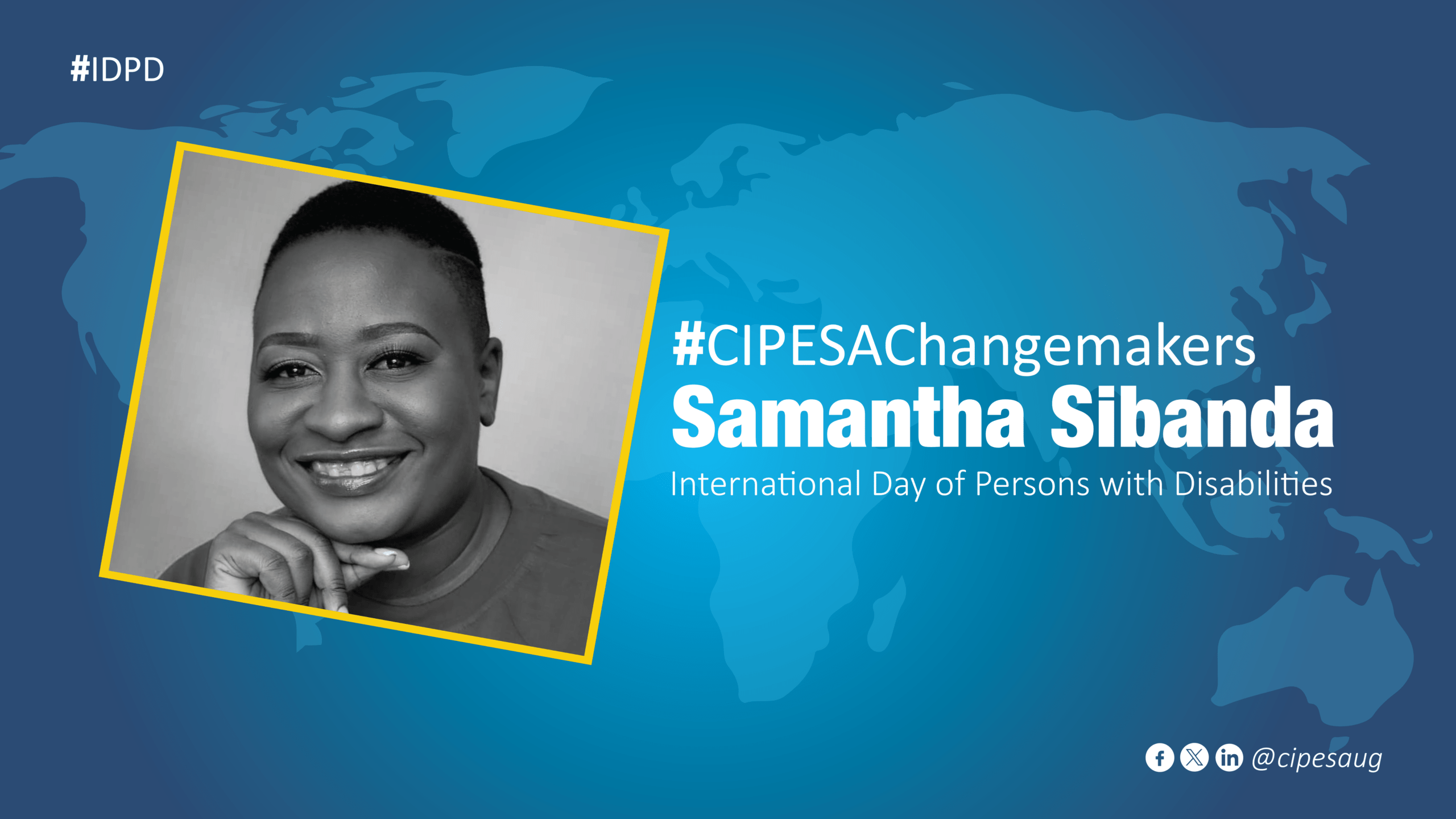
Who is Samantha Sibanda?
I am a human rights advocate and survivor of mental health issues who has dedicated the past decade of her life to championing the rights of persons with disabilities. In 2014, I founded the Signs of Hope Trust, an organisation for persons with disabilities, which focuses on access to information, digital rights, and inclusion, as well as inclusive civic engagement and public finance management.
I am also a trainer in the Freedom of Information Act, selected by the Zimbabwe Media Commission to support government entities and the public in understanding the Act and improving transparency and accessible information practices. My advocacy work is grounded in the principles of Ubuntu, which utilise community-driven and collaborative approaches to achieve change.
My motivation to work on disability and digital rights stems from a combination of personal experience and what I’ve observed in my own community. As a survivor of mental health challenges, I was drawn into advocacy through my own journey, and I continue to support community-based rehabilitation and mental health champions in my work.
As for digital rights, it grew naturally from my work at Signs of Hope Trust. For many years, we shared information via WhatsApp and other platforms to bridge information gaps for persons with disabilities. However, at the peak of the COVID-19 pandemic, between 2020 and 2021, the disability digital divide became more apparent. Everything shifted to online, including education, communication, and public services, and many individuals with disabilities were left behind due to inaccessible technologies, limited data, or a lack of access to devices.
That moment pushed me to focus intentionally on digital inclusion. We also added Digital Rights as a core programming area at Signs of Hope Trust, and I have continued to champion this work from the grassroots level, where our communities are most affected.
There have been tremendous efforts to expand digital rights and inclusion for persons with disabilities in Africa. The digital divide related to disabilities has become a key topic at most digital rights convenings that I have been privileged to attend. Regionally, the AfricanUnion (AU) Protocol to the African Charter on Human and Peoples’ Rights (ACHPR) on the Rights of Persons with Disabilities in Africa came into force in May 2024, reinforcing the legal basis for accessible ICT [Information and Communications Technology], barrier-free access to communication systems, and the right to information.
Alongside this, more organisations are adopting accessibility standards, governments are integrating disability inclusion into national digital strategies, and communities are increasingly vocal about the need for accessible online services. While gaps remain, the momentum is good, and the conversation is shifting from awareness to implementation.
I want to commend CIPESA for developing the Disability& ICT Accessibility Framework Indicators. I have personally used these in our research in Zimbabwe, and I have seen more studies that have used them. This is a crucial tool for data-driven advocacy and enhancing access to ICT for persons with disabilities.
Additionally, Universal Service Funds are increasingly being used to finance assistive technologies and expand connectivity, while community-based efforts, such as community networks supported by the Internet Society, are bringing internet access to remote areas. In Zimbabwe, there are community information centres which provide shared devices, internet connectivity, and training spaces for persons with disabilities who may not have individual access. Lastly, emerging satellite internet solutions, such as Starlink, are bringing reliable internet access to remote areas.
These innovations, when combined with accessible design, digital literacy programmes, and advocacy for inclusive policy, are creating practical pathways for persons with disabilities to participate fully in the digital world.
There are several pressing challenges that threaten digital rights and inclusion for persons with disabilities in Africa. One emerging concern is the rise of Artificial Intelligence (AI) tools, such as generative AI chatbots and image generators, which can reproduce harmful biases and create misinformation that is difficult to fact-check. This disproportionately affects persons with disabilities, who often lack access to digital literacy and critical information verification skills. Information disorders, including deepfakes and manipulated content, further exacerbate these risks.
Ableism remains another persistent barrier, carried into online spaces and contributing to self-censorship or exclusion of persons with disabilities from digital participation. It also shapes whose voices are considered in policymaking, often leaving persons with disabilities sidelined in laws and digital governance.
I often reference the seven pillars of inclusion, and when contextualised to digital rights, several stand out. First, inclusive policy frameworks must provide tangible ways to embed the needs of these groups into national and regional digital strategies and practices. Communication should be accessible, transparent, timely, multilingual, and adaptable to diverse abilities, ensuring that information reaches everyone.
Offering choice in how people engage digitally allows communities to use tools and platforms that best suit their needs. Building strong partnerships across government, civil society, industry, and community networks amplifies impact and accountability. Accessibility must be prioritised in both digital content and devices, ensuring that platforms are usable by all. Web accessibility guidelines should be applied when developing websites to ensure they are accessible to all users.