
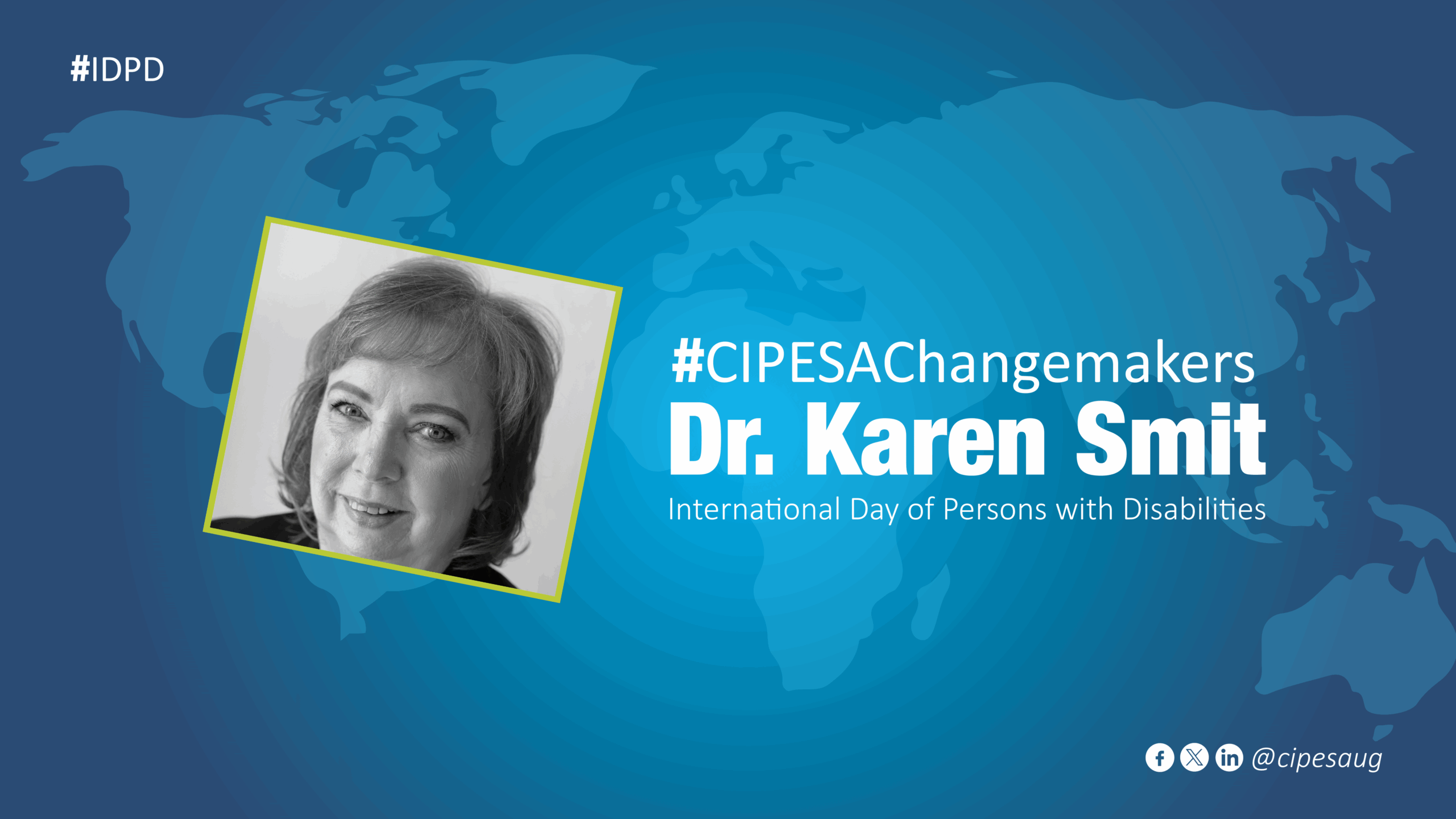
Who is Dr. Karen Smit?
I am a mother, wife, sister, expert, and a professional with a disability who has dedicated my life to advocating for the inclusion of persons with disabilities in Africa. My lived experience has shaped my worldview and strengthened my commitment to social justice, particularly in advancing digital inclusion, so that persons with disabilities can fully enjoy their human rights and access opportunities. For 28 years, I have worked at Vodacom, driving disability inclusion and influencing systemic change.
I have been married to my wonderful husband for 31 years, and being a mom reminds me every day that miracles do happen.
My journey as a disability and digital rights advocate began shortly after completing my undergraduate studies in the 1990s, when I realised the power of using my voice to make a meaningful difference in people’s lives. I completed my MA in Social Work at the University of Stellenbosch, where I identified barriers to employment for individuals with disabilities and provided guidelines for line managers on the successful recruitment of candidates with disabilities.
The turning point came when I experienced the enabling role of technology firsthand. Becoming a user of accessible technology revealed its power to open doors, level the playing field, and create opportunities. This realisation fueled my passion to drive accessibility and digital inclusion across Africa. My vision is clear: I want all Africans with disabilities to fully participate in the digital society and economy – accessing opportunities, resources, and becoming active citizens who contribute to economic empowerment.
Over the past 28 years at Vodacom [in South Africa], my advocacy has deepened significantly as I pushed for inclusive innovations. The company’s senior leadership created a platform that empowered me to champion inclusion for employees and consumers with disabilities. The unwavering support of Vodacom’s Group CEO and senior leaders has been transformative – shifting the focus from a “tick-box” approach to embedding inclusion systemically into the company’s technology, products, services, and processes, in alignment with Vodacom’s Purpose Strategy.
Having worked for Vodacom for many years and being responsible for driving the accessibility agenda for consumers with disabilities sparked my interest in pursuing a PhD in disability studies, with a focus on developing a Framework for promoting the digital inclusion of disabled consumers that companies can implement.
There has been some progress in expanding digital rights and inclusion for persons with disabilities in Africa, but it remains limited. In many ways, we are still only scratching the surface. I am, however, encouraged that some countries are taking active steps to promote disability inclusion, which is a positive sign. Most African nations have disability legislation and regulations in place, which is commendable.
However, the real challenge lies in implementation and creating real impact. Progress is slow, and without effective enforcement and commitment, transformation stalls, leaving behind many persons with disabilities.
Vodacom markets have several disability inclusion initiatives, including creating inclusive workplaces, accessible contact (customer service) centres, and retail stores offering multiple communication channels for persons with various disabilities. Additionally, digital centres provide smartphones and digital skills training to organisations for persons with disabilities.
The company also provides text Emergency Services for Deaf, hard-of-hearing, and persons with speech disabilities, accessible apps such as M-Pesa and VodaPay for visually impaired users, [it] hosts the annual Africa Accessibility conference, and offers tailor-made packages for disabled contract users, as well as training for store consultants.
Furthermore, the African Union (AU) Protocol to the African Charter on Human and Peoples’ Rights (ACHPR) on the Rights of Persons with Disabilities in Africa recently came into effect to protect and promote the rights of persons with disabilities across Africa. In 2025, Kenya enacted a progressive Persons with Disabilities Act, 2025 (Act No. 4 of 2025), marking a major milestone in disability inclusion and rights protection.
Research indicates that there are several barriers that persons with disabilities face, such as affordability, a lack of digital skills, and limited access to devices. Women with disabilities and those in rural areas face compounded barriers due to cultural norms, infrastructure gaps, and affordability challenges.
Meanwhile, with the emergence of new technologies, intentional efforts must be made to ensure that Artificial Intelligence (AI) systems are not trained on biased datasets that fail to represent persons with disabilities. Innovators must prioritise accessibility when designing solutions for smart cities, environmental sustainability, safety, security, and tourism.
To stay ahead, we must involve the disability community at every stage – from the conceptualisation of innovations to implementation – ensuring their voices shape innovation. This transforms persons with disabilities from passive beneficiaries into active partners and co-creators of solutions for a barrier-free Africa.
To build trust, foster partnerships, and strengthen regional collaboration among African stakeholders in the disability rights movement, it is essential to create a unified ecosystem that drives systemic change. These actors must recognise that disability is a natural part of the human experience and that exclusion stems from societal barriers, not just individual limitations. When these barriers are removed, persons with disabilities can fully exercise their rights and participate equally in all aspects of life.
Efforts to promote digital rights and inclusion in Africa must intentionally address how disability intersects with other marginalised identities – such as women, youth, and older persons – so that no one is left behind. Women with disabilities represent more than half of all persons with disabilities worldwide, and yet they continue to face numerous barriers, including being less likely to hold leadership roles, to be employed, to use the internet, and to experience barriers to sexual and reproductive healthcare. Their voices and specific needs must be prioritised and integrated into every stage of innovation and policy development to ensure an inclusive society for all.