By CIPESA Writer |
Digital transformation is reshaping governance, service delivery, and civic life across Africa. At the centre of this transformation is the growing adoption of Digital Public Infrastructure (DPI) — foundational interoperable digital systems such as digital identity programmes, payment systems, and data exchange frameworks that enable governments to deliver services at scale.
Across Eastern Africa, governments are increasingly investing in DPI as a core pillar of their digital transformation strategies. These systems promise to improve administrative efficiency, expand access to services, and support more inclusive digital economies.
However, DPI is not merely a technical infrastructure. It is also an institutional and political infrastructure. The way these systems are designed, governed, and implemented can shape power relations, accountability structures, privacy protections, and citizen participation in the digital state.
Despite the growing importance of DPI, public debate around these systems remains limited. A study by the Collaboration on International ICT Policy for East and Southern Africa (CIPESA) into media coverage of DPI in Eastern Africa shows that reporting is largely government-centric and event-driven, focusing primarily on announcements and service delivery benefits while giving limited attention to governance arrangements, procurement processes, rights protections, and questions of inclusion.
Strengthening informed public discourse around DPI is therefore critical. Greater participation by civil society, journalists, policymakers, technologists, and citizens can help ensure that emerging digital systems are transparent, accountable, inclusive, and aligned with the public interest.
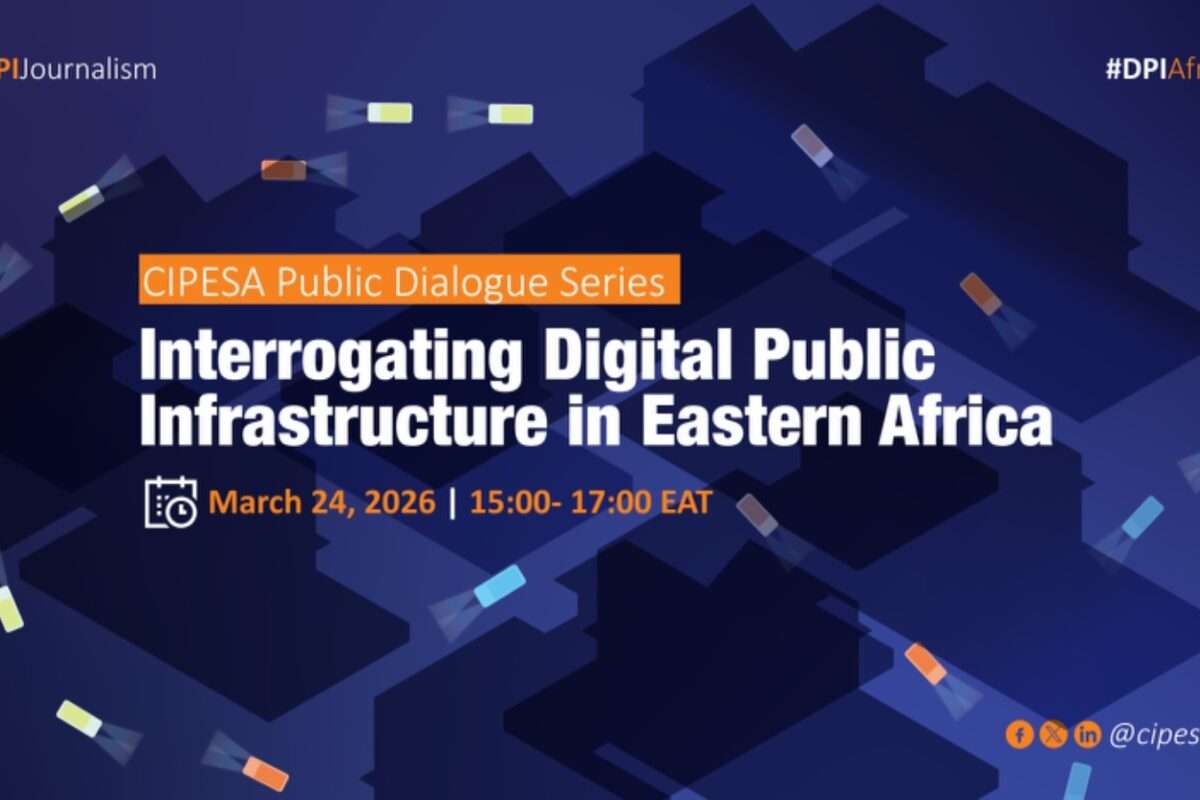
To contribute to this goal, CIPESA is convening a series of public dialogues on DPI in Eastern Africa. Through four in-depth discussions, the CIPESA public dialogue series will explore key dimensions of DPI implementation such as governance and accountability, data protection and trust, inclusion and equity, and cross-regional learning, while bringing together diverse stakeholders to deepen public understanding and encourage more critical engagement with the region’s digital transformation.
The details of the CIPESA Public Dialogue dare listed below. Be sure to mark your calendar for each dialogue!
Follow @cipesaug on social media and join the conversation using #DPIAfrica and #DPIJournalism.
Dialogue 1: Interrogating DPI: Governance, Power, and Accountability
Background: As governments across Eastern Africa accelerate the rollout of Digital Public Infrastructure systems, questions of governance, oversight, and accountability are becoming increasingly important.
While DPI initiatives are often presented as tools for efficiency and innovation, they also shape power relations within the digital state. Decisions about who designs these systems, who controls the data they generate, and how procurement and partnerships are structured can significantly influence how public digital systems operate and whom they ultimately serve.
Yet public scrutiny of these governance questions remains limited. Media coverage frequently focuses on the technical benefits of DPI, such as improved service delivery, while giving less attention to governance arrangements, procurement transparency, and mechanisms for accountability when systems fail.
This dialogue will examine the political economy of DPI, focusing on questions of governance, oversight, transparency, and accountability as the region expands its digital infrastructure.
Date: March 24, 2026 | 15:00 PM Nairobi | Reserve your seat
Dialogue 2: Interrogating DPI: Data, Privacy, and Trust
Background: Digital Public Infrastructure systems depend heavily on the collection, processing, and exchange of large volumes of personal data. While these systems can improve efficiency and coordination across government services, they also raise significant questions about privacy, surveillance, and data protection.
Public discourse around DPI in Eastern Africa has largely focused on service delivery benefits, with relatively limited attention to the risks associated with data governance and citizen trust.
CIPESA’s media analysis similarly shows that journalists tend to under-report issues of data protection, surveillance, and the enforcement of privacy laws, despite growing public concerns about the misuse of personal data and weak institutional safeguards.
This dialogue will examine whether DPI systems in Eastern Africa are being designed and implemented in ways that protect rights and build public trust.
Date: March 31, 2026 | 15:00 PM Nairobi | Reserve your seat
Dialogue 3: Interrogating DPI: Inclusion, Equity, and Gender
Background: Digital Public Infrastructure is often framed as inclusive by design. However, evidence from across Eastern Africa suggests that issues of equity, access, and representation remain underexplored in both policy debates and media coverage.
Media analysis conducted by CIPESA reveals limited reporting on how DPI systems affect citizens differently based on gender, geography, income, and digital access. It also highlights a significant gender imbalance in media sources, with roughly 80 percent of quoted sources being male.
Yet digital systems can inadvertently reinforce existing inequalities if barriers related to connectivity, digital literacy, affordability, identification documents, or social norms are not addressed.
This dialogue will explore whether DPI initiatives are truly delivering on their promise of inclusion, and who may be left behind by digital transformation.
Date: April 7, 2026 | 15:00 PM Nairobi | Reserve your seat
Dialogue 4: Interrogating DPI: Cross-Regional Learning Session
Africa is undergoing a profound digital transformation. The African Union Digital Transformation Strategy (2020–2030) encourages member states to develop Digital Public Infrastructure and Digital Public Goods as foundations for inclusive service delivery, digital trade, and economic growth.
However, public participation in shaping these developments remains limited, partly due to insufficient public discourse and limited specialised reporting on DPI and DPGs.
To address this gap, Co-Develop partnered with regional organisations, including the Media Foundation for West Africa (MFWA) and CIPESA, to establish journalism fellowships focused on DPI reporting in West and Eastern Africa.
MFWA launched the first fellowship in West Africa in 2023, generating valuable lessons and case studies. CIPESA has since adapted the fellowship model for Eastern Africa, creating opportunities for cross-regional learning among journalists and ecosystem actors.
This session will bring fellows and stakeholders from both regions together to share lessons, experiences, and strategies for strengthening public discourse on DPI and DPGs.
Date: April 14, 2026 | 15:00 PM Nairobi | Reserve your seat