
Africa Law Tech Festival 2021: CIPESA Underscores Strategies to Cutting Through Common Emerging Barriers To Access To Justice Despite the Covid-19 Pandemic

By the Lawyers hub |

At the onset of the COVID-19 pandemic, governments across Africa implemented measures to curb the spread of the virus that greatly disrupted judicial processes, slowing down access to justice. Such measures include suspension of all in- person court activities like mentions, hearings and appeals as well as execution of court judgements. Gradually, courts looked to adopting technological measures to aid in the delivery of justice; measures which despite the noble intentions, had to be grounded in law. 

These developments informed the Collaboration on International ICT Policy for East and Southern Africa (CIPESA)’s masterclass at the second edition of the Africa Law Tech Festival, a five-day annual conference that convenes different stakeholders in Africa to deliberate on digital policy issues. In line with this year’s theme, ‘Digital Policy for Economic Growth’, the class explored The Role of Lawyers and Courts digital access to Justice amidst the Covid 19 Pandemic. CIPESA affirmed that for many African countries, the basis for e-justice can be founded on the supreme law- the Constitution. In July 2020, the Supreme Court of Nigeria ruled in favour of virtual courts and  dismissed suits by Lagos and Ekiti States in which they sought to have virtual courts declared unconstitutional and null and void. 

Since the emergence of COVID-19, the African Judicial system has greatly changed. Courts have developed guidelines and practice notes for development of virtual courts and adopted online case management systems. As at December 2020, at least 20 African states had adopted e-filing and e-service and incorporated virtual hearings. Despite these successes, there are various challenges inhibiting the growth and adoption of virtual courts in Africa including:

The costs of acquisition of hardware and software needed for virtual courts. Africa has the lowest internet penetration rate caused by high cost of services and connectivity devices. In 2020, the Alliance for Affordable Internet reported that Africa had the least affordable smart devices globally costing about 62.8% of individual monthly income. Unaffordable devices raise the cost of connectivity for most Africans, pushing many offline. Conversely, those offline are not able to effectively utilize and participate in virtual courts, thus limiting access to justice. In Uganda, the judiciary obtained support from the UNDP to purchase zoom licenses. In Kenya, the judiciary partnered with the Ministry of ICT to acquire licenses for teleconferencing facilities and technical officers to provide support in respective court stations. 

Africa’s increasing digital divide has further degenerated access to justice. The International Telecommunication Union reports that Africa has the lowest percentage of persons using the internet globally. Moreover, urban areas have twice as much home internet access than rural areas. Despite having internet access, the reliability may be affected by constant power outages. Other justice actors like prisons would also need to be meaningfully connected. Previous efforts to implement the e-filling system and virtual courts by the judiciary in Kenya were slowed down due to lack of digital infrastructure and unreliable electricity in courts. As the adoption of virtual courts becomes widespread, it is crucial to ensure accessibility for all by addressing issues of digital infrastructure, device and broadband affordability otherwise justice would be discriminatory and a violation of their right to access to justice. 

Law and policies regulating the internet are not favourable. For instance, taxation of the internet leads to high data costs which in most cases aggravates digital exclusion. In 2021, Uganda replaced the unpopular social media tax of 200 shillings (USD 0.02) by introducing a 12% excise duty on the internet. In 2018 Zambia introduced a daily tax of USD 0.03 on internet voice calls following research that 80% of the citizens were using internet voice calls like WhatsApp, Skype and Viber. Recently, Kenya raised excise duty on internet services by from 15% to 20% further raising the cost of internet.  Such tax raises the cost of the internet, decreasing affordability for most citizens. Limitation on access and usage stifles innovation and ultimately access to justice as litigants would also be required to meet these high costs whether directly or indirectly. 

While digital security is important for a safe digital space, there has been a rise in cybercrimes during the COVID-19 pandemic. This includes malware that was previously dormant. The Communication Authority of Kenya reported a 152.9% increase in cybercrimes during the pandemic as cyber criminals exploit vulnerable computer systems. With recent cyberattacks in Uganda’s financial system as well as South Africa’s healthcare, there is concern over capacity to deal with cyberattacks given the sensitivity of judicial proceedings. Cyberattacks and crime are usually associated with a chilling effect on the use of digital platforms.

Meanwhile lack of the required digital skills pose a challenge to use of ICTs. While the goal remains to leave no one in Africa offline, African participation may be hindered by lack of digital skills. According to a study by the International Finance Corporation, by 2030,  over 200 million jobs in Africa will require digital skills. This means that Africans should strive to have the basic skills required that allows for full participation in virtual court system such as the filing of documents or attendance of virtual hearings. This is especially so in critical times like the pandemic where isolation could cause one to be away from those with the digital skills.   

From the aforementioned highlights, it is necessary to undertake practice measures that harness access and use of technology for justice. This would in turn lead to maximization of the benefits of e-justice. Similarly, governments should undertake a favourable licensing policy and legal frameworks that encourage investment and connectivity in ICTs. 
Africa Law Tech Festival 2021: CIPESA Demystifies the Role Of Lawyers And Courts In Ensuring Digital Access To Justice Amidst The Covid-19 Pandemic

By the Lawyers hub |

The Collaboration on International ICT Policy for Eastern and Southern Africa (CIPESA) administered a masterclass at the Africa Law Tech Festival 2021, which is hosted yearly by the Lawyers Hub. The CIPESA team was represented by Edrine Wanyama and Prof. Anthony Kakooza, who discoursed the effects of COVID-19 on the Justice sector. The session interrogated the various responses by different African States; the challenges faced, and possible recommendations to ensure timely access to justice for all, amidst the pandemic.

While lawyers and courts, including court officials, play an important role in facilitating access to justice, COVID-19 and the ardent restrictions that came with it, fundamentally affected this role. Courts could no longer be physically accessed; clients could not fulfill their obligations and witnesses could not undertake their roles. In the circumstances, technology-based alternatives for enhanced access to justice have emerged.

Over the past year there have been multiple opportunities and initiatives for innovation in the justice sector in Africa. Edrine Wanyama began by pointing out that the advent of COVID-19 has seen a shift from the traditional approaches of administering justice to E-Justice approaches which do not necessarily require physical interface and meetings.

In Kenya, the courts were quick to embrace the use of digital technology with the Practice Directions on Electronic Case Management being gazetted as early as 24th March 2020.[1] The electronic case management system’s interface allows lawyers, law firms and individuals to register through the e-filing portal on the Judiciary website or through e-citizen portal while also allowing judicial officers access to court documents and issue rulings through the portal or email. The use of video and audio conferencing through virtual platforms such as Zoom or Skype has also been integrated into the system.[2]

Nigeria’s National Judicial Council (NJC)[3] issued Guidelines for Court Sittings and Related Matters in COVID19 Period to guide the courts in implementing remote justice systems, amongst other COVID-19 related measures. Rwanda’s judiciary also outlined an Integrated Electronic Case Management System. The Online Cases Division clearly outlines the purpose of the Integrated Electronic Case Management System, benefits, account creation, case filing and follow up, a self-service user manual and video recording on how to access the system.[4].

Prof. Kakooza further delved into the various tech-innovations which have been motivated by COVID-19 to promote access to justice despite the associated challenges. The professor stated that the use of online court systems and videoconferencing to hear and determine cases had narrowed the gap between the courts and the affected individuals who no longer have to travel to courtrooms to have their matters heard. Further, the use of Online Records Management systems has made the process more efficient and accelerated the adjudication of matters and rendering of judgments via email. This has thus cut down on the case backlog and undoubtedly promoted access to justice.

However, the adoption of tech facilitated justice has not come without its challenges. In Kenya, for instance, most people do not have access to the internet and neither are they familiar with the technology in use by the courts.[5] As of January 2021, only a mere 26% of the Ugandan population used the internet[6] and as a majority of the country was unable to access the internet and geographical discrepancies forced courts to transfer cases to those capable of facilitating smooth video conferencing facilities.

While video conferencing has acted as a substitute for physical court appearances, the assessment of non-verbal cues such the defendants’ emotions and eye movements to gauge credibility is limited when compared to physical court appearance.[7] Additionally, virtual court appearances do not allow for proper detection of signs of torture and ill-treatment of accused persons and may also potentially skew the criminal justice system against persons deprived of freedom as they may feel intimidated and lack confidence when they are not able to physically appear before a judge.  This would ultimately lead to a breakdown in the justice process and negatively contribute to access to justice across the region.

Furthermore, due to the digital divide and increased exclusion, access to justice for certain groups has not been possible. Exclusion on the continent is facilitated by factors such as high internet costs,[8] not being able to afford the right technology like a laptop or smartphone, lack of access to information or communication and weak ICT infrastructure[9]. Additionally, unreliable internet connectivity and provision is prevalent in remote localities, resulting in virtual courts being out of reach for rural and marginalized communities in Africa.[10]

In addition to the fore highlighted challenges, data protection and privacy has become a major concern for tech users across the continent with laws falling short of robust protection standards such as for Botswana,[11] Kenya[12], Lesotho[13], Nigeria,[14] Rwanda,[15] Uganda,[16] and Zambia[17] among others.  For instance, there are data security concerns which potentially stem from the use of virtual courtrooms, digital storage of case records and the protection of personal information relating to litigants and witnesses and the evidence they provide in the courtroom.

In spite of the challenges that come with access to justice in the advent of the COVID-19 pandemic, the need to build a versatile technological adaptation and resilience of our judicial systems is critical for the promotion of access to justice on the Continent. The embrace of technology is indeed the path towards a digital legal ecosystem. It is also one that will require proactivity from all the stakeholders involved and the strengthening of cross-border interactions that support access to justice in Africa. The adoption of policies that contribute to lower internet costs, and embrace as well as facilitate the use of technology across the internet is indeed no less a venture to embark on. Public private partnerships and the integration of uniform e-justice systems across the Continent also require similar attention if the desired justice system is to be realized.

You can find the session’s recording here.

Countdown to The Forum on Internet Freedom in Africa 2021 (#FIFAfrica21) – Here Is What You Can Expect!

FIFAfrica21 |

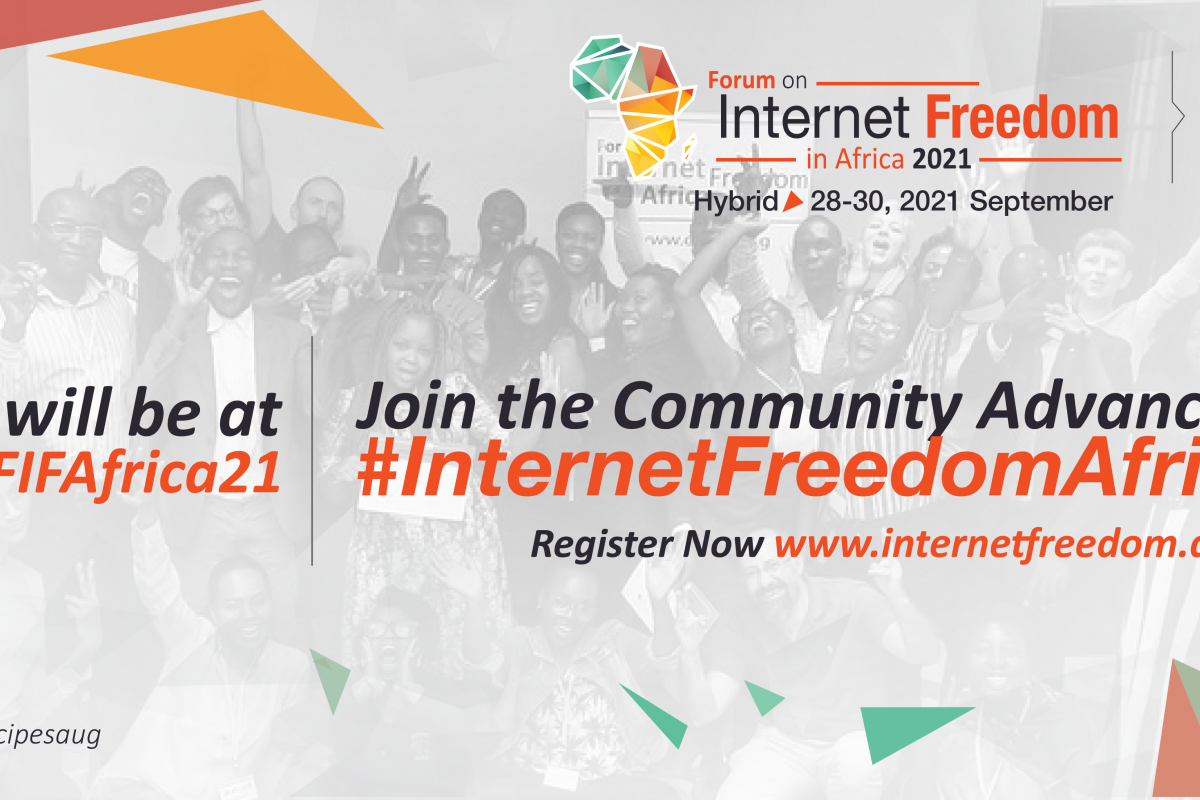
The five-day countdown to the eighth edition of the annual Forum on Internet Freedom in Africa 2021 (FIFAfrica21) is on! 

While revolving around three primary themes of Access to Information, Digital Inclusion, and Key Trends shaping digital rights in Africa, the Forum will serve as a platform to dissect and deliberate on topics shaping the digital rights agenda in the continent and other parts of the world.

Setting the stage for FIFAfrica, the Collaboration on International ICT Policy for East and Southern Africa (CIPESA) will host a keynote panel featuring journalist and writer Samira Sawlani, Cameroonian lawyer and activist Michelle Ndoki, the Chief Executive Officer of the Pan African Lawyers Union (PALU), Donald Deya, and Ambassador Tadej Rupel from the Ministry of Foreign Affairs of Slovenia, Presidency of the Council of European Union 2021. The diversity of backgrounds and expertise of the panel is reflective of the nature of deliberations, participants and content that will form the backbone of the Forum.

Overview of FIFAfrica21

  • 2 Pre-event trainings
  • 6 Remote hubs across five countries – Democratic Republic of Congo, Senegal, Tanzania, Uganda and Zimbabwe
  • 25 virtual sessions (lightning talks, report launches, strategy sessions, panels and learning calls)
  • 115 speakers

See the current agenda and speaker lineup.

Supported by the Ford Foundation, Sigrid Rausing Trust, Omidyar Network, Small Media, Internews, the European Union Institute for Security Studies (EU ISS), and the Slovenian Presidency of the Council of the European Union, FIFAfrica21 will serve as a platform for deliberation on gaps, concerns and opportunities for advancing privacy, free expression, non-discrimination and the free flow of information online. 

The virtual sessions, remote hubs and pre-event trainings have been organised in partnership withData4Change, the International Centre for Non-for-Profit Law (ICNL), Paradigm Initiative, Zaina Foundation, Africa Kiburi, Jonction Senegal, International Training Programme (ITP), Zimbabwe Centre for Media and Information Literacy (ZCMIL), Centre for Media Literacy and Community Development (CEMCOD), and Rudi International.

Registration for FIFAfrica21 remains open and includes access to the online event space wherein participants are already engaging with each other. Registered attendees can also lookout for the following at the Forum:

    • Build networks of practice: The Forum provides an opportunity for like-minded individuals to get to know and engage with each other. Be sure to look out and diarise sessions that resonate with you.
    • Access to the Digital Security and Virtual Support Desk: We have a wonderful team of digital security experts who will be on hand to provide personalised support and advice to attendees on any digital security issues and concerns.  
    • Visit Exhibitors: There is a plethora of very interesting work being done by the digital rights community across the world. You can visit the exhibitors’ centre to see some of this work and directly engage with the entities and people behind the various initiatives
    • Launch of the State of Internet Freedom in Africa 2021 report: This year we look forward to launching the latest edition of the State of Internet Freedom in Africa report. This adds to our repository of tracking the trends shaping digital over the years since 2014.

FIFAfrica21 to Feature Remote Hubs in Five African Countries

FIFAfrica21 |

Set to kick off next week on September 27, 2021 and taking on a hybrid approach blending virtual and physical engagements, the Forum on Internet Freedom in Africa 2021 (FIFAfrica21) will feature six remote hubs in five countries – the Democratic Republic of Congo (DR Congo), Senegal, Tanzania, Uganda and Zimbabwe. The hubs are an opportunity to convene small in-person country engagements of no more than 30 people as permitted and guided by Covid-19 Standard Operating Procedures (SOPs) in the respective countries.

On September 30, 2021, in Entebbe, Uganda, the International Training Programme on Media Development in a Democratic Framework (ITP) has organised a Media and Information Literacy (MIL) dialogue in partnership with the Zimbabwe Centre for Media and Information Literacy and the Uganda-based Centre for Media Literacy and Community Development. Select participants in Uganda will be joined virtually by counterparts in Kenya, Namibia, Sweden, Tanzania, Zambia and Zimbabwe to explore the importance of media and information literacy in empowering citizens to navigate misinformation and disinformation; the nexus between media and information literacy and digital rights, civic engagement, and trust in the media; and the use of media and information literacy as a strategic approach for citizens to achieve the Web We Want.

Dr. Emilly Comfort Maractho, the Director of the Africa Policy Centre at Uganda Christian University, will deliver a keynote address, framing MIL and the opportunities as well as challenges it presents as a vehicle for empowering citizens to become discerning information consumers online. The Entebbe hub will also feature two panel panel discussions, which will explore how MIL is essential for citizens to claim their rights online and for digital inclusion. The second panel discussion will cover the restoration of public trust in the media and building civic competence through news literacy amidst media institutions’ viability concerns brought about by the Covid-19 pandemic.

Still in Uganda, as part of Internews ADOPTABLE Project, a digital security tool usability session in Iganga district titled The Invisible Internet will explore use case scenarios and risks. The session will also explore how developers of open source digital security tools and the users of these tools can develop sustainable relationships.

Meanwhile, in Dakar, Senegal, Jonction will host an engagement on regulation of ICT and the right of access to information, where speakers will include representatives from Facebook, University Cheikh Anta Diop University, MonUniversDigital_Sénégal and the legal fraternity. The Dakar hub builds on a similar event in 2020 which engaged stakeholders on misinformation and its impact on freedom of expression online during the Covid-19 pandemic.

On September 29, 2021, Africa Kiburi will lead a national roundtable engagement in Harare, Zimbabwe with the objective to raise awareness about minority and marginalised groups’ digital rights issues and to generate policy recommendations to feed into the Cybersecurity and Data Protection Bill which is currently before parliament. The Women’s Coalition of Zimbabwe, Gender Media Connect, Digital Society of Africa, Media Institute of Southern Africa (MISA) Zimbabwe Chapter, the Zimbabwe Gender Commission and the Zimbabwe Ministry of ICT Postal and Courier Services are among the hub’s expected participants.

Meanwhile, the Goma-based Rudi International will conduct a capacity building workshop for Members of the National Assembly of the DR Congo on the prevailing ICT policy landscape, how to champion formulation of progressive laws on privacy and data protection, and the need to ally with digital rights organisations. Taking place from September 30, 2021 to October 1, 2021 in the capital Kinshasa, the training will bring together legislators on the Telecommunications and Technology Committee, industry players and government officials working in the sector ministries and agencies. The engagements will also build the participants’ digital security knowledge and  skills.

Finally, in Dar es Salaam, the NetRights Forum will be held as a two-day multi-stakeholder dialogue on internet rights and governance issues in Tanzania. It will seek to secure the government’s commitments not to entrench digital repression but to promote progressive legislative and practical reforms instead. Hosted by Zaina Foundation, this year marks the second year of a FIFAfrica hub in Tanzania. Last year, Zaina Foundation convened a remote hub to deliberate on digital rights in Tanzania with reference to the shrinking environment for advocacy work in the run up to the October 2020 general elections.

See the FIFAfrica21  agenda and speaker lineup.

Registration remains open.

Apply for Data Driven Advocacy Sketchathon at FIFAfrica21

Call for Applications |

Do you want to use data for advocacy but you’re not sure where to start? Would you like to transform statistics into compelling stories? Are you passionate about a digital rights cause, and want to convince others to join your efforts?

In the lead up to the Forum on Internet Freedom in Africa 2021 (FIFAfrica21), the Collaboration on International ICT Policy for East and Southern Africa (CIPESA) and Data4Change will host a virtual data sketchathon and series of critical discussions to get you thinking more about how to use data in digital rights advocacy. The sketchathon will take place on Monday 27 September 2021.

The schedule
Starting at 10am East African Time (EAT) and finishing at 5pm EAT, the sketchathon will entail a combination of live Zoom sessions and self-paced activities.

We’ll use the answers in your application forms to set an agenda for the group discussions as we explore themes like: data biases; representation, accessibility and ownership of data; and data inequalities. You’ll also have an opportunity to work in small groups to map your data advocacy aspirations and to tackle some of the data questions you’re grappling with as individuals or organisations.

Participants will also have an opportunity to create a data design using data from the #KeepItOn campaign Shutdown Tracker Optimisation Project.

Who should apply
There are no prerequisites, and literally anybody can apply. We are looking for people who are passionate about uncovering the potential of using numbers to drive forward emotive stories that have the power to advance digital rights preferably in Lesotho, Mozambique, Tanzania, Uganda, Zambia, and Zimbabwe.

A limited number of spaces are available for the workshop. We endeavour to create diverse and collaborative spaces and to foster a sense of community that lasts beyond the event and will strive to create a balanced representation of different geographies, abilities, and approaches among participants.

How to apply
Submit this form before 18.00 East African Time on Wednesday September 22, 2021.

Successful applicants will be notified by Friday September 24, 2021. A modest reimbursement will be provided for participants’ connectivity costs.