The Collaboration on International ICT Policy for East and Southern Africa (CIPESA) is in a phase of dynamic growth and we are actively seeking exceptional individuals to join our team. We are excited to announce two job opportunities, and the application window remains open until October 31, 2024. To explore further, simply click on the role that resonates most with you:
The Collaboration on International ICT Policy for East and Southern Africa (CIPESA) is seeking a Programme Officer to Support the implementation of activities that advance respect for human rights by businesses in Uganda.
Job Title: Programme Officer
Location: Kampala, Uganda
Duration: Two (2) Years
Reports to: Programme Manager
Deadline: October 31, 2024
About CIPESA
The Collaboration on International ICT Policy for East and Southern Africa (CIPESA) works to defend and expand the digital civic space to enable the protection and promotion of human rights and to enhance innovation and sustainable development. With a focus on disparate actors, including the private sector, civil society, media, policymakers, and multinational institutions, our work aims to engender a free, open, and secure internet that advances rights, livelihoods, and democratic governance. CIPESA’s work responds to a shortage of information, research, resources, and actors consistently working at the nexus of technology, human rights, and society. Indeed, CIPESA’s establishment in 2004 was in response to the findings of the Louder Voices Report for DFiD, which cited the lack of easy, affordable, and timely access to information about ICT-related issues and processes as key barriers to effective and inclusive ICT policy-making in Africa.
Job Summary
The Programme Officer will be responsible for planning, implementing, and reporting all project activities related to business and digital rights. Their duties will include organising and participating in training and mentoring partners, supervising research activities, and engaging with and maintaining relationships with various project stakeholders.
Key areas of accountability include:
Partnership Building
Identify project partners and develop sustained relationships with various stakeholders in the human rights, digital civic space and the private sector.
Build relationships with government actors, particularly those who work on human rights, labour, and digital policy.
Support the capacity building of various stakeholders in advocacy for respect of digital rights by businesses.
Participate in events by organisational and project partners.
Policy Engagement
Lead in the convening of digital rights and business policy dialogues.
Coordinate CIPESA research in the area of business and digital rights.
Support policy engagements with District Local Governments, Small and Medium Enterprises (SMEs), as well as Ministries, Departments and Agencies (MDAs).
Training and Mentorship
Participate in the development of digital rights advocacy toolkits for businesses.
Participate in training civil society organisations and SMEs in advocacy for digital rights protection in the business context.
Mentor civil society, small business enterprise owners, and associations in implementing digital rights awareness campaigns.
Support the development and dissemination of Information, Education and Communication (IEC) materials.
Project Management and Reporting
Ensure that project outcomes are delivered on time, on budget and according to the quality of standards of CIPESA and funding partners.
Prepare project reports and briefs and ensure timely submission to the CIPESA Management and funding partners.
Monitor the progress of project milestones and activities against the scheduled work plans and objectives.
Support the wide dissemination and visibility of project achievements among partners and other stakeholders.
Qualification and Experience
An undergraduate degree in human rights, law, social or development studies, governance, or project planning and management. A Post-Graduate/ Masters qualification will be an advantage.
Four or more years of experience in human rights, governance or humanitarian programming with a reputable institution, preferably in the civil society/ non-government sector.
An understanding of digital rights and human rights in the business context.
Effective communication, excellent written and presentation skills, and attention to detail.
Demonstrable experience in project management and implementation.
Experience in effective teamwork, as well as interpersonal and liaison skills.
Experience in coalition building, advocacy and working with civil society actors to deliver effective policy change.
Training and mentoring experience, particularly for adults.
Donor funds management and reporting experience.
Ability to conduct research and write policy reports and briefs is desirable.
Standards of Professional Conduct:
CIPESA staff and partners must adhere to the values and principles outlined in the Code of Conduct, and the Safeguarding against Sexual Exploitation and Abuse and Sexual Harassment (SEAH) Policy. In accordance with these, CIPESA operates and enforces policies on Beneficiary Protection from Exploitation and Abuse, Child Safeguarding, Harassment-Free Workplace, Fiscal Integrity, Anti-Retaliation, and several others.
How to Apply:
Applications, including a cover letter outlining how you fit the job requirements, your areas of expertise, and salary expectations, a CV, samples of your work, and the names and contacts of two referees, should be submitted in one PDF file to [email protected] with Application for Programme Officer in the email subject line.
The Collaboration on International ICT Policy for East and Southern Africa (CIPESA) is seeking a Driver to support the implementation of organisational activities.
Job Title: Driver
Location: Kampala, Uganda
Duration: Three (3) Years with possibility of renewal
Reports to: Procurement and Logistics Officer Deadline: October 31, 2024
About CIPESA
The Collaboration on International ICT Policy for East and Southern Africa (CIPESA) works to defend and expand the digital civic space to enable the protection and promotion of human rights and to enhance innovation and sustainable development. With a focus on disparate actors, including the private sector, civil society, media, policymakers, and multinational institutions, our work aims to engender a free, open, and secure internet that advances rights, livelihoods, and democratic governance. CIPESA’s work responds to a shortage of information, research, resources, and actors consistently working at the nexus of technology, human rights, and society. Indeed, CIPESA’s establishment in 2004 was in response to the findings of the Louder Voices Report for DFiD, which cited the lack of easy, affordable, and timely access to information about ICT-related issues and processes as key barriers to effective and inclusive ICT policy-making in Africa.
Job Summary
The Driver will be responsible for driving company vehicles to support the implementation of organisational operations. The Driver will also be responsible for maintenance of the organisation’s fleet of vehicles per CIPESA’s Travel and Fleet Management Policy.
Key responsibilities:
Vehicle maintenance
Ensure that all organisation vehicles are in sound mechanical condition and are serviced promptly.
Ensure that all organisational cars are kept clean and well-maintained.
Report any mechanical faults or accidents to the Procurement Officer.
Regularly check that the First Aid kits are complete and that every vehicle has the required spare parts and tools.
Regularly check vehicles and submit a checklist report to the Procurement Officer.
Where possible, perform minor repairs as required but recommend significant cases to a garage/auto repair shop.
Record keeping
Maintain vehicle log sheets and ensure the accurate record of all vehicle trips, fuel fill-ups, time and mileage readings.
Ensure a timely and accurate fuel fill-up of vehicle log sheets.
Monitor and ensure that vehicle request forms are filled out and submitted to the Procurement Officer for travel allocation.
Ensure that all vehicle repair reports are forwarded to the Procurement Officer every time a repair is done.
Regularly check and ensure that vehicle comprehensive and third party insurance is valid before any trip and inform the Procurement Officer a month in advance for renewals.
Qualifications and Experience
Minimum of O’Level certificate or equivalent
Valid driver’s licence of class ‘B’ and/ ‘D’
A Defensive driver’s certificate
Demonstrable experience of at least five years of class B and/or D driving
Experience working with an NGO, with at least three years in the field.
Excellent understanding of vehicle mechanics, maintenance and management
Clean criminal record.
Good command of the English language.
Good interpersonal skills.
Standards of Professional Conduct:
CIPESA staff and partners must adhere to the values and principles outlined in the Code of Conduct and the Safeguarding against Sexual Exploitation and Abuse and Sexual Harassment (SEAH) Policy. In accordance with these, CIPESA enforces policies on Beneficiary Protection from Exploitation and Abuse, Child Safeguarding, Harassment-Free Workplace, Fiscal Integrity, Anti-Retaliation, and several others.
How to apply Applications, including a cover letter and CV with the contacts of two referees, should be submitted in one PDF file to [email protected] with “Application for Driver” in the email subject line.
Can the AU Data Policy Framework (DPF) support Digital Trade in SACU? For SACU member states (MS)—comprising Botswana, Eswatini, Lesotho, Namibia, and South Africa—digital trade can be a key facilitator of economic development.
While the DPF offers important guiding principles, the Data Economy Policy Hub (DepHUB) supported by the Collaboration on International ICT Policy for East and Southern Africa (CIPESA) have published a paper and policy brief on “Assessing the Suitability of the African Union Data Policy Framework for Digital Trade in Africa: A South African Customs Union (SACU) Case Study” thatreveals shortcomings regarding the DPF according to three main categories, namely, approach, implementation, and scope that affect its suitability for SACU’s digital trade aspirations. SACU has the potential to leverage digitalisation to enhance trade facilitation, revenue collection, and competitiveness. However, SACU’s digital landscape is still evolving, with varying levels of endowments, capabilities, and enablers such as digital infrastructure, robust data governance policies, and regulatory frameworks amongst the SACU member states, which pose a significant challenge to deepening SACU integration.
Furthermore, the successful integration of digital trade within the African context relies on the effectiveness and harmonization of various prerequisites and enablers, such as cross-border data policy frameworks and essential network infrastructure, among others, to support an inclusive digital single market.
The DPF offers an essential starting point for SACU’s engagement with digital trade, but it falls short in several key areas:
Approach: The DPF’s overemphasis on legal frameworks such as FRAND , and regulatory sandboxes as only positive aspects needs to be recalibrated with a more balanced approach to better support digital trade in Africa. CBDF should be prioritized alongside data sovereignty and mutual recognition agreements— greater flexibility and policy space is needed to enable innovation in SACU’s nascent data ecosystem.
Implementation: Relying on national data protection authorities and the AUC’s limited capacity may hinder effective implementation across SACU. A more legally binding regionally coordinated approach such as the Digital Protocols of the Africa Continental Free Trade Area (AfCFTA) may be more appropriate as the Draft Protocol can create binding conditions necessary to ensure that all SACU members benefit from the DPF.
Scope: The DPF does not include data governance issues that impact digital trade such as all the dimensions of data interoperability, gender inequality, and environmental sustainability. Addressing these gaps is crucial for ensuring that SACU’s digital trade is not only economically inclusive but also socially and environmentally responsible. To fully capitalize on the potential of digital technologies for economic growth, SACU countries need a more harmonized and collaborative approach to data governance.
A proactive sociotechnical approach, which better addresses the complexity of the data economy, must be adopted to balance the risks and benefits of digital transformation.
To overcome multidimensional barriers, SACU member states must adopt a transversal approach that aligns digital trade policies with broader economic, regulatory, and infrastructure goals. A transversal approach requires a much-needed focus on both supply-side policies, such as enhancing digital public infrastructure, and demand-side policies, such as promoting digital capabilities.
Technology was supposed to be a great equalizer in Africa’s democratic journey, but as the “State of Internet Freedom in Africa 2024” report reveals, technology has instead become a tool for authoritarian control.
As internet shutdowns, disinformation, and the digital divide grow, the hope for transparent elections continues to dim away, writes FRANK KISAKYE.
Technologies initially seen as tools to empower Africa’s youth and dismantle authoritarian regimes have, paradoxically, become instruments of digital repression. Rather than facilitating democratic transitions, politicians are exploiting these innovations for misinformation, censorship and disinformation.
Hopes were high as mobile phone usage and internet access rapidly expanded across the continent, reaching 43 per cent mobile penetration with 489 million unique subscribers and 25 per cent internet penetration with 287 million mobile internet users. These advances were expected to modernize electoral processes through biometric voter registration, digital verification methods, and faster result transmission.
However, the “State of Internet Freedom in Africa 2024” report by the Collaboration on International ICT Policy for East and Southern Africa (CIPESA) reveals a darker reality. Rather than promoting transparency, governments have turned to technology to undermine elections, suppress dissent and manipulate outcomes.
States have used technology to suppress elections
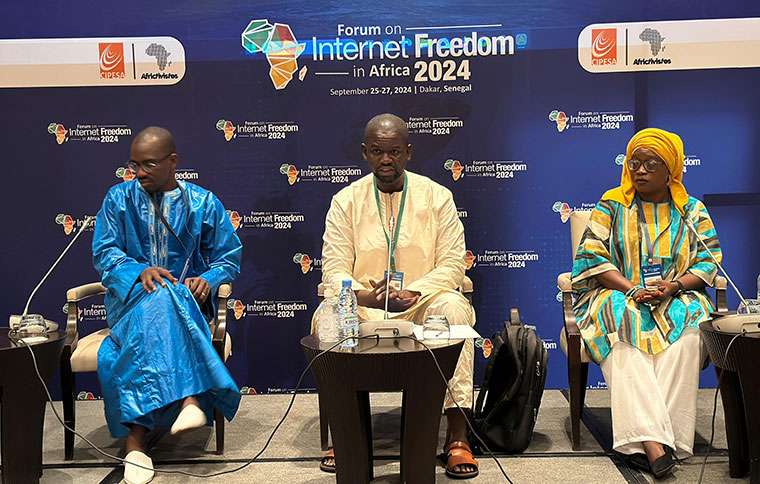
Launched in Dakar, Senegal, at the 2024 Forum on Internet Freedom in Africa (FIFAfrica) which was co-hosted by CIPESA and AfricTivistes, the report emphasizes how digital repression has become a key tool for authoritarian regimes.
Cheikh Fall, president of AfricTivistes, urged the continent to develop indigenous digital frameworks, saying, “Africa’s greatest challenge today is that it is experiencing the effects of all three industrial revolutions that shaped the world. We must create homegrown technologies and frameworks that address the continent’s unique needs and aspirations.”
INTERNET SHUTDOWNS
The report highlights countries such as Chad, Gabon, Uganda, and Zimbabwe, where internet disruptions and shutdowns have been used during elections and protests to stifle political opposition and control information. Since 2022, over 18 election-related internet disruptions have been recorded across Africa, a clear sign of growing digital authoritarianism. Rather than embracing transparency, these regimes are using technology to erode democratic governance.
Internet censorship, surveillance, and repressive laws are also key tactics used to weaken civic participation. Countries like Ethiopia, Mozambique, and Mali have engaged in targeted surveillance of political opponents and human rights defenders. The result is an environment where citizens fear participating in democratic processes, fearing reprisal and distrusting government institutions.
For example, Uganda has blocked Facebook since 2021 after President Yoweri Museveni accused the platform of siding with the opposition by deactivating accounts linked to his ruling National Resistance Movement (NRM). Facebook accused NRM of creating ‘fake accounts’ to manipulate the electoral process. This growing trend toward digital suppression makes it increasingly difficult for citizens to engage politically.
In 2023 alone, African governments imposed 283 internet shutdowns in 39 countries – a 41 per cent increase from 201 shutdowns in 2022. Ten of these shutdowns specifically targeted social media platforms like Facebook and X (formerly Twitter), which were once seen as tools for youth empowerment.
Instead, these platforms have become victims of repression, preventing young people from using them to effect political change. Despite 2024 being a pivotal year for African democracy, with over 20 countries heading to the polls, authoritarian regimes are doubling down on their use of technology to suppress opposition and manipulate electoral outcomes. This year could further erode trust in electoral transparency as governments increasingly seize control of internet governance.
Internet shutdowns have far-reaching consequences beyond politics. In conflict zones like Gaza, Myanmar, and Sudan, shutdowns disrupt essential services, including humanitarian aid. African countries are no exception. For instance, Algeria lost an estimated $70.4 million due to internet disruptions between 2019 and 2024.
Ugandan advocate Michael Aboneka warns that the continent may see even more internet shutdowns as regimes aim to control narratives during elections and protests. The economic and social costs are profound – undermining public trust in election outcomes and exacerbating political tensions.
Disinformation has also emerged as a key tactic to manipulate African elections. The CIPESA report highlights the increasing use of artificial intelligence (AI) to create fake content that misleads voters. Politicians are weaponizing AI to discredit electoral bodies and deepen political polarization.
In Uganda, for example, AI-generated disinformation has fueled the power struggles between prominent figures such as General Muhoozi Kainerugaba and President Museveni’s son-in-law, Odrek Rwabwogo. This not only confuses voters but also distorts the political landscape, making it difficult for citizens to make informed choices.
The proliferation of disinformation diminishes trust in democratic institutions, and AI’s ability to amplify these false narratives poses a growing challenge to fair elections.
While technology has transformed some aspects of African elections, the digital divide remains a significant barrier. High data costs, poor infrastructure, and limited digital literacy exclude large portions of the population, particularly rural communities, women, and people with disabilities.
Countries like Zimbabwe, South Sudan, and the Central African Republic have some of the most expensive mobile data prices globally, preventing many citizens from accessing crucial information and participating in online civic spaces. This deepens political inequalities and prevents marginalized groups from fully engaging in the democratic process.