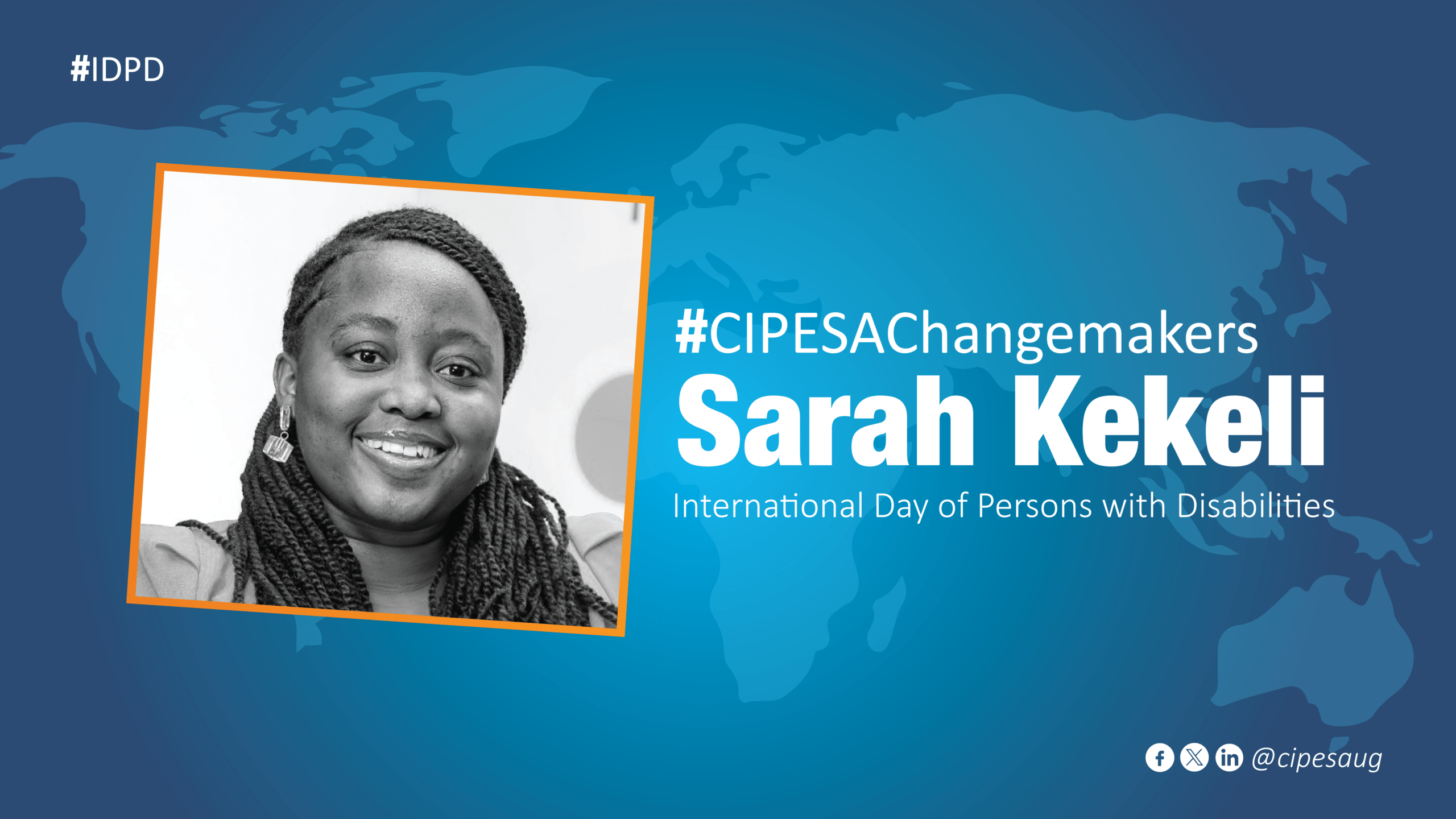
Who is Sarah Kekeli Akunor?
I am a young woman with visual impairment. I recently graduated from the University of Ghana with a Bachelor’s degree in Political Science and Philosophy. I am a member of the Mastercard Foundation’s Alumni Network Committee, serving as the lead for Inclusion, Gender, and Safeguard. I am also a Disability Inclusion Facilitator under the Mastercard Foundation’s ‘We Can Work’ programme. I also serve as an interim executive for the newly inaugurated Ghana Youth Federation, where I hold the position of Secretary for Gender Equality and Social Inclusion. I am a passionate advocate for disability rights and digital rights, and inclusion. I have a certificate in Disability Leadership in Internet Governance and Digital Rights from the Internet Society (ISOC).
Before I lost my sight, I had a very limited understanding of disability or its challenges. I have a genetic eye condition called Retinitis Pigmentosa, which was only diagnosed when I was 24 years old. I was born with the condition, but I could see with the help of glasses until the condition deteriorated through my teenage years and early twenties. After I lost my sight, I couldn’t read Braille, so I needed to learn how to use a computer. I noticed that leveraging technology made it possible for me to live a more fulfilling life. This served as a basis for my strong passion for advocating for digital rights, not just for myself, but for the countless persons with disabilities who are out there. Through my experience, I witnessed the transformative impact of Assistive Technology in the lives of persons with disabilities.
In Africa, there is inaccessibility everywhere. I noticed that persons with disabilities are left behind even in the digital space. I started by advocating in my own space, such as discussing disability inclusion with family and friends. I entered the digital space by volunteering at the Ghana Blind Union Assistive Technology lab and with Inclusive Tech Group. Now that I have a platform, my goal is to see the rights of persons with disabilities mainstreamed in all spaces, especially online, as online spaces have become increasingly central to how the world functions.
Across Africa, there are several innovators creating brilliant solutions for various categories of persons with disabilities. In Ghana, for example, a young innovator has developed an app called DeafCanTalk, which enables deaf people to communicate through sign language. The app converts the signs into written or spoken text for the other party to understand.
Other initiatives in Ghana, such as the “Disability Conclusion Hackathon”, organised by the Inclusive Tech Group, make it possible for young innovators without disabilities to co-design and co-create disability-relevant tech solutions together with their counterparts with disabilities. One organisation I belong to, The Phoenix Unity Club, is also championing the accessibility of apps and websites in Ghana by advocating strongly for the development of Ghana’s own ‘Web Content Accessibility Policy.’
In furtherance of these goals, I have held positive engagements with the authorities at the National Information Technology Agency and the Ghana Investment Fund for Electronic Communication. Across Africa, InABLE is doing great work promoting digital rights through its annual Inclusive Africa Conference. The Collaboration of ICT Policy for East and Southern Africa (CIPESA), with its Forum on Internet Freedom in Africa, the Internet Society, the Internet Governance Forum, and Paradigm Initiative, with its Digital Rights and Inclusion Forum (DRIF), are all actively promoting the realisation of digital rights for persons with disability across Africa.
The deployment of various apps, technologies, and AI platforms in Africa is definitely worth commending. However, there is a real risk of widening the digital divide if these technologies and AI platforms are not accessible to persons with disability, either because they are too expensive or poorly designed without consideration for accessibility needs. There are also real risks of data protection issues, particularly for persons with disabilities and those with little or no education.
To stay ahead of the curve, policymakers need to ensure that new technologies in Africa are only deployed for public use after they have been proven to be compliant with diverse accessibility needs. Again, innovators must be encouraged to co-create with persons with disabilities. And finally, data protection laws must be strengthened and strictly enforced.
There are several things that we should be doing. First, we need to make sure that we build meaningful collaborations and partnerships among all stakeholders across policy, civil society, digital rights activists, government, and persons with disabilities from different parts of Africa, and foster a spirit of true friendship and openness in discussing the common problems of access to assistive devices, online accessibility, data privacy breaches, etc., and develop solutions that are relevant to our local African context.
Secondly, it is important to promote co-creation and co-design of all innovations in Africa with persons with disabilities. Persons with disabilities, women, youth, and older persons must be involved in the innovation process right from the ideation stage. Once these innovations are complete, these groups of people must be consulted in testing the products before they are released to the market.
In addition, as digital rights advocates, we must not only make passionate arguments for inclusion but also insist that there is a business case for including persons with disabilities and other vulnerable groups in the development of new technologies. After all, there are countless funding and grant opportunities that make accessibility a non-negotiable requirement before these funds are granted. In short, disability inclusion is not a matter of charity but a long-term business strategy.