
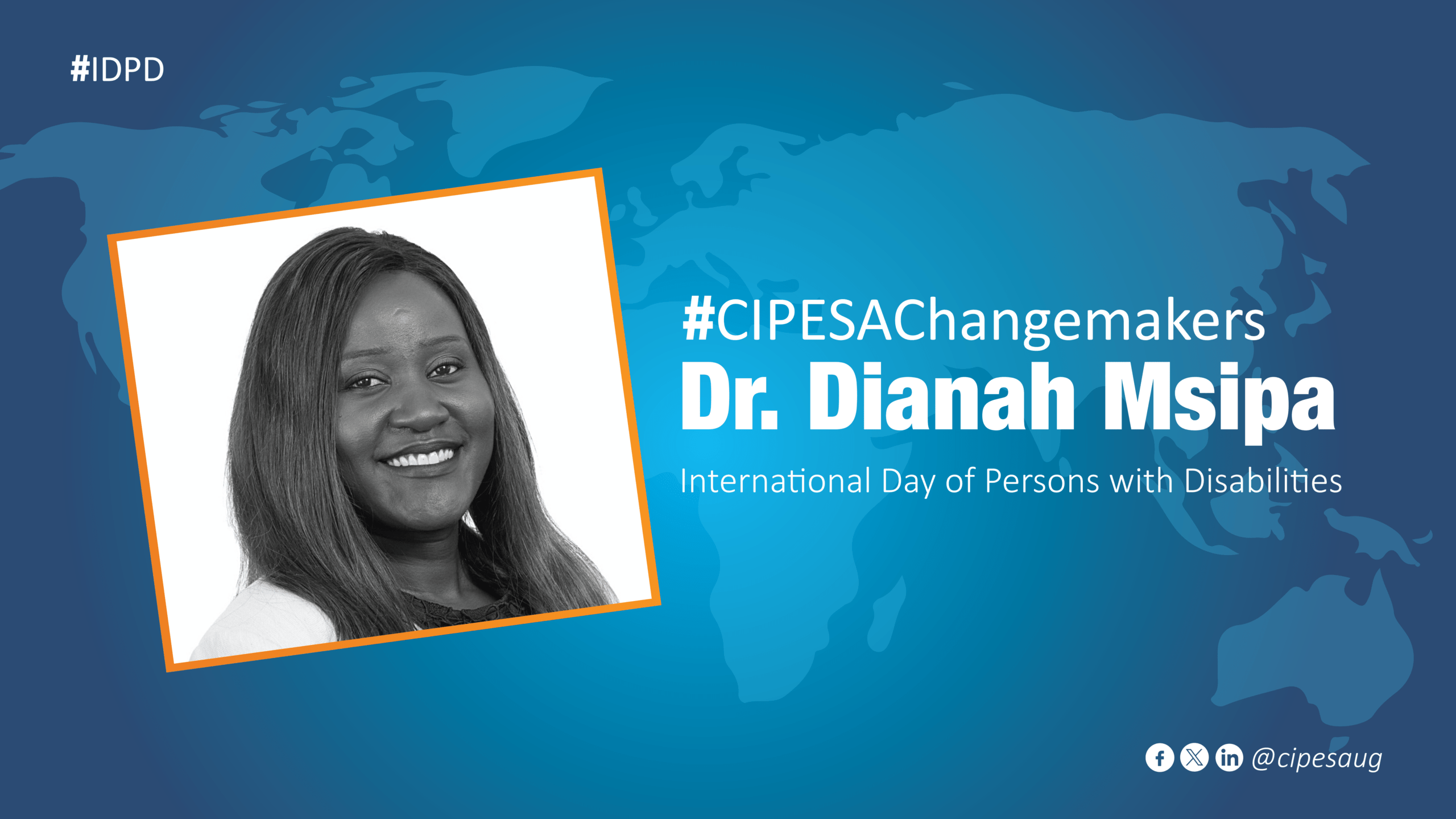
Who is Dianah Msipa?
I am an International Human Rights Lawyer specialising in Disability Rights Law and Policy in Africa. I am currently the Programme Manager of the Disability Rights Unit at the Centre for Human Rights in the Faculty of Law at the University of Pretoria, where I contribute to promoting the rights of persons with disabilities in Africa through human rights education, advocacy, capacity strengthening, and research. I am also a postdoctoral fellow at the same institution, conducting research on the sexual and reproductive rights of women with disabilities in Africa. I am an author with numerous publications in peer-reviewed journals and books, and I serve as an Assistant Editor for the academic journal, the African Disability Rights Yearbook. I am also an educator teaching African disability rights protection at the post-graduate level at the Centre for Human Rights, University of Pretoria.
I first became interested in disability rights while working as a Criminal Prosecutor. One of the cases I was prosecuting involved a young woman with intellectual disability who had been raped. I found it difficult to lead evidence from this complainant because I had no knowledge about how to provide accommodations to persons with disabilities in the criminal justice system. That is what motivated me to learn more about the rights of persons with disabilities. I then pursued a Master’s degree at McGill University in Canada, where I conducted research on the barriers that prevent persons with disabilities from accessing justice on an equal basis with others and the various accommodations that can be provided to enable their effective participation. After completing my Master’s degree, I left prosecution and began working in the disability rights sector, first as a human rights researcher with Inclusion International, and then as a programme officer and subsequently a programme manager in the Disability Rights Unit at the Centre for Human Rights. I further specialised in Disability Rights in Africa through my Doctor of Laws degree, which I completed at the Centre for Human Rights. Although access to justice was my entry point into disability rights, I later became interested in other areas of disability rights, including digital rights. Digital inclusion is not simply a right in and of itself, but it is also necessary for the enjoyment of numerous other rights, including education and access to justice. It is therefore integral for the societal inclusion of persons with disabilities and an important aspect of the work that I do.
A sign of progress in the recognition of digital rights for persons with disabilities is the increased attention being paid to inclusive digital technologies in recent years, particularly at the regional level in law and policy. The inclusion of digital rights in the Protocol to the African Charter on Human and Peoples’ Rights on the Rights of Persons with Disabilities in Africa (African Disability Protocol) is indicative of progress towards the digital inclusion of persons with disabilities on the continent. Article 15 on accessibility and Article 24 on access to information are examples of rights that require the digital inclusion of persons with disabilities. By incorporating digital rights into the African Disability Protocol, the African Union has effectively established an enabling legal framework for promoting the digital rights of persons with disabilities. In conjunction with policy frameworks such as the Economic Commission for West Africa (ECOWAS) ICT Accessibility Policy, the African Disability Protocol emphasises the importance of digital inclusion for persons with disabilities.
Poverty remains a pressing challenge to the realisation of digital rights by persons with disabilities in Africa. Research indicates that persons with disabilities are disproportionately represented amongst the poor due to a lack of opportunities to access education and employment. Financial barriers make it difficult for persons with disabilities to have access to smart devices, internet connectivity and digital skills training. This is a significant barrier to their digital inclusion on the continent. Moreover, the rapid pace at which technology, including Artificial Intelligence, is developing without much attention being paid to its impact on the rights of persons with disabilities, creates an additional threat that needs to be addressed.
To address some of these challenges, States and other relevant stakeholders need to ensure that persons with disabilities receive digital skills training and are provided with accessible devices to participate in the digital world. Accessibility assessments and audits of new software and AI need to be conducted to determine the level to which they are inclusive and to interrogate how they can be made more accessible. Crucially, persons with disabilities need to be meaningfully involved in the development, implementation and evaluation of programmes seeking to achieve digital inclusion.