Towards the end of 2014, Uganda’s government through the National Information Technology Authority (NITA-U), Ministry of Information Communication and Technology (MoICT) and the Ministry of Justice and Constitutional Affairs (MOJCA) issued a draft Data Protection and Privacy Bill for public comment. The Bill seeks to protect the privacy of the individual and personal data by regulating the collection and processing of personal information. It provides for the rights of persons whose data is collected and the obligations of data collectors and data processors; and regulates the use or disclosure of personal information.
The Collaboration on International ICT Policy in East and Southern Africa (CIPESA) welcomes the move by the Uganda Government, however, following an analysis of the Bill, we identified some areas of concern and gaps that need to be addressed. We have assembled our comments as part of the CIPESA ICT briefing series and have also submitted official comments to the government as part of the public comments phase.
Read more on our Reflections on Uganda’s Draft Data Protection and Privacy Bill, 2014 in the CIPESA ICT Briefing series and see our Formal Comments Submitted for consideration.
Call for Partnerships: Technology/Innovation Institutions
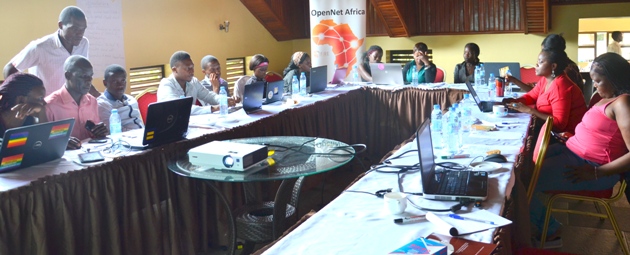
The Collaboration on International ICT Policy in East and Southern Africa (CIPESA) is seeking partnerships with local tech communities in Kenya, Uganda, Tanzania, Rwanda, Burundi and Ethiopia to generate an empirical understanding in an [East] African context, of online safety and security technologies for ICT/internet users in the region. Each tech institution will work with CIPESA to bring together various competencies and networks to address the various internet freedoms challenges faced in the region.
The partnerships are in the context of the OpenNet Africa initiative (www.opennetafrica.org) which is aimed at promoting internet freedom in the region through digital security and safety skills development, creating awareness on the status of online freedoms, building a network of the region’s actors in this domain, and advocacy to engender more progressive digital rights regimes. OpenNet Africa is supported by the Humanist Institute for Co-operation with Developing Countries (Hivos), the Open Technology Fund (OTF) and the Citizen Lab at the University of Toronto.
Closing date for applications: Friday January 9, 2015
Further details on the scope, eligibility and how to apply are available here.
Vodafone Reveals Government Requests for Subscriber Information
By Ashnah Kalemera & Juliet N. Nanfuka
The true extent of governments’ surveillance and monitoring of citizens’ communications across the world remains largely unknown. This is despite legislative rights provisions for privacy and increased calls for data protection of citizens in their communications.
Last month, Vodafone became the first telecomuminications company to reveal the extent of government surveillance of its subscribers. In its Law Enforcement Disclosure Report, the company revealed that governments in some of the 29 countries in which it operates – including in Africa – are requesting its subscribers’ data sometimes without warrants. In addition, government agencies also listen in on subscribers’ conversations and monitor their whereabouts through wires connected to the Vodafone networks.
However, the British company and world’s second largest mobile phone operator could not disclose the full extent of surveillance in nine of the countries it operates in due to legal provisions prohibiting the disclosure of information relating to government wiretapping and interception of communications.
Vodafone operates in eight African countries, namely the Democratic Republic of Congo, South Africa, Lesotho, Tanzania, Mozambique (in all of which it operates as Vodacom), Kenya (as Safaricom), Egypt and Ghana. In 2013, the company received around 100,000 requests from African governments for metadata such as phone numbers, addresses, device locations and times of calls and text messages.
The report cites the Tanzanian government as having made the highest number of requests – 98, 765. Authorities in Congo made 436 requests while in Lesotho 488 requests, were made.
Due to laws restricting the disclosure of information related to law enforcement, Vodafone was unable to publish statistics on the other five African states where it has operations.
According to the report, in Egypt, local criminal laws prohibit the disclosure of national security-related information and other matters related to law enforcement. In Ghana, unclear legal restrictions on access to, transfer and disclosure of electronic records meant that Vodafone was unable to publish information on the demands made. “We have asked the [Ghana] authorities for guidance: however, we have not yet received a reply.” said the report.
Vodafone was also unable to publish statistics related to the Kenyan government’s request for individual communications data due to unclear provisions in the Official Secrets Act and the National Intelligence Services Act. Unclear legal provisions in Mozambique meant that the same statistics could not be published.
Similarly, South Africa’s Regulation on Interception of Communication and Provision of Communication-related Information Act prohibits the disclosure of the fact that any demand for lawful interception or communications data has been issued under the Act. Accordingly, Vodafone did not publish any statistics for the country.
The legal provisions preventing Vodafone from indicating the exact number of government requests for its subscriber information, instances of lawful interceptions or even any indication of interception capabilities, is telling of the degree to which some governments will go to hide the extent of their surveillance.
In the report, Vodafone disclosed that it had not implemented the technical requirements necessary to enable lawful interception in Congo, Kenya, Lesotho, Ghana, Tanzania and Mozambique and as such had not received any demands from those authorities for lawful interception assistance.
Vodafone Communication Interception and Data Requests in Africa
(Source: Country-by-country disclosure of law enforcement assistance demands Report)
| Country | Communications meta data requests | Implementation of technical capacity for lawful interception |
| Democratic Republic of Congo | 436 | None |
| Egypt | Disclosure of information is unlawful | |
| Ghana | Disclosure of information is unlawful | None |
| Kenya | Disclosure of information is unlawful | None |
| Lesotho | 488 | None |
| Mozambique | Disclosure of information is unlawful | None |
| South Africa | Disclosure of information is unlawful | |
| Tanzania | 98,765 | None |
Vodafone reported that similar to Egypt and South Africa, the disclosure of information related to interception of communications and government data requests was unlawful in India, Qatar, Romania and Turkey.
In Europe, Italy made the highest metadata requests to the company – a total of 605,601. This was followed by Hungary (75,938), Spain (48,679) and Portugal (28,145). The governments of Albania, Ireland and Malta made 7,667, 4,124 and 3,773 metadata requests respectively. Two requests were received from Belgium and three from France. From the South Pacific, 760 metadata requests were received from Fiji.
The report states that Australia, Germany, Greece, the Netherlands, New Zealand and the United Kingdom were the only countries whose authorities published statistics on interception of communications and requests for communications metadata.
Vodafone’s report brings to the fore the intermediary liability challenge faced by many other telecommunications service providers across the world. The company published its statistics in an effort to urge all states to publish annual data on the surveillance and monitoring of citizens via digital technologies. Indeed, a similar recommendation was made by a research report published in May 2014 on the State of Internet Freedoms in East Africa. The report revealed the use of legal and extra-legal means to snoop on citizens under the guise of national security in the six countries studied – Burundi, Ethiopia, Kenya, Rwanda, Tanzania and Uganda.
While Vodafone has broken its silence on this highly secretive issue, it remains to be seen whether other service providers will follow suit or whether governments will change their legal provisions to allow for increased transparency in surveillance.
Launch of the Internet Freedoms in East Africa 2014 Report
Today, the Collaboration on International ICT Policy in East and Southern Africa (CIPESA) launches The State of Internet Freedoms in East Africa research report which is an Investigation into the policies and practices defining internet freedom in East Africa.
Thought leaders in the East African ICT industry have gathered in Kampala, Uganda for the launch of this pivotal report.
The report presents the findings of an exploratory study on the state of internet freedoms in Burundi, Ethiopia, Kenya, Rwanda, Tanzania and Uganda. The research reviewed policy developments and actions related to internet freedoms over the period 2010 to April 2014.
As the day progresses, emerging themes will be explored by the attendees who will share their early thoughts on the findings as well as explore issues related to internet freedom in East Africa.
The report can be found here.
See the day’s programme here.
New Laws in Uganda Restrict Citizens’ Rights
By Juliet Nanfuka
Recently introduced laws and regulations in Uganda have caused a stir both within the country and internationally for restricting citizens’ rights to freedom of expression on the internet and offline.
The most contentious of these are the Anti-Pornography Act 2014, the Public Order Management Act 2013, the Anti-Homosexuality Act 2014, the 2014 Press and Journalist regulations and the Non Government Organisation (NGO) Amendment bill. They are criticised for creating unwarranted restrictions to liberties granted by the country’s 1995 constitution.
As a result, the space in which civil society, the media and citizens can enjoy constitutionally granted rights to freedom of expression, opinion, assembly, and information is steadily shrinking.
In an April 2014 brief, CIPESA takes a look at how the recently enacted laws and proposed amendments impact on citizens’ rights, including internet rights, as well as on the work of human rights defenders. Read the full brief here.