As internet usage continues to grow in Africa, so does the interest by governments to monitor users’ online activities. This has led to a clash between internet rights promoters and governments in some African countries.
On February 12–13, 2014, participants from several African civil society organisations involved in promoting human rights and internet rights convened in Johannesburg, South Africa to draft an African Declaration on Internet Rights and Freedoms. The meeting was organised by the Association for Progressive Communications (APC) and Global Partners Digital in collaboration with the Media Rights Agenda, Media Foundation for West Africa and the Kenya Human Rights Commission.
Many countries justify their tough stance on internet freedom as necessary to fight cybercrime, promote peace and maintain national security. Whereas some of these policies and practices have been adopted by authoritarian regimes to retain power, others were in response to national crisis contexts such as hate speech and terrorism. Ultimately, the measures have often had chilling effects on access to information, freedom of expression, privacy and data protection.
Participants in this meeting called for the promotion of an open, free and accessible internet. Issues identified as the most crucial and still hindering internet growth in Africa that need immediate action were: improving access to internet including the development and promotion of localised multi-lingual content; addressing internet infrastructure obstacles; capacity building for users; and the need to create a balance between freedom of expression and privacy of users.
Others identified were data protection, addressing gender inequalities and gender-based violence against women online, and adopting supportive ICT policies that promote freedom of expression online and equitable access to information.
Due to increased internet freedom violation incidents coupled with regressive policies being made in many countries, the need for a well-defined Internet Intermediary Liability (ILL) regime has also become increasingly apparent. Another meeting held on February 10-11, 2014 organised by the APC with support from Google Africa discussed the responsibility that may be placed on intermediaries in implementing monitoring and control mechanisms laid down by the laws.
At the regional level, there are legal and regulatory frameworks like the Africa Charter on Declaration of Principles on Freedom of Expression in Africa, which provide limited protection for internet rights and the liability of internet intermediaries. It was noted that such frameworks could act as building blocks for individual countries to draw up best practices on ILL regimes.
There was consensus that such existing frameworks should be the basis for adopting a general guide with definitions of terms on Internet intermediary liability. This guide would act as central referencing document on which individual countries would base their national IIL regimes.
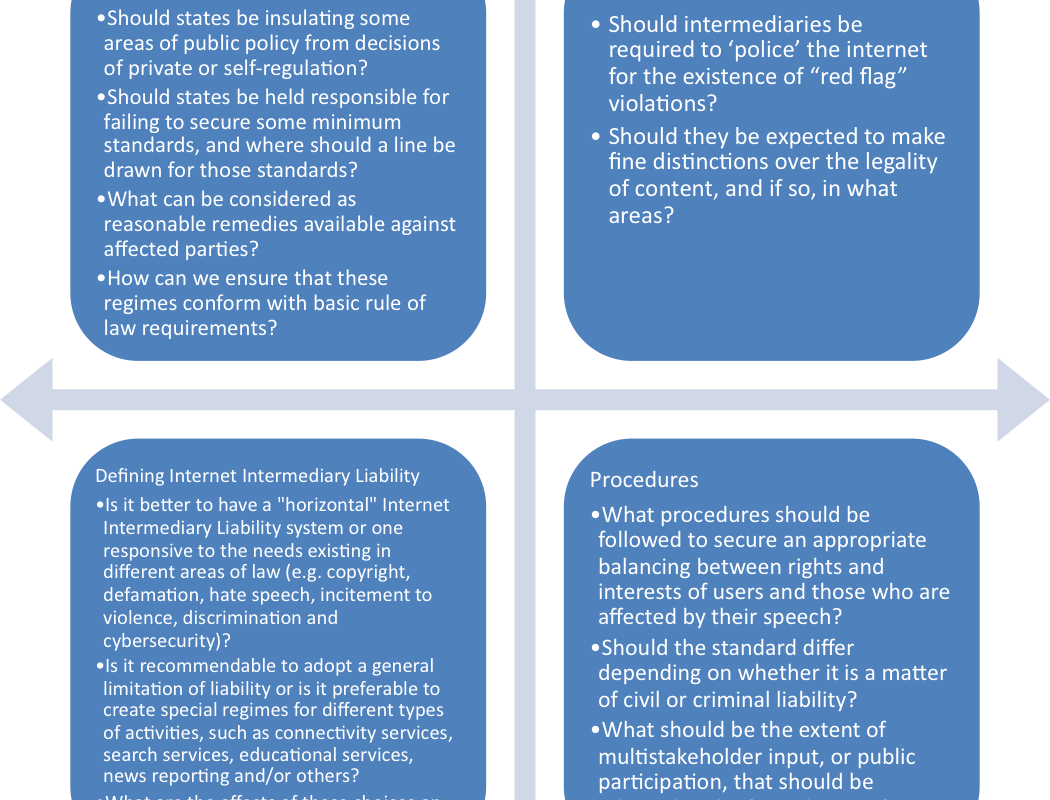
During the discussions, participants charted their thoughts on a best practice guide for an IIL regime for Africa by asking the below questions:

While responding to these questions, participants recognised that intermediaries can play a crucial role in promoting Internet freedoms in Africa.
Meanwhile, the meeting also reviewed recent policy and practice developments in Uganda, Kenya, South Africa and Nigeria since the 2011 Intermediary Liability in Africa research. It identified a need to increase awareness among different stakeholder groups of the importance of clear regulatory frameworks for intermediary liability to secure rights on the internet; and for stronger collaboration to advocate for best practice internet intermediary regulatory measures in Africa.
The outcomes of both these meetings will form the basis for the draft civil society Africa Declaration on Internet Rights and Freedoms, which will be launched at the ninth global Internet Governance Forum (IGF) in Istanbul, Turkey September 2-5, 2014. The declaration will be available for public input throughout the period leading up to IGF 2014.
Internet Rights in Uganda: Challenges and Prospects Workshop Report
The Collaboration on International ICT Policy in East and Southern Africa (CIPESA, www.cipesa.org) in conjunction with Unwanted Witness Uganda (www.unwantedwitness.or.ug) on November 28, 2013 organised a workshop on promoting internet rights in Uganda. The workshop aimed to create awareness among civil society, netizens, and the media in Uganda on how policy and practice affect internet freedoms in the country. The workshop also sought to draw up strategies for network building and advocacy to promote and protect online freedoms in Uganda.
Download the workshop report here.
CIPESA, Partners to Host Uganda Internet Governance Forum 2013
The Collaboration on International ICT Policy in East and Southern Africa (CIPESA) in partnership with the Internet Society Chapter Uganda and the ICT Association of Uganda (ICTAU) will host the Uganda Internet Governance Forum (UIGF) at the Hive Colab, Kamyokya on September 18, 2013.
The one-day Forum, whose theme is “Harnessing Internet Development in Uganda: Connecting the last mile”, is a multi-stakeholder event that involves representatives from government, civil society, academia, private sector entities and individuals interested in Internet Governance (IG) issues.
The objectives of this Forum are to discuss obstacles to internet access in Uganda, establish the key current internet governance issues relevant to the country, and build consensus on national and regional positions around IG issues. The national forum will also discuss the outcomes from the regional East Africa Internet Governance Forum held in Burundi last month.
Since its inauguration in 2006, the UIGF has continued to discuss and address internet policy issues in Uganda and East Africa. The proceedings of this year’s Forum will also be presented at the Second African Internet Governance Forum to be held in Nairobi September 24-26, 2013 and the global Internet Governance Forum in Bali, Indonesia October 22-25, 2013.
Tentative Programme
| Time | Activity | Speaker/moderator |
| 08:00am – 08:30am | Arrival and registration of participants | ISOC Uganda |
| 08:30am – 08.45am | Welcome Remarks | Lillian Nalwoga |
| 08:45am – 09:00am | Keynote Address | Dr. David Turahi, Director for Information Technology and Information Management Services – Ministry of ICT] |
| 09:00am – 09:30am | Presentation: Online discussions report | Daniel Nanghaka (ISOC Uganda) |
| 09:30am – 10:00am | Q&A session | Sarah Kiden (ISOC Uganda) |
| 10:00 am – 10:15am |
Morning break |
|
| 10:15am – 11:15am | Panel discussion (15 mins each): – Achieving affordable internet access in Uganda – infrastructure and affordability; what have we achieved so far and how can we utilise the existing infrastructure | Mr. Bob Lyazi, Director RCDF – UCC (TBD)Mr. Mike Barnard, Director – Uganda Internet Exchange Point (UIXP)Mr. Julius Torach, Director of egovernment, NITA – UJoseph Munuulo, Systems Administrator – Uganda Registration Services Bureau. Hari Kurup – Roke Telecom |
| 11:15 am – 11:45am | Q&A session and discussion | Sarah Kiden |
| 11:45am – 12:45pm | Panel Discussion (15 mins each): Online freedoms – Privacy, data protection, surveillance and censorship: what needs to be balanced? | Mr. Peter Kahiigi, Director Information Security – NITA – UMs. Ashnah Kalemera, OpenNet Africa Initiative.Mr. Peter G. Mwesige, Director Africa Center for Media Excellence. |
| 12:45pm – 01:15pm | Q&A session and discussion | Mr. Albert Mucunguzi – ICTAU |
| 01:15pm – 02:00pm |
Way forward, closure and Lunch |
Lillian Nalwoga |
See past reports from the Uganda IGF here: 2011 Forum Report, 2011 Online Discussions and 2012 Forum Report.
See past reports from the East Africa IGF here:
Improving eGovernment Initiatives: A Global Concern
By Lillian Nalwoga
At the end of May, Finland hosted an international conference to discuss ways of improving eGovernment programmes. In particular, the conference attended by Government Chief Information Officers (CIO) and other officials from across the world reviewed the role of leadership in e-government development.
While noting immense advancements in eGovernment, particularly in the European Union (EU), delegates at the ‘Leading the way in eGovernment development’ conference highlighted numerous factors hampering effective implementation of eGovernment strategies both in developed and developing countries.
According to a May 28, 2013 European Commission press release (see: ‘eGovernment improving but citizens ask for more), almost half (46%) of EU citizens go online to look for a job, use the public library, file a tax return, register a birth, apply for a passport or use other eGovernment services. In addition, 80% indicated that using online public services saves them time, while 76% like the flexibility of the services and 62% said they save money when they use e-services.
Despite these positives, European governments still believe that public perception of governments and public institutions is still low and likely to worsen, stated the press release. Factors cited as constraining eGovernment included: inadequate capacity by some CIOs to implement eGovernment strategies, inadequate trust citizens have in some eGovernment systems, ineffective technological systems, inadequate open, transparent and collaborative efforts by governments, and limited availability of cross-border eGovernment services. According to the UN eGovernment survey 2012, for Africa and other developing regions, the above realities, in addition to the lack of e-infrastructure, mean that eGovernment remains at an elementary level.
Paul Timmers, Director of the Sustainable and Secure Society Directorate, DG Connect at the European Commission, noted that these challenges can be solved by governments’ smart use of new Information Communication Technologies (ICTs), adopting new processes and skills sets. In agreement, Ms. Henna Virkkunen, Finland’s Public Administration Minister, noted that ICT is a key element of every government task and new ways of using latest technology like cloud computing must be explored. Nonetheless, she cautioned that ICT should not be an end itself. Governments need to find ways to use inclusive technology in a manner that benefits them and their citizens, as citizens are demanding for better, user friendly and practical e-services.
In addition, governments also need to include third party users in the design, development and delivery of e-government services such as open data. Mr. Timmers remarked that the “market value of Open Public Data” in EU countries alone is estimated at 140 billion Euros. According to the Open Government Partnership, the market value of Open data can be realised in three main channels – business innovation (making scientific research works more accessible hence driving innovation capacity in fields such as pharmaceutics and renewables); business creation (creating a new market as business can build new innovative applications and eServices based government data); and business efficiency (business and public bodies contributing to ‘smart’ growth by becoming more efficient in tackling citizens’ and customers’ needs by gaining precise and completer insight into citizens’ and customers’ preferences and needs).
But how do governments build positive perceptions of their citizens toward eGovernment? Ian Goldin, Director of the Oxford Martin School and Professor of Globalisation and Development at Oxford University, stated that in order to achieve this, governments have to build trust in the systems; address user privacy concerns; play a stronger role in regulatory frameworks; involve youth and the elderly in digital government and invest in latest technologies as older ones become difficult to work with.
Besides advancements in eGovernment, conference delegates discussed global related concerns such as openness and freedom on the internet as well as data protection. They called for immediate government attention to protecting citizens’ rights while considering the opportunities and benefits of private sector companies that provide online services in the “networked” era where multi-national players like Google, Facebook, Twitter, Amazon, and Yahoo have their own rules on how to handle customer data.
Further, the conference called for common efforts in capacity building for e-government development; sharing best practices to learn from each other; strengthening ethical behaviour in governments to pave way for a culture of openness and the adoption of political will in practicing openness. Other suggestions included the EU issuing directives to all its member countries to open up public data as well as the UN adopting a global framework on promoting openness.
The conference, which took place on May 28–30, 2013, was organised by the United Nations Department of Economic and Social Affairs (UNDESA) and Finland’s Ministry of Finance in collaboration with the European Commission.
More information about the conference is available here.
Africa Internet Summit Opens Next Week in Zambia
Taking it to the Summit: AFRINIC and AfNOG to host the 1st Africa Internet Summit – AIS’13 – from 9-21 June 2013 in Lusaka, Zambia
The much-awaited Africa Internet Summit (AIS) will be held in Lusaka, Zambia, on 9-21 June. The meeting will be held at the InterContinental Hotel in Lusaka, Zambia. The focus this year will be the role and impact of the Internet in African development. The brainchild of AFRINIC, the Regional Internet Registry for Africa, and the African Network Operators’ Group (AfNOG), the Africa Internet Summit is the premier multi-stakeholder event combining conference, training and networking for the Internet industry. The annual summit attracts internationally renowned speakers to share knowledge and experiences on technology developments, changes, uses and effects. Experts from different sectors, both public and private, ICT Industry leaders and technical experts including Internet Service Providers (ISP), government, regulators, academia, business, civil society, and interested groups, among others are expected to attend this major event. It is a great opportunity for networking among peers and businesses.
The AIS addresses the current and future needs of operators from the ICT industry. It is open to members and entrepreneurs in ICT, the business community and civil society. The AIS is focused on popular and emerging ICT industries such as mobile telephony and its impact around the world. It is the ideal platform for networking and keeping abreast with cyber security. “While the Internet will remain at the centre of the discussions, workshops and various meetings, the event will also deal with other important matters relating to emerging technologies, particularly mobile telephony, their use, and how they can contribute to both social and economic development in Africa. The forum thus aims at meeting the ever-changing expectations of the ICT Industry and goes beyond core IP engineering to integrate the real world use and impact of IP technologies. The AIS includes sessions that cover business and technical aspects of the Internet: Policy, Content and Names, Internet Numbers, Research, Infrastructure, Capacity building, and Security” says Adiel Akplogan, the CEO of AFRINIC.
Please contact Mrs Vymala Thuron [email protected] if you require any more information or have any questions.
For more information on the Summit please visit our websites: http://www.internetsummitafrica.org/