CIPESA and OpenNet Africa Join Public Call Against  Internet Shutdown in Zimbabwe

By Juliet Nanfuka |
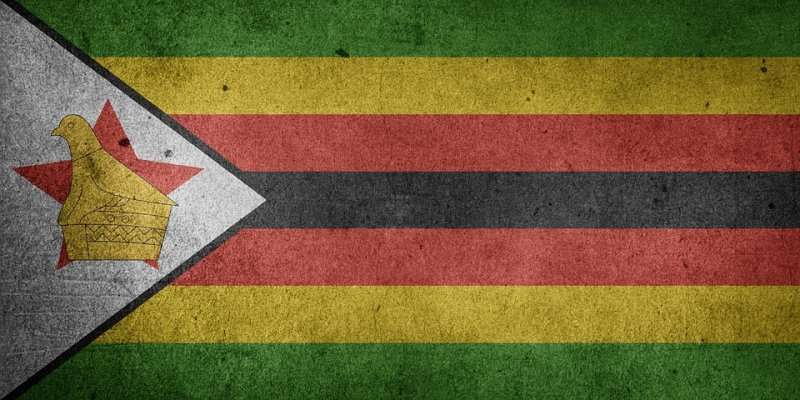
Zimbabwe has experienced a shutdown of social media platforms and major websites as of January 15, 2019 following public protests against a 150% increase in fuel prices. The protests have resulted in the death of at least eight people and arrest of up to 200 others. The disruptions to online communications were reported on social media and also confirmed by network measurements conducted by Netblocks.


The Collaboration on International ICT Policy for East and Southern Africa (CIPESA) and its internet freedoms initiative OpenNet Africa have joined over 20 civil society organisations in calling for the restoration of internet access in the country. A letter sent to Kazembe Kazembe, the Minister of Information Communication Technology and Cyber Security, implores the government to “ensure the stability and openness of the internet in Zimbabwe.” The letter was delivered as part of the #KeepItOn coalition, which represents more than 175 organisations in 60 countries.
As at time of writing, no statement on the shut down had been released by the government, telecommunications companies, or the Postal and Telecommunications Regulatory Authority of Zimbabwe (POTRAZ).
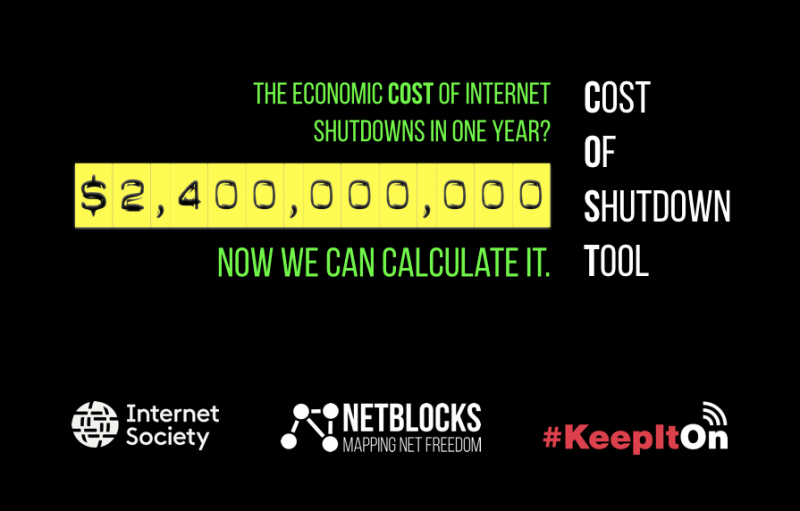
The shutdown is doing little to alleviate the economic crisis in Zimbabwe. Projections show that the country can lose at least USD 5.7 million per day in direct economic costs, according to estimates using the COST tool by NetBlocks and the Internet Society. The tool references a framework for calculating the economic impact of shutdowns developed by CIPESA.
Further, the economic impact of the shutdown is likely to persist far beyond the days in which access is disrupted due to systemic effects which harm efficiency throughout the economy. Internet shutdowns, however short-lived, undermine economic growth, and erode business confidence as global and national perceptions on the offending country are also affected.
The joint letter notes that the UN Human Rights Committee, the official interpreter of the International Covenant on Civil and Political Rights (ICCPR), emphasises in General Comment no. 34 that restrictions on speech online must be strictly necessary and proportionate to achieve a legitimate purpose.  Shutdowns, by contrast, disproportionately impact all users, and unnecessarily restrict access to information and emergency services during crucial moments. Shutdowns are neither necessary to, nor effective at, achieving a legitimate aim, as they often spread confusion and encourage more people to join public demonstrations.
CIPESA research recommends that governments should desist from ordering shutdowns because they have a high economic impact at micro and macro levels, adversely affecting the livelihoods of citizens, undermining the profitability of business enterprises, and reducing the Gross Domestic Product (GDP) and competitiveness of countries that implement them. This is also why CIPESA is part of the global campaign #ForTheWeb aimed to get governments, companies and the public to stand up for a  free, open and fair web that works for everyone, everywhere.
See the joint letter here.

“What Next for Advocacy Against Network Disruptions?

By David Sullivan |

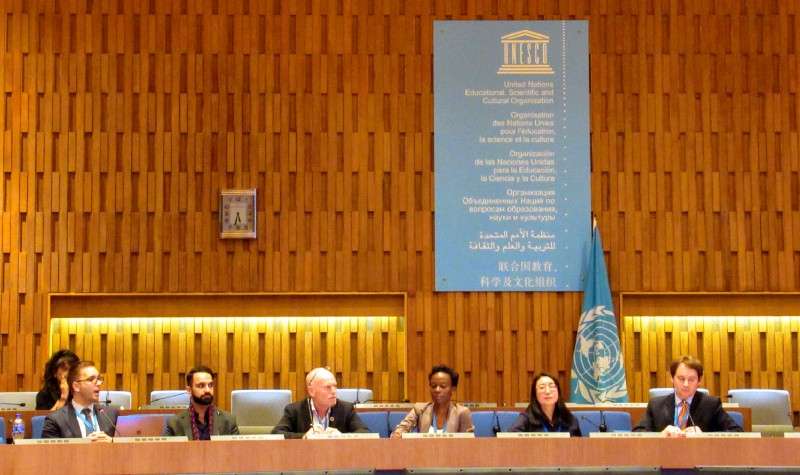
Few events bring together the multitude of actors with a stake in tough technology and human rights challenges quite like the Internet Governance Forum, or IGF. The 2018 edition, held in Paris and hosted by UNESCO, was no exception, with nearly 2,000 delegates from 143 countries. It was a particularly suitable setting for the Global Network Initiative, or GNI, to
gather a panel of experts to reflect on the alarming trend of government-ordered network disruptions.

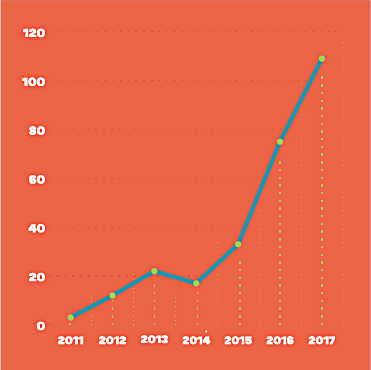
The sharp increase in the number of major government-ordered disruptions from 2015 to 2017. Figure from Jan Rydzak’s report for GNI: “Disconnected: A Human Rights-Based Approach to Network Disruptions.”

Collaborating with the Open Internet for Democracy Initiative, GNI brought members and experts from civil society, the private sector, and international organizations together to consider challenges and opportunities for the movement fighting network disruptions. Session moderator Daniel O’Maley from the Center for International Media Assistance opened the conversation by noting that disruptions are increasing worldwide, affecting both democracies as well as authoritarian countries. With this prompt, the speakers highlighted successful advocacy initiatives and shared their insights into this concerning trend.

Usama Khilji from Pakistani civil society organization Bolo Bhi described how network disruptions have become normalized in many societies, with an increasing expectation that connectivity will not be available around events like public holidays or political protests. He said there is little evidence that the use of network disruptions and shutdowns during sensitive moments is effective at providing security for citizens and stressed the importance of making this point with policymakers.

Providing a company perspective, GNI Board member Patrik Hiselius from Sweden’s Telia Company described tools that help companies contend with “unusual requests” such as disruption orders. Telia has a form they use to assess risks and escalate such requests, ensuring senior company officials are informed and reducing security risks for staff on the ground. He also highlighted GNI’s one-page guide on the negative consequences of shutdowns, a document that arose out of a brainstorming session at the 2016 IGF and which has now been translated into 12 languages.

Ashnah Kalemera from the Collaboration on International ICT Policy in East and Southern Africa, or CIPESA, discussed their work documenting the economic impact of disruptions on the African continent, which was used successfully in advocacy to prevent shutdowns in Ghana and Kenya and to strengthen partnerships with the private sector and technologists.

Representing our hosts at UNESCO, Xianhong Hu described network disruptions as a threat to Internet universality and suggested the indicators they have been developing may be a useful tool for documenting and discouraging such actions.

Lastly, participating remotely from Cameroon and persevering through technical difficulties, entrepreneur and activist Kathleen Ndongmo said that governments who shut down the Internet are not only blocking democracy but also costing their societies millions of dollars in lost business. She urged the audience to collaborate at the regional level to push for the passage of legislation that protects rights and innovation, such as Nigeria’s Digital Rights and Freedom Bill.

The audience contributed to the discussion with probing questions and comments, from how strategic litigation may contribute to the fight against disruptions to a reminder of the significant privacy risks from surveillance in many settings when networks remain on.

The discussion left me reflecting on more than two years of work by GNI to build consensus among our members and with policymakers on this issue. Early on, we faced challenges bridging very different perspectives and postures among human rights NGOs and telecommunications and Internet companies. Through discussion and deliberation, we reached consensus on a common position in 2016. Since then, we have developed tools and conducted research, convened experts and affected communities, and brought the digital rights and technology policy communities into alignment as powerful voices. But network disruptions are blunt instruments that affect a far wider population than just the technology industry. We need to marshal a much broader movement, one including the media, labor unions, and a wider set of sectors, to demonstrate the consequences of government-ordered shutdowns and educate policymakers about alternatives.

In his rousing opening address to the IGF, UN Secretary-General António Gutteres said “we must be more than multistakeholder, we must also be multidisciplinary,” and he went on to “urge your digital discussions to move beyond the so-called ‘usual suspects’.” Following his lead, we need a concerted effort to forge greater and new alliances, between both online and offline communities, if we are to keep free and open networks connected around the globe.

This article was first published on November 29, 2018 on GNI Website.

MLDI to Host a Strategic Digital Rights Litigation Workshop at FIFAfrica18

Announcement |

Litigation has been recognised as a potentially effective tool in removing restrictions on the free flow of information online in countries with repressive internet regimes. Increasingly, some initiatives are seeking to encourage collaboration among different actors in strategic litigation for a free and open internet.

Indeed, various cases in litigation for the respect and realisation of digital rights have recently been recorded in Cameroon, Kenya, Burundi and Gambia, among other countries in Africa.

Yet still, litigation remains under-utilised because of a lack of effective collaboration between different actors: lawyers, activists, academics, technical experts and other members of civil society.

Accordingly, the Forum on Internet Freedom in Africa (FIFAfrica) 2018 will serve as an opportunity for the Media Legal Defense Initiative (MLDI) to build the capacity of internet activists to collaborate across disciplinary silos to more effectively push back against regressive legal frameworks that are not conducive to access and use of the internet in Africa.

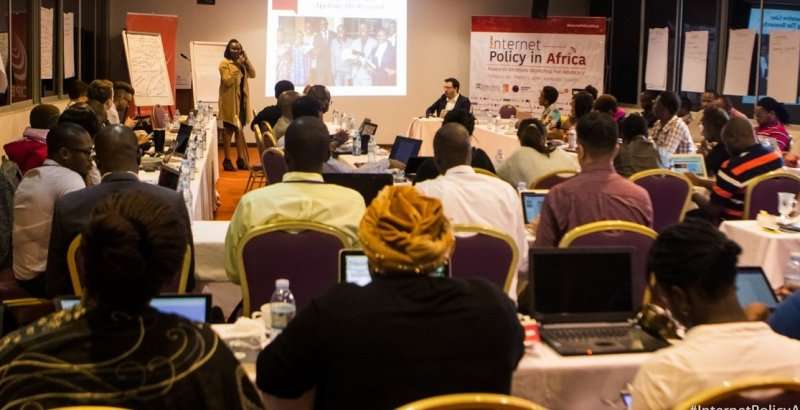
Sessions at the workshop will explore the meaning of strategic litigation and examine relevant comparative and international legal standards drawing on judgments from regional courts. Together with participants, MLDI will analyse the legal issues that can arise in the context of digital rights and freedom of expression through three case studies. Through interactive group sessions, participants will examine how the comparative and international standards can be applied in practical terms.

The workshop, scheduled to take place on September 26, 2018, is aimed at enhancing the strategies for future digital rights and online freedom of expression litigation and advocacy in Africa. It builds on the foundations set in knowledge and skills for collaboration in research for internet policy advocacy as well as regional efforts targeting the legal fraternity in East and West Africa.

The 2018 workshop is the second digital rights litigation training to be held on the sidelines of FIFAfrica. The first workshop was hosted at the 2017 edition of FIFAfrica in Johannesburg, South Africa by the Berkman Klein Centre for Internet and Society at Harvard Law School and MLDI.

NetBlocks and CIPESA to launch COST tool at the Forum on Internet Freedom in Africa

Announcement |
LONDON — Today, the Collaboration on International ICT Policy in East and Southern Africa (CIPESA) and digital rights group NetBlocks are announcing plans for the Africa launch of the Cost of Shutdown Tool – COST, at the Forum on Internet Freedom in Africa (FIFAfrica) 2018, set to take place 26 – 28 September, 2018, in Accra, Ghana.
The tool, developed by NetBlocks in collaboration with the Internet Society and first unveiled at RightsCon Toronto in May 2018, is aimed at automating the task of economic estimation of the impact of internet shutdowns, mobile data blackouts and social media restrictions. It draws inspiration from the new model for calculating the economic impact of shutdowns in sub-Saharan Africa launched by CIPESA last September as well as earlier research by the Brookings Institution.

Lаunching the COST tool at FIFAfrica is vital to support the advocacy and documentation efforts against shutdowns on the continent,” Ashnah Kalemera, Programme Manager, CIPESA, said.
“We hope that the economic loss proven by the tool will support litigation efforts as well strengthen pushbacks which will include the private sector”, she added.
CIPESA and NetBlocks will move forward as official partners. Both organisations are part of the #KeepItOn coalition against internet shutdowns, and support fast, reliable and open access to the Internet and knowledge online as a tenet of democracy, freedom of speech and economic prosperity.
“We are ecstatic to be partnering with CIPESA, one of the leading research and policy think-tanks in the region. Their expertise will ensure our work on Africa is accurate and up-to-date”, Hannah Machlin, Global Advocacy Manager, NetBlocks said.
Their collaboration will provide access to new network measurement techniques that can detect telecommunications blackouts and emerging threats to internet freedom in real-time, aiding the development of sustainable rights-based ICT policies.
CIPESA was established in 2004 under the Catalysing Access to Information and Communications Technology in Africa (CATIA) initiative, which was mainly funded by the UK’s Department for International Development (DfID). CIPESA works to enable policy makers in the region to understand ICT policy issues, and for various stakeholders to use ICT to improve governance and livelihoods. They currently approach their work through four different but interrelated thematic areas, namely promoting online freedomICT for democracy and civic participation, the right to information, and contributing to internet governance debate at national, regional and global level.
The NetBlocks Group is a civil society initiative building new techniques for network measurement that support freedom of expression and digital transparency, defending access to free and open technology and working on the security and privacy of core internet standards at groups including the Internet Engineering Task Force.

MFWA to Co-Host Africa’s Biggest Internet Freedom Event

Announcement |

From September 26 to 28, 2018, the Media Foundation for West Africa (MFWA) will co-host Africa’s biggest Internet freedom forum in Accra, Ghana.  The annual convening, which is dubbed Forum on Internet Freedom in Africa (FIFAfrica) brings together key stakeholders in the Internet governance and online/digital rights environment from the continent and beyond.

The MFWA will be hosting the forum jointly with the Uganda-based organization, Collaboration for International ICT Policy in East and Southern Africa (CIPESA). The forum is convened annually by CIPESA to deliberate on developments, challenges, opportunities and ways of improving the Internet ecosystem in Africa.  Participants also adopt strategies aimed at enhancing citizens’ digital or internet rights on the continent.

This is the first time the FIFAfrica event is being held in West Africa. Last year’s event was held in South Africa while the maiden event in 2014 and subsequent editions were held in Uganda.

The internet has become a vital tool for enhancing freedom of expression, access to information and citizens’ participation in national discourse and governance. At the same time, it is the target of hostile policies and practices by some governments. It is thus important for all stakeholders to dialogue on how to preserve the internet for development.

“The MFWA is delighted to co-host this important continental forum on Internet freedom. There couldn’t have been a better time to host this event in West Africa as the region is currently witnessing significant developments and challenges in the internet environment,” said Sulemana Braimah, Executive Director of the MFWA.

Online freedom of expression has come under attack in recent years in Africa. Over the past one year, countries such as Kenya, Uganda and Tanzania have passed laws to restrict internet freedom.  There have also been network disruptions and shutdowns in about seven African countries over the same period. Besides, there have been increasing incidents of arrest and detentions of citizens, bloggers and journalists for their social media activities.

The FIFAfrica event will also coincide with the International Day for Universal Access to Information (IDUAI), which is observed on September 28 each year. The day has been set aside by the UNESCO to mark the importance of universal public access to information and protection of fundamental freedoms.

The FIFAfrica event is scheduled to take place at the La-Palm Royal Beach Hotel in Accra, and is expected to host about 300 participants from dozens of countries in Africa and around the world.

You can learn more about the event by visiting the event website at:  https://cipesa.org/fifafrica/ or follow the #FIFAfrica18.

For further information or inquiries, kindly contact Felicia Anthonio on [email protected] or +233 206 972 867.

This statement was originally published on mfwa.org on July 4, 2018 and Africafex.org.