Democratising Big Tech: Lessons from South Africa’s 2024 Election

By Jean-Andre Deenik | ADRF

South Africa’s seventh democratic elections in May 2024 marked a critical turning point — not just in the political sphere, but in the digital one too. For the first time in our democracy’s history, the information space surrounding an election was shaped more by algorithms, platforms, and private tech corporations than by public broadcasters or community mobilisation.

We have entered an era where the ballot box is not the only battleground for democracy. The online world — fast-moving, largely unregulated, and increasingly dominated by profit-driven platforms — has become central to how citizens access information, express themselves, and participate politically.

At the Legal Resources Centre (LRC), we knew we could not stand by as these forces influenced the lives, choices, and rights of South Africans — particularly those already navigating inequality and exclusion. Between May 2024 and April 2025, with support from the African Digital Rights Fund (ADRF), we implemented the Democratising Big Tech project: an ambitious effort to expose the harms of unregulated digital platforms during elections and advocate for transparency, accountability, and justice in the digital age.

Why This Work Mattered

The stakes were high. In the run-up to the elections, political content flooded platforms like Facebook, YouTube, TikTok, and X (formerly Twitter). Some of it was civic-minded and constructive — but much of it was misleading, inflammatory, and harmful.

Our concern wasn’t theoretical. We had already seen how digital platforms contributed to offline violence during the July 2021 unrest, and how coordinated disinformation campaigns were used to sow fear and confusion. Communities already marginalised — migrants, sexual minorities, women — bore the brunt of online abuse and harassment.

South Africa’s Constitution guarantees freedom of expression, dignity, and access to information. Yet these rights are being routinely undermined by algorithmic systems and opaque moderation policies, most of which are designed and governed far beyond our borders. Our project set out to change that.

Centering People: A Public Education Campaign

The project was rooted in a simple truth: rights mean little if people don’t know they have them — or don’t know when they’re being violated. One of our first goals was to build public awareness around digital harms and the broader human rights implications of tech platforms during the elections.

We launched Legal Resources Radio, a podcast series designed to unpack the real-world impact of technologies like political microtargeting, surveillance, and facial recognition. Our guests — journalists, legal experts, academics, and activists — helped translate technical concepts into grounded, urgent conversations.

We spoke to:

Alongside the podcasts, we used Instagram to host

Holding Big Tech to Account

A cornerstone of the project was our collaboration with Global Witness, Mozilla, and the Centre for Intellectual Property and Information Technology Law (CIPIT). Together, we set out to test whether major tech companies (TikTok, YouTube, Facebook, and X) were prepared to protect the integrity of South Africa’s 2024 elections. To do this, we designed and submitted controlled test advertisements that mimicked real-world harmful narratives, including xenophobia, gender-based disinformation, and incitement to violence. These ads were submitted in multiple South African languages to assess whether the platforms’ content moderation systems, both automated and human, could detect and block them. The findings revealed critical gaps in platform preparedness and informed both advocacy and public awareness efforts ahead of the elections.

The results were alarming.

  • Simulated ads with xenophobic content were approved in multiple South African languages;
  • Gender-based harassment ads directed at women journalists were not removed;
  • False information about voting — including the wrong election date and processes — was accepted by TikTok and YouTube.

These findings confirmed what many civil society organisations have long argued: that Big Tech neglects the Global South, failing to invest in local language moderation, culturally relevant policies, or meaningful community engagement. These failures are not just technical oversights. They endanger lives, and they undermine the legitimacy of our democratic processes.

Building an Evidence Base for Reform

Beyond exposing platform failures, we also produced a shadow human rights impact assessment. This report examined how misinformation, hate speech, and algorithmic discrimination disproportionately affect marginalised communities. It documented how online disinformation isn’t simply digital noise — it often translates into real-world harm, from lost trust in electoral systems to threats of violence and intimidation.

We scrutinised South Africa’s legal and policy frameworks and found them severely lacking. Despite the importance of online information ecosystems, there are no clear laws regulating how tech companies should act in our context. Our report recommends:

  • Legal obligations for platforms to publish election transparency reports;
  • Stronger data protection and algorithmic transparency;
  • Content moderation strategies inclusive of all South African languages and communities;
  • Independent oversight mechanisms and civil society input.

This work is part of a longer-term vision: to ensure that South Africa’s digital future is rights-based, inclusive, and democratic.

Continental Solidarity

In April 2025, we took this work to Lusaka, Zambia, where we presented at the Digital Rights and Inclusion Forum (DRIF) 2025. We shared lessons from South Africa and connected with allies across the continent who are also working to make technology accountable to the people it impacts.

What became clear is that while platforms may ignore us individually, there is power in regional solidarity. From Kenya to Nigeria, Senegal to Zambia, African civil society is uniting around a shared demand: that digital technology must serve the public good — not profit at the cost of people’s rights.

What Comes Next?

South Africa’s 2024 elections have come and gone. But the challenges we exposed remain. The online harms we documented did not begin with the elections, and they will not end with them.

That’s why we see the Democratising Big Tech project not as a one-off intervention, but as the beginning of a sustained push for digital justice. We will continue to build coalitions, push for regulatory reform, and educate the public. We will work with journalists, technologists, and communities to resist surveillance, expose disinformation, and uphold our rights online.

Because the fight for democracy doesn’t end at the polls. It must also be fought — and won — in the digital spaces where power is increasingly wielded, often without scrutiny or consequence.

Final Reflections

At the LRC, we do not believe in technology for technology’s sake. We believe in justice — and that means challenging any system, digital or otherwise, that puts people at risk or threatens their rights. Through this project, we’ve seen what’s possible when civil society speaks with clarity, courage, and conviction.

The algorithms may be powerful. But our Constitution, our communities, and our collective will are stronger.

Après Une année au Pouvoir, le Président du Burundi Evariste Ndayishimiye Présente Un Bilan Mitigé en Matière de Liberté de la Presse

Par CIPESA |

Une année après son arrivée au pouvoir, Evariste Ndayishimiye présente un bilan mitigé concernant la liberté de la presse au Burundi. Ayant connu de sévères restrictions sous le règne du prédécesseur de Ndayishimiye, le défunt Pierre Nkurunziza, les professionnels des media et les activistes avaient de l’espoir qu’après sa prestation de serment, Ndayishimiye initierait des réformes positives dans le pays.

Depuis son entrée en fonction le 18 Juin 2020, Ndayishimiye a activement travaillé avec les media, ce qui conduit à la levée de certaines sanctions. Comme actions notables, soulignons la grâce présidentielle accordée à des journalistes emprisonnés, la levée de certaines sanctions contre des media en ligne à l’instar d’Iwacu et Ikiriho, et contre les radiodiffuseurs dont la BBC et Radio Sans Frontières Bonesha FM (RSF Bonesha). Il ne s’agit cependant que de réformes partielles car bien d’autres media indépendants restent sous sanction, sans oublier que la culture de l’auto censure et le harcèlement de la société civile sont toujours notables.

 Bref historique de la Répression

En Mai 2015, la candidature de Nkurunziza pour un nouveau mandat à la présidence de la République a déclenché une contestation, par laquelle les partis politiques d’opposition et des organisations de la société civile protestaient contre ce qu’ils considéraient comme un troisième mandat inconstitutionnel à la tête de l’Etat. Il s’en est suivi des manifestations publiques qui ont conduit à une crise politique sanglante, plusieurs rapports faisant état de brutalités policières, de destructions physiques de stations de radio et de télévision, et d’arrestation de plusieurs journalistes. Ces évènements ont été précédés d’un ordre du gouvernement aux fournisseurs d’accès à internet (FAI) de bloquer l’accès aux plateformes de media sociaux tel que Facebook, WhatsApp, Twitter et Viber.

Nkurunziza a poursuivi le processus électoral et remporté le scrutin de 2015, succès qui l’a conduit à verrouiller systématiquement l’espace public. La période qui a précédé son décès en Juin 2020, fut caractérisée par une augmentation de la répression contre des médias en ligne et hors ligne, et un harcèlement des journalistes, forçant beaucoup d’entre eux à fuir en exil.

En Juillet 2016, Jean Bigirimana, journaliste indépendant est porté disparu dans des circonstances non encore éclaircies jusqu’à présent. Des témoins anonymes affirment que Bigirimana fut enlevé par des officiels du service secret burundais. Bien que les autorités du Burundi nient toute implication dans l’enlèvement de Bigirimana, des rapports ont fait état de menaces de mort adressées ultérieurement à sa famille forçant sa femme et ses enfants à fuir en exil.

En Octobre 2017, l’accès à des sites web appartenant à des médias locaux   http://www.iwacu-burundi.org, http://www.isanganiro.org, et http://www.ikiriho.org depuis le Burundi était bloqué, sauf  à travers des techniques de contournement (http://www.isanganiro.org fut débloqué peu après, les deux autres demeurent bloqués en Juin 2021). La station de radio Isanganiro et l’hebdomadaire Iwacu sont restés respectivement opérationnels et en circulation. L’équipe du journal en ligne IWACU a contacté le Conseil National de la Communication (CNC) ainsi que l’Agence de Régulation et de Contrôle des Télécommunications ( ARCT), mais tous ont nié toute responsabilité, arguant que le problème serait dû à une panne technique à chercher chez le fournisseur du service internet.  Afin de maintenir l’accès à ses publications en ligne, IWACU a dû mettre en place un site web alternatif ( https://iwacu.global.ssl.fastly.net/ ). Entretemps, la lettre de demande de déblocage du site web adressée par Ikiriho au CNC est restée sans réponse.

En mai 2018, le CNC a adressé des mises en garde respectivement à la Radio Isanganiro, à la Radio CCIB FM+ et à la Radio France Internationale, et a suspendu les licences de la BBC et de la Radio Voie d’Amérique (VOA) pour une période de six mois, les accusant de diffuser des informations non rigoureusement vérifiées ou des informations tendancieuses. Quelques mois plus tard, le gouvernement  suspendait les activités d’Organisations Non Gouvernementales internationales, les accusant de violer le cadre général de coopération entre la République du Burundi et les organisations non gouvernementales étrangères de 2017, qui leur exige un recrutement de leur personnel en suivant des quotas ethniques.

Du point de vue législatif, Nkurunziza a décrété un nouveau code de procédure pénale le 11 May 2018, qui comprend notamment des dispositions sur l’interception de communications électroniques. Ces dernières octroient à des agences gouvernementales les pleins droits pour la saisie de communications électroniques et de données informatiques dans la conduite d’enquêtes. Ledit code fut décrété deux semaines seulement après avoir été présenté au conseil des ministres en violation de la constitution selon certains observateurs.

Entretemps, un blocage de YouTube fut signalé au Burundi par Open Observatory of Network Interference durant le mois de Décembre 2019 sans aucune explication officielle. Avant la coupure de YouTube, le Gouvernement avait suspendu les commentaires de la chaine YouTube de l’agence de presse en ligne Nawe, et interdit toute nouvelle publication sur ladite chaîne. Au départ, le site web de Nawe et son compte twitter restèrent actifs mais n’ont plus publié depuis Aout 2020. De plus, Nawe ne figure plus sur la liste des médias en ligne disposant d’une licence d’opération au Burundi.

Le début de la pandémie de Covid-19 a présenté des défis encore plus importants. En mai 2020, le Burundi a expulsé des fonctionnaires de l’Organisation Mondiale de la Santé pour avoir contesté la stratégie nationale de riposte la pandémie de Covid-19, dans un contexte de tensions pré-électorales. Alors que le pays a communiqué certaines statistiques sur la pandémie de Covid-19, le gouvernement ont été accusé de cacher les vraies données en les minimisant et de museler la société civile et les travailleurs de la santé.

Une nouvelle aube

Sous la direction du nouveau chef d’Etat Ndayishimiye, qui venait de remporter les élections avec un score de 67%, la répression s’est quelque peu atténuée. Quatre journalistes du magazine Iwacu ont été libérés de prison en Décembre 2020 par une grâce présidentielle après  avoir purgé 14 mois d’une peine qui devait durer deux ans et demi pour « tentative de complicité d’atteinte à la sûreté de l’État ». Les accusations étaient relatives à la couverture de combats entre l’Armée du Burundi et une milice armée venue de la République Démocratique du Congo voisine. Avant leur libération, plusieurs organisations, dont le Comité pour la Protection de Journalistes (CPJ), avaient écrit une pétition pour démontrer que les journalistes avaient été emprisonnés injustement.

Comme autre évolution positive, le Président Ndayishimiye a tenu une session de dialogue avec les journalistes burundais en Janvier 2021, durant laquelle il a affirmé que les media sont un pilier solide pour la démocratie et le développement. Il a encouragé le régulateur des Médias (CNC) à engager rapidement un dialogue avec les organismes de presse sous sanctions afin d’explorer la voie vers leur réouverture.

Suite à cette directive du Président, le CNC invita Léandre Sikuyavuga, Rédacteur en chef chez Iwacu à une réunion le 11 Février 2021. Sikuyavuga a été informé que le CNC était en pourparlers avec les services techniques habiletés pour rétablir l’accès au site web d’Iwacu depuis le Burundi. De plus, le forum de discussion sur le site web, fermé depuis Avril 2018 a également été rouvert. Cependant, l’accès au site web d’Iwacu depuis le Burundi n’est toujours pas effectif au moment cet article est écrit.

Par ailleurs, le Président du CNC a tenu une conférence de presse en Février 2021 pour annoncer la levée de toutes les sanctions prises à l’encontre de la RSF Bonesha FM. Le radiodiffuseur est l’une des stations indépendantes détruites en 2015, et sa licence d’exploitation avait été révoquée pour une durée indéterminée en 2017. La station a repris ses émissions quatre jours après la conférence de presse. Exprimant sa joie après la levée de sanctions, Léon Masengo, Directeur de Bonesha FM a expliqué que plusieurs équipements avaient été détruits en 2015, mais que la station commencerait à émettre dans la capitale économique Bujumbura d’abord, puis couvrirait tout le pays lorsque les équipements seraient remplacés. Il a déclaré que le coût total de rénovation serait estimé à 60.000 Dollars US.

Plus récemment, le CNC a levé les sanctions contre Ikiriho et contre la BBC. Pour reprendre ses activités, il a été demandé à la BBC de refaire une demande pour l’obtention d’une nouvelle licence. De son côté, Ikiriho a immédiatement repris ses activités notamment ses publications sur son compte Twitter qui était resté inactif depuis Octobre 2018. Son site web demeure cependant inaccessible.

Néanmoins, plusieurs autres radio dont la VOA, la Radio Publique Africaine (RPA) et la Radiotélévision Renaissance restent bannies. Pour contourner l’interdiction nationale, la RPA et la Radiotélévision Renaissance, dont les journalistes sont actuellement en exil continuent à préparer et à diffuser activement les éditions quotidiennes sur leurs chaines YouTube (Radio Publique Africaine Ijwi ry’Abanyagihugu et Radio Télé Renaissance). Ces éditions quotidiennes sont très partagées par des citoyens Burundais via WhatsApp.

De surcroit, plus de 70 journalistes burundais qui ont fui la crise de 2015 vivent toujours en exil selon le journal Le Monde. De plus, l’auto censure et la répression de la société civile persistent.

Les quatre prochaines années

Afin de ramener l’espace médiatique et civique burundais au dynamisme d’avant 2015, Ndayishimiye doit s’engager à défendre la liberté des médias et de l’internet en levant sans condition les interdictions imposées à tous les organes de presse, notamment en amnistiant tous les journalistes qui vivent actuellement en exil. Les réformes des pratiques doivent s’accompagner de réformes en matière de politiques, notamment par la modification des lois qui accordent des pouvoirs abusifs aux autorités leur permettant de mener des activités de surveillance et de censure injustifiées. Ndayishimye devrait également rompre avec l’habitude de coupure d’accès à l’Internet et aux médias sociaux.

One Year into his Reign, Burundi’s President Evariste Ndayishimiye has a Mixed Media Freedom Record

By CIPESA Writer |

A year into his presidency, Evariste Ndayishimiye has posted a mixed scorecard for media freedom in Burundi. Having experienced harsh restrictions under Ndayishimiye’s predecessor, the late Pierre Nkurunziza, there was optimism among media practitioners and activists that once sworn in, Ndayishimiye would usher in progressive reforms in the country.

Since taking office on June 18, 2020, Ndayishimiye has actively engaged the media, leading to the lifting of some sanctions. Notable actions have seen the pardon of jailed journalists, lifting of bans against online publishers such as Iwacu, Isanganiro and Ikirihoo as well as broadcasters including the BBC and Radio Sans Frontières Bonesha (RSF Bonesha). However, these have only been partial reliefs as many independent media houses remain banned, while the culture of self-censorship and civil society oppression prevails. 

A History of Repression

In May 2015, Nkurunziza’s bid for a new term in office triggered contestation, with opposition parties and civil society organisations protesting against what they considered an unconstitutional third term in office. The ensuing public demonstrations led to a deadly political crisis, with widespread reports of police brutality, physical destruction of radio and televisions stations, and the arrest of several journalists. The events were preceded by a government order to Internet Service Providers (ISPs) to block access to social media platforms such as Facebook, WhatsApp, Twitter, and Viber.

Nkurunziza eventually had his way and won the 2015 elections, after which he set upon systematically shrinking civic space. The period until his death in June 2020 saw an escalation in the crackdown on independent media and journalists, both offline and online, forcing many to flee to exile.

In July 2016, Jean Bigirimana, an independent online journalist, went missing and his whereabouts remain unknown. Witness testimonies allege that Bigirimana was abducted by officials of Burundi’s national intelligence services. Although authorities have denied any involvement in Bigirimina’s abduction, further reports indicate that his family received death threats, forcing his wife and children to flee into exile.

As of October 2017, access to the websites of independent local news publishers http://www.iwacu-burundi.org, http://www.isanganiro.org, and http://www.ikiriho.org was blocked from within Burundi except through use of circumvention methods. Isanganiro’s radio station and Iwacu’s weekly print newspaper remained operational and in circulation, respectively. The management of Iwacu contacted the National Communication Council (CNC) as well as the telecommunication regulatory authority regarding the website blockage, but the authorities denied responsibility, arguing that it could be a technical issue at the Internet Service Provider level. In order to keep its services accessible, Iwacu set up an alternative website (https://iwacu.global.ssl.fastly.net/). Meanwhile, a letter from Ikiriho to the CNC requesting for its website to be unblocked went unanswered.

In May 2018, the CNC issued warnings to Radio Isanganiro, Radio CCIB FM+, and Radio France Internationale, and suspended the licenses of the BBC and Voice of America (VOA) for six months on allegations of not verifying sources and broadcasting unbalanced news. Months later in October 2018, the government suspended the operations of international non-governmental organisations, accusing them of violating the 2017 General Framework for Cooperation between the Republic of Burundi and Foreign NGOs, which requires recruitment of national staff by ethnic quotas. 

On the legislative front, on May 11, 2018, Nkurunziza assented to a new interception of communications law, with sweeping powers granted to government agencies carrying out investigations to intercept electronic communications and seize computer data. The law was passed within two weeks of first being tabled –  in contravention of the constitution.

Meanwhile,  YouTube block in Burundi was documented by the Open Observatory of Network Interference during December 2019 without official explanation. Leading up to the alleged restriction on YouTube, the Burundian government suspended the comments section on the YouTube channel of Nawe, an independent media outlet, and prohibited new channel uploads. Initially, Nawe’s website and Twitter remained active but both have been inactive since August 2020. Moreover, Nawe is no longer listed among CNC’s licensed online media houses. 

The onset of the Covid-19 pandemic presented even bigger challenges. In May 2020, Burundi expelled officials of the World Health Organisation for challenging the country’s Covid-19 response, amidst a looming election. Whereas the country reported some Covid-19 statistics, there was criticism of under-reporting and gagging of civil society and health workers. 

A New Dawn

Under the new head of state Ndayishimiye, who won the 2020 polls by 67%, the repression has eased somewhat. Four Iwacu journalists were released from prison in December 2020 by way of a presidential pardon after serving 14 months of a two-and-a-half year jail sentence for “complicity in undermining state safety.” The charges related to coverage of clashes between the Burundian army and militia from neighbouring Democratic Republic of Congo. Prior to their release, various organisations, including the Committee to Protect Journalists (CPJ), had petitioned Ndayishimiye, arguing that the four journalists’ conviction was unjust.

In another positive development, Ndayishimiye held a dialogue with Burundi journalists in January 2021, during which he said that the media are a strong pillar for democracy and development and urged the country’s media regulatory body CNC to urgently engage with media houses that were banned or sanctioned to explore possible reopening.

Following the president’s directive, the CNC invited Léandre Sikuyavuga, Editor-in-Chief of Iwacu, for a meeting on February 11, 2021. Sikuyavuga was informed that the CNC was in talks with the relevant technical service providers to reinstate access to the Iwacu website in Burundi. The ban on the discussion forum of the website, which was imposed back in April 2018, was also revoked. However, at the time of writing, Iwacu remains inaccessible within Burundi.

Also in February, the President of the CNC held a press conference during which he announced the end of all restrictions against RSF Bonesha FM. The broadcaster was one of the independent radio stations destroyed in 2015 and its operating license was indefinitely revoked in 2017. Within four days of the press conference, the station resumed broadcasting. While expressing his joy at the lifting of the sanctions, Leon Masengo, the Director of Bonesha FM, said a lot of their equipment was destroyed in 2015, but the station would start airing in the capital Bujumbura initially and later countrywide once the necessary equipment was replaced. The estimated cost of replacing the damaged equipment was USD 60,000.

More recently, on June 16, 2021, the CNC lifted the ban on Ikiriho and the BBC. In order to resume operations, the BBC is required to apply for a new license. For its part, Ikiriho immediately resumed operations including posts via its Twitter account which had been dormant since October 2018. However, its website remains inaccessible. 

Nonetheless, many other broadcasters including VOA, Radio Publique Africaine (RPA), and Radio Télévision Renaissance remain off air. In order to overcome the national ban, RPA and Radio Télévision Renaissance, whose journalists live in exile, maintain active Youtube channels (Radio Publique Africaine Ijwi ry’Abanyagihugu and Tele Renaissance), whose daily news editions are widely circulated among Burundians via Whatsapp. 

Further, more than 70 journalists who fled the country during the 2015 crisis for fear of their lives are still living in exile as reported by the Le Monde. Meanwhile, self-censorship and civil society repression persists.

 The Next Four Years

In order to rejuvenate the media landscape and civic space to its dynamism prior to 2015, Ndayishimiye must show commitment to uphold media and internet freedom by unconditionally lifting bans on all media houses, including granting amnesty to all journalists currently living in exile. The practice reforms should be matched with policy reforms including amendments to laws that grant undue powers to authorities to conduct unwarranted surveillance and censorship. Ndayishimye should also desist from interrupting access to the internet and social media.

Charting the Link Between Disinformation, Disruptions, Diseases and the Diaspora in Cameroon and DR Congo

By Richard Ngamita |

Disinformation on social media has been a growing concern in global politics for several years, and it is now exploding across Sub-Saharan Africa, where social media-based disinformation campaigns are increasingly being deployed by foreign entities and governments  to influence narratives.

Several socio-political and economic factors provide fertile ground for disinformation to thrive in African countries. The exploding youth population – with many coming online for the first time through social media – growth in the use and availability of internet-enabled mobile phones, ethno-religious conflicts, and insecurity are some of the factors that have contributed to the large amount of information accessible via digital media and provided new, fast-moving channels for spreading and amplifying false information.

This growth in disinformation in the region has presented a new stress test for emerging internet policy and legislative responses. For instance, in March 2020, Ethiopia enacted the Hate Speech and Disinformation Prevention and Suppression Proclamation to address hate speech and disinformation, which have historically troubled the country. However, it has been argued that whereas government regulation is legitimate to control hate speech, Ethiopia’s new law poses a threat to freedom of expression and access to information online.

In Cameroon, under the Law Relating to Cyber Security and Cyber Criminality, it is an offense to publish and propagate information online “without being able to attest its veracity” or truthfulness. In a July 2020 press conference, Cameroon’s Communication Minister, René Emmanuel Sadi, expressed concerns over “irresponsible” use of social media to tarnish the image of public officials or sabotage government actions and warned that those who continued to propagate such information on social media platforms would face the heavy arm of the law.

Other countries like Zimbabwe and Tanzania have broader media laws that have been used to target fake news. The various laws have been criticised for posing a threat to digital rights, especially when deployed as tools against critical opinion, the media, and dissent in African countries with democratic deficits.

Many African countries, including Cameroon and the Democratic Republic of Congo (DR Congo), continue to grapple with disinformation, with a high risk of online activity resulting in offline harm. This report reviews the situation in these countries, where – despite relatively low connectivity levels – disinformation presents a considerable concern.

As of 2017, Cameroon had  19.7 million mobile phone subscribers  representing a penetration rate of 85%, while internet penetration was 35.6%. Meanwhile, as of December 2019, the DR Congo had an internet penetration rate of 19.2%, while mobile phone penetration was 42%.

Conflict Awareness and Disinformation

Citizens in Cameroon and the DR Congo rely on a wide range of traditional sources of information (including print and broadcast media), alongside online sources to keep abreast of social, economic and political issues. However, social media has come to play an increasing role on issues related to conflict because mainstream media is censored by their governments.

In Cameroon, tensions between Anglophone and Francophone regions date back to the country’s independence in 1961. Over the years, there have been fatal violence and protest action against the continued “francophonisation” and marginalisation of English speakers who say that the central government privileges the majority French-speaking population.

In 2015, a video showing two women and two children being shot dead by soldiers in the Far North town of Zelevet started to circulate on social media. According to a July 2018 BBC Africa Eye investigation, the government initially dismissed the video as fake news. However, Amnesty International revealed credible evidence that the Cameroon military was responsible, prompting the authorities to retract and state that the 10 soldiers depicted in the video had been arrested and would be prosecuted. Five years after the incident, a military court convicted and sentenced the soldiers to imprisonment.

Whereas the BBC Africa Eye investigation into the shooting incident revealed that several people did not like to spread hate speech and graphic violence content online, sometimes they recognised that such content could include safety information, especially for those who live in conflict areas.

cameroon
Source: Twitter

In the DR Congo, a history of armed conflict has left millions dead and the country destabilised, with continued violence perpetrated by several armed groups active in the region, including the Allied Democratic Forces (ADF), the Democratic Forces for the Liberation of Rwanda (FDLR), and numerous militias. The United Nations Organization Stabilization Mission in the DR Congo (MONUSCO) has operated in the region since 1999 and is the largest UN peacekeeping mission in the world.

During the 2018 elections that had been long awaited, there were reports of widespread election irregularities, with competing political parties claiming to be in the lead as several unofficial tallies started to circulate on social media. Sponsored content from Google and Facebook falsely alleged that former President Joseph Kabila’s surrogate, Emmanuel Ramazani Shadary, had won the elections. The ads were published before the official results announcement by the Electoral Commission, which had been delayed. There were internet shutdowns in key cities, which made it even harder for fact checkers to verify any information related to the elections.

RDC
Source : Twitter

Considering the elections had been postponed from November 2016 to December 2017, and then to April 2018, the circulation of false election results could have prolonged the cycle of instability.

 Role of the Diaspora Community

The diaspora community is a huge contributor to the inflaming of tensions online in both countries, often through fake accounts that regularly share hateful and inciting content against rival political factions.

During the 2018 elections in Cameroon, there were several instances of social media posts from the diaspora claiming that long-serving President Paul Biya had died. Biya went on to win the disputed elections, and two years on, social media content, often from the diaspora, continues to fuel political and ethnic tensions.

Cameroon
Source:  Facebook

With the conflict in Anglophone regions leading to calls for a break-away state and separatists actively seeking support from the Cameroonian diaspora, there is an ongoing risk that online content that depicts the Cameroonian government as repressive and violent could result in offline harm.

Source
Source: Facebook

As for the social media posts falsely claiming that Shadary had won the 2018 presidential election in DR Congo, considering the internet disruption at the time, indications are that the perpetrators of the sponsored ads and admins of the accounts in question were based in the diaspora. Lumumba aime LE CONGO (Lumumba loves Congo), which was among the key propagators of the ads, had been created just before the elections and traded on the likeness of Patrice Lumumba, a famous independence leader. Besides content claiming victory for Shadary, the page also shared posts from several fake domains or news aggregation websites like CongoActu24.com. This was another example in which disinformation had the potential to lead to offline harms within a fragile political environment.

Congo

Pandemics

Like in other African countries, Cameroon and DR Congo have seen a surge in Covid-19 disinformation online, some of it pegged on cultural, political and religious sensitivities including promotion of herbal remedies, steaming, alcohol, contradictory and speculative reports about treatments and/or confusing guidance about standard operating procedures (SOPs).

The spread of disinformation around diseases can be a public health risk, as has been the case in Cameroon and the DR Congo regarding Ebola and, more recently, Covid-19. Disease disinformation undermines confidence in underlying science, slows down sensitisation, politicises health activities and questions the motives of health officials.

DR Congo is no novice to pandemics, having borne the brunt of the Ebola outbreak between 2017 and  2019. In May 2020, France 24 News reported a Covid-19 fake news campaign in DR Congo. The France 24 reports were later corroborated by Facebook and DFRLab, which linked the network to a politician called Honore Mvula. The network carried several Covid-19 false claims attributed to public figures including French infectious disease expert Didier Raoult, French president Emmanuel Macron and Madagascar president Andry Rajoelina and these made rounds on Congolese Facebook pages, recording a high rate of engagement. Mvula denied the allegations against him. Facebook took down the pages.

FFRDC

Internet Disruption

Cameroon and DR Congo have a history of ordering internet disruptions on multiple occasions during public protests and elections. In January 2017, internet connectivity was restricted in the Anglophone region of Cameroon following dissent and calls for succession from the Francophone region. The disruption, which lasted for over 230 days until March 2018 is recorded as the longest internet shutdown on the continent.

Similarly, in the DR Congo, instability in the country has been continuously characterised by persistent internet shutdowns since December 2011. Following a relatively peaceful voting day on December 30, 2018, the government shut down the internet on December 31 and progressively, broadcast  media, and expelled some international journalists reporting on the elections. The official reasons provided by policymakers were “to avoid fake results from circulating”.

According to analysts, the internet shutdown in Cameroon cost the economy USD 1.67 million per day, while the shutdown in DR Congo  cost the economy USD 3 million per day.

Net block
Source: Twitter

Internet shutdowns during elections are a common and growing trend of digital repression especially in authoritarian countries in Africa, whose leaders have been in power for many years. When governments impose information blackouts or curtail the free flow of information online through other means, disinformation thrives as fact-checking and the production of counter-narratives are hampered. In the case of Cameroon and DR Congo, that disinformation, much of it originating from the diaspora, propagates hate speech and disinformation that threaten to exacerbate civil strife and undermine electoral integrity. In turn, the shutdowns and the disinformation propagated by state and non-state actors, are eroding technology’s potential to enhance electoral integrity, to civic engagement and the fight against diseases such as Covid-19.

Netblock1
Source: Twitter

Overcoming Disinformation

Accounts of targeted messaging during elections have become common, and they are particularly concerning as the content of the messages is often misleading, out-rightly false, or inciting. This recent rise of online campaigning through social media platforms has thus raised further concerns about how the required data is obtained, the extent to which African democracies are vulnerable to foreign interference, the ways in which social media algorithms are prone to manipulation, and the ethics of using African countries as a testing ground for new digital technologies.

Whereas efforts to legislate against disinformation are human rights pressure points, alternative countermeasures, in collaboration with social media platform operators, hold some promise. In 2020, several sub Saharan African governments partnered with social media platforms and other intermediaries to fight Covid-19 disinformation. Earlier in 2018, Cameroon directly engaged with Facebook to explore opportunities for fighting the spread of false and misleading information within the country. Meanwhile, promoting digital literacy skills and fact checking capacity, and creating awareness about what is unacceptable content on platforms and how to report objectionable content, remain key needed actions. Hence efforts and other measures to combat disinformation and other harmful content, including around elections and in the fight against Covid-19, require closer collaboration between governments, civil society and platforms than we have witnessed this far.

Richard Ngamita is a Data Researcher who currently works on human rights, disinformation and espionage. He previously worked at Google with the Spam team. He has also led investigative research across health, agriculture and refugee movements.

Silencing Critical Voices: Our Online Civic Space is Shrinking

By Digital Shelter |

Somalia had recorded steady growth in telephone penetration – with 7.6 mobile subscribers. However, internet penetration remains low – 2% as at 2017, according to the International Telecommunications Union (ITU). The adoption of technology has expanded civic space in the post conflict era, with social media platforms and blogs empowering journalists, activists and human rights defenders to document and report human abuses, mobilize public opinioncampaign for reforms, share relevant content and information, and build networks at national and global level.

However, the past three years have seen a rise in threats against online freedom of expression, such as the arrest and intimidation of several journalists and social media campaigners for comments posted on social media. There are reports of dissenting social media accounts being hacked, while others have deactivated their accounts due to fear of attacks. A culture of censorship prevails, amidst a rise in sponsored trolls spreading misinformation and propaganda to counter factual narrative reported by journalists, human rights defenders and activists online.

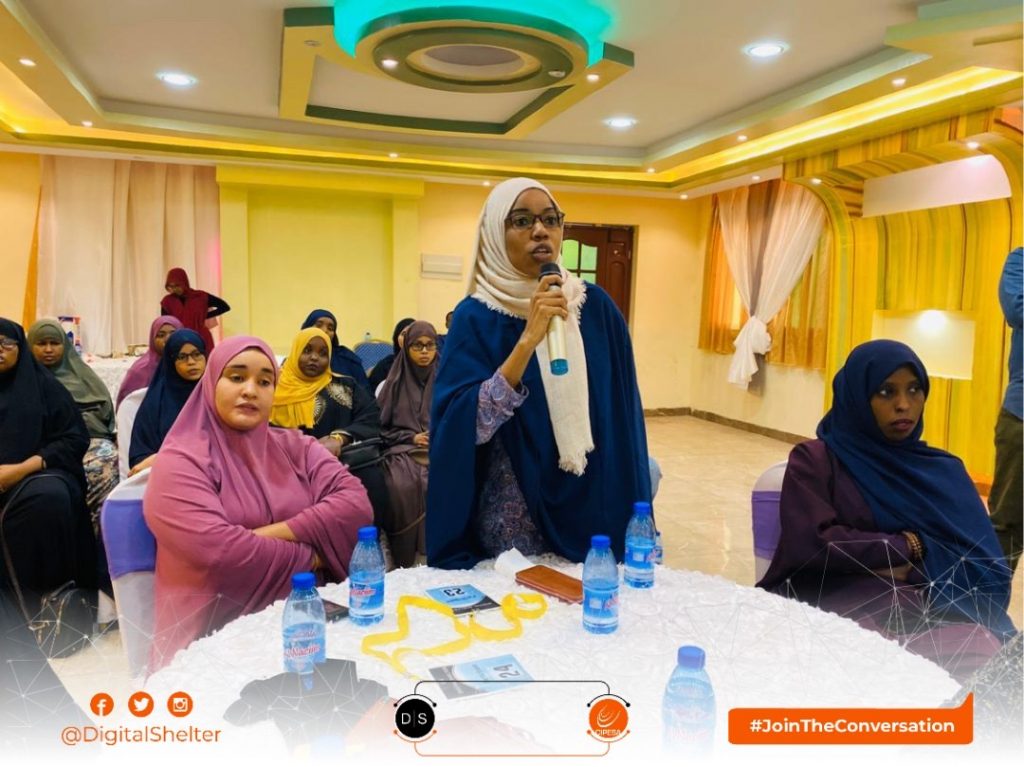
It is against this background that Digital Shelter hosted a panel discussion on the shrinking online civic space in Somalia and the growing digital threats faced by media professionals, bloggers and human right defenders in the digital space on February 13, 2020. The event was part of series of activities under the theme “Protect our Online Space”, supported by the Africa Digital Rights Fund (ADRF) – an initiative of the Collaboration on International ICT Policy for East and Southern Africa (CIPESA).

Among the panelists was Mohamed Irbad, a prominent blogger and researcher known for his critical writings on governance, human rights, freedom of expression and censorship on social media platforms. In early 2019, after publishing an article titled “Media Censorship In Somalia: A Nation Risk Into Information Darkness” on his personal blog, Mohamed faced serious online and physical threats which forced him to flee the country for six months due to fear for his safety.
“All critical voices, particularly individuals who are based inside Somalia have been silenced with online and physical threats altogether. For instance, when your raise critical issue on Twitter or Facebook you have two options, you either end up battling with anonymous trolls in their hundreds by answering to their toxic comments or you feel intimidated and sacred of writing about certain issues, hence, your remain silenced . And that is exactly what happened to me after writing that article. And therefore, it is fair to stay that we are witnessing the worst shrinking of our online/offline civic and democratic spaces” Mohamed Irbad.
Also speaking at the event was Hassan Ali Osman, a journalist, with the New Humanitarian newsletter. Hassan actively uses Twitter to disseminate local and international news as it breaks for his 90,000 followers. He shared that he has been constantly attacked by trolls merely because of reporting the truth on social media platforms.
Highlighting the issue of online violence against women was Sucdi Dahir Diriye, a passionate community volunteer and member of CaawiWalaal loosely translated as “HelpYourBrother” –  a digital campaign launched three years ago to support local communities affected by droughts in Somalia. As in most of the world, the internet has provided a platform for Somali women to amplify their voices. However, it has also enabled perpetuation of different forms of online violence against women including harassment, doxing, threats, stalking and blackmail, sometimes leading to physical violence. The targets of these attacks are women that are vocal on issues such as gender equality, sexual violence, free expression, or challenging the patriarchal structure of the society. This has created a hostile online environment for women and girls in Somalia, fraught with shaming, intimidation and degrading, leading to withdraw of from the online space.
As part of her work, Sucdi documents cases of online blackmailing and extortion against young girls in Mogadishu and other regions of Somalia. She stated that limited recognition of the existence of online violence and harassment against women in Somalia is allowing the abuse to continue inexorably. Relevant policies to address online violence against women need to be put in place and more women and girls need to be skilled in digital safety and security.
Based on their personal and professional experiences, the panelists stressed the need for counter measures against the prevailing threats. Among the recommendations made was increased digital security skills and knowledge building among activists, bloggers and media professionals. Specialized training on gendered online harassment was encouraged. Panelists also emphasized a dual approach in voice amplification – online and offline to reach wider audiences.  Furthermore, more stakeholder dialogue to raise awareness on online civic space and digital rights, including data protection and privacy inline with Somalia’s growing technology sector. Other recommendations included research undertakings on current digital threats in Somalia, to inform advocacy and policy interventions; and establishment of a solidarity network to support victims of online attacks.
“Digital Shelter is proud to be in a unique position to amplify voices in the most difficult time where the online civic space is shrinking in Somalia”, said Abdifatah, co-founder of Digital Shelter in the closing remarks of the forum.
Digital Shelter continues its “Protect our Online Space” drive during March 2020 with series of trainings on digital security. Digital Shelter is also planning to host other forums on expanding online civic space in Somalia.

This article was first published by the Digital Shelter on March 04, 2020