IDUAI has particular relevance with the new 2030 Development Agenda, and in particular with Sustainable Development Goal (SDG) target 16.10 which calls for ensuring public access to information and protection of fundamental freedoms.
Information, Digital AgClick here to access the event page for more information.
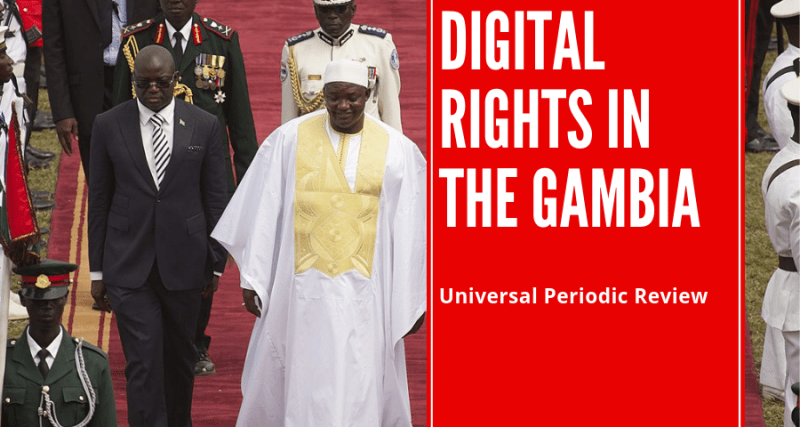
Stakeholder Submission to the UN Human Rights Council on Digital Rights in The Gambia
By Ashnah Kalemera |
In November 2019, The Gambia will be coming up for its third cycle review under the United Nations Universal Periodic Review (UPR) mechanism. Former President Yahya Jammeh, before his ouster in 2017, was renowned for his utter disregard for constitutional rights, once stating publicly that he would “not compromise or sacrifice the peace, security, stability, dignity, and the well-being of Gambians for the sake of freedom of expression.”
However, since the new administration of Adama Barrow took office in January 2017, the government has made public its intention to review and revise the current regulatory framework for press freedom and freedom of expression. Indeed, in June 2017, the new Attorney General and Justice Minister Abubacarr Tambadou conceded at the Constitutional Court that the charge of “sedition” under a law that had been frequently used to silence journalists and critics under the former regime was unconstitutional.
Later in February 2018, the Economic Community of West African States (ECOWAS) Community Court ruled that Gambian authorities should repeal sections of the Criminal Code on libel (Sections 178 & 179), sedition (Sections 51& 52), false news (Sections 59 & 181) and false publication on the internet (Section 173). Following this ruling, the government of The Gambia indicated its intention to “honour” the judgement after review by the Ministry of Justice and other relevant authorities.
As The Gambia’s online user base increases, it becomes increasingly important for UPR recommendations at the upcoming review to reflect explicitly the need for the rights to freedom of opinion and expression, and to privacy to be protected online as well as offline, in line with the state’s obligations under Articles 17 and 19 of the International Covenant on Civil and Political Rights (ICCPR).
What is the UPR? It’ is a full assessment of a country’s human rights. Every United Nations (UN) member state has its human rights record assessed, and all UN member states are involved in the review process. It happens every four-and-a-half years, for every state.
As part of the Internet Freedom in Africa and UPR project, the Collaboration on International ICT Policy for East and Southern Africa (CIPESA), Small Media, The Gambia Press Union, Give1 Project Gambia and the YMCA Computer Training Centre, and Digital Studio have made a joint stakeholder submission on digital rights in The Gambia. The submission focuses on freedom of expression, freedom of information, right to equal access and opportunity, as well as data protection and privacy. It explores relevant developments since the previous UPR review in October 2014 and makes the following recommendations:
- In compliance with international standards, as well as the rulings of the Supreme Court and the ECOWAS Community Court, repeal provisions violating freedom of expression under the Criminal Code (2014) and the Information and Communication Act (2013).
- Repeal in its entirety the Official Secrets (Amendment) Act 2008 and enact and implement a right to information law.
- Hasten efforts to provide equal access to technology and communications to all citizens, including disadvantaged and marginalised groups of the population, by removing barriers to access and improving affordability, as well as expanding infrastructure and desisting from internet disruptions.
- Reform the legislation on personal data protection and privacy in order to provide safeguards on the use of personal data and to protect the right to privacy online.
See the full submission.
Despots and Disruptions: Five Dimensions of Internet Shutdowns in Africa
Report |
Up to 22 African governments have ordered network disruptions in the last four years and since the start of 2019, six African countries – Algeria, the Democratic Republic of Congo (DR Congo), Chad, Gabon, Sudan and Zimbabwe – have experienced internet shutdowns.
A new report by the Collaboration on International ICT Policy for East and Southern Africa (CIPESA) titled Despots and Disruptions: Five Dimensions of Internet Shutdowns in Africa notes, however, that internet shutdowns remain the preserve of Africa’s most despotic states.
According to the report, 77% of the countries where internet shutdowns have been ordered in the last five years are categorised as authoritarian under the Democracy Index produced by the Economist Intelligence Unit. All the other African countries that have disrupted communications are categorised as hybrid regimes, meaning they have some elements of democracy with strong doses of authoritarianism.
The authoritarian regimes that have ordered network disruptions include Algeria, Burundi, the Central African Republic (CAR), Cameroon, Chad, DR Congo, Congo (Brazzaville), Egypt, Equatorial Guinea, Gabon, Ethiopia, Libya, Mauritania, Niger, Togo, Sudan, and Zimbabwe. Hybrid regimes that have ordered internet shutdowns include the Gambia, Mali, Morocco, Sierra Leone, and Uganda.
For countries that are classified as authoritarian but have not ordered shutdowns, the report states that it is likely that “the authoritarian state is so brutal or commanding that civil society or opposition organising and protests – online and offline – are unfathomable” or “internet control measures in place render ordering overt internet disruptions unnecessary.” These countries include Djibouti, Eritrea and Rwanda.
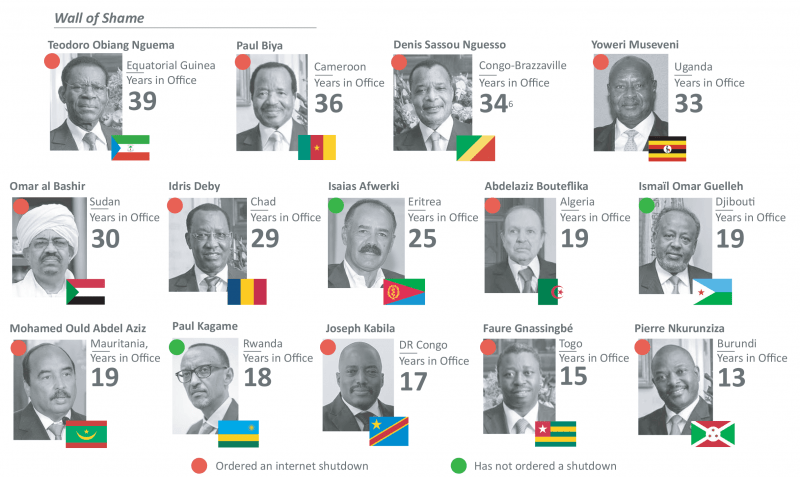
The report also notes that countries whose leaders have been in power for several years are more likely to order internet shutdowns. As of January 2019, of the 14 African leaders who had been in power for 13 years or more, 79% had ordered shutdowns, mostly during election periods and public protests against government policies.
These included Equatorial Guinea’s Teodoro Obiang Nguema (39 years); Cameroon’s Paul Biya (36); Congo Brazaville’s Denis Sassou Nguesso (34); Uganda’s Yoweri Museveni (33); Sudan’s Omar El Bashir (30); Chad’s Edris Deby (29); Algeria’s Abdelaziz Bouteflika (19); Mauritania’s Mohamed Ould Abdel Aziz (19); DR Congo’s Joseph Kabila (17); Togo’s Faure Gnassingbé (15); and Burundi’s Pierrie Nkurunziza (13).

The report says 2019 could see a record number of network disruptions since at least 20 African states will hold various forms of elections including local, legislative, general or presidential.
Over the years, many network disruptions have typically occurred in autocratic African countries around election times, and among the states scheduled to conduct polls this year are those which have previously initiated various forms of shutdowns during elections periods (such as Equatorial Guinea), public protests (Cameroon, Togo), and national school exams (Algeria, Ethiopia).
Other highlights from the Despots and Disruptions: Five Dimensions of Internet Shutdowns in Africa report:
The report notes that governments that order disruptions and the Internet Service Providers (ISPs) that implement them now more openly acknowledged the disruptions. Governments often cite digital technologies’ increasing usage to spread disinformation, propagate hate speech, and to allegedly fan public disorder and undermine national security.
For their part, more ISPs and platform operators are making public their responses to shutdown directives as and to user information and interception requests from governments through transparency reports. This openness could represent the normalisation of shutdowns, implying that a growing number of governments feel no shame in openly acknowledging ordering shutdowns. However, it has positive elements too, as it can be the basis of litigation and push back advocacy.
The report reiterates that internet disruptions, however short-lived, affect many facets of the national economy and tend to persist far beyond the days on which access is disrupted. “If just five of the countries that have previously disrupted internet access and who are going to the polls this year disrupted access to internet including apps such as Twitter, Facebook and Whatsapp at a nationwide level for five days each, the estimated economic cost would be more than USD 65.6 million,” the report states.
Further, the report notes that the countries that disrupt internet access have some of the lowest internet usage figures and highest data prices in Africa. Conventional wisdom might suggest that low-internet usage countries would be the last to disrupt internet access as they might consider the population online too small to threaten “public order” or “national security” or to threaten the regime’s hold on power. On the contrary, says the report, it appears that African governments with democracy deficits, regardless of the numbers of their citizens that use the internet, fear the power of the internet in enabling citizen organising and empowering ordinary people to speak truth to power.
The report can be downloaded here.
Forum on Internet Freedom in Africa 2019 (FIFAfrica19)
Indeed, spreading the physical footprint of FIFAfrica across different regions of the continent ensures that the Forum lives up to its goal of unpacking internet freedom challenges and opportunities in sub-regions of Africa and developing responses that are collaborative, and informed by insights from the experience of other sub-regions of the continen.
See our FIFAfrica event page here. More information on FIFAfrica2019 coming soon.
FIFAfrica 2018: Taxes Sur les Réseaux Sociaux et Coupures Internet au cœur des Discussions
FIFAfrica18 Update |
Du 26 au 28 septembre 2018 se tenait à Accra la 5è édition du Forum on Internet Freedom in Africa (FIFAfrica), auquel participait Internet Sans Frontières. J’ai eu le privilège d’y représenter l’association. Co- organisé par le Collaboration on International ICT Policy for Eastern and Southern Africa, un organisme consultatif indépendant, et la Media Foundation for West Africa, ce forum se veut un haut lieu d’échanges entre différents acteurs sur l’état et les perspectives des libertés et droits numériques en Afrique.
Les Taxes sur l’utilisation des réseaux sociaux au cœur des discussions
Il a évidemment été question des législations visant à taxer auprès des utilisateurs l’usage des réseaux sociaux et applications de messagerie, quelques jour après qu’une régulation similaire ait été retirée au Bénin, suite à une forte mobilisation des béninois, soutenue par Internet Sans Frontières. Le panel consacré aux implications économiques et sociales des taxes sur les réseaux sociaux, auquel j’ai pris part pour Internet Sans Frontières, était modéré par Sandi Chimpala de TechTrends, aux côtés du Dr. Wairagala Wakabi de CIPESA, Broc Rademan de Research ICT Africa et Kojo Boakye de l’entreprise Facebook . Au delà de l’impact économique négatif, les panélistes ont rappelé ces taxes sont porteuse d’un relent autoritariste, en ce qu’elles font peser de réelles menaces sur la liberté d’expression, et l’accès l’information. L’occasion m’a été donnée de rappeler que la victoire historique et inédite des citoyens béninois face à leur gouvernement ne doit pas faire oublier que de nombreux utilisateurs en Ouganda, en Zambie subissent encore le poids de ces régulations injustes.

L’urgence en Afrique d’adopter des indicateurs de l’universalité de l’Internet
Internet Sans Frontières a également pris part à la session organisée par l’UNESCO sur les indicateurs de l’universalité de l’Internet : fruit d’une réflexion entamée en 2017, ces indicateurs doivent permettre à chaque pays d’auto-évaluer le niveau d’universalité de l’Internet disponible dans un territoire donné, en particulier vérifier que l’Internet est fondé sur les droits humains, s’il est ouvert, accessible à tous, et fruit de la participation de plusieurs acteurs. Aux côté de James Marenga, Vice-président de l’Institut des Médias pour l’Afrique Australe (MISA), de Damola Sogunro, Principal Computer Analyst au Ministère de la Communication et des Technologies du Nigeria et de Dorothy Gordon, activiste technologique ghanéenne et spécialiste du développement, j’ai pu rappeler
les nombreux obstacles qui entravent l’accès aux informations en ligne sur le continent Africain tels que les coupures d’Internet, la restriction des libertés et la criminalisation des discours en ligne, la faible protection de la vie privée, les taxes relatives à l’usage d’Internet et le manque de transparence par rapport aux activités des gouvernements.
Plaidoyer contre les coupures Internet et données
Le panel consacré au plaidoyer axé sur les données relatives aux coupures d’Internet en Afrique a permis de rappeler le travail d’Internet Sans Frontières contre cette forme grave de censure, aux côtés de ses partenaires Access Now, the Global Network Initiative, et Netblocks, tous membres de la coalition Keepiton fondée en 2016. Les données sont nécessaires dans cette lutte, notamment celles permettant de connaitre le nombre précis de coupures Internet, mais également l’impact économique et financier de celles-ci. En 2017, le premier calcul par Internet Sans Frontières du coût économique de la coupure totale d’Internet dans les régions anglophones du Cameroun, la plus longue à ce jour en Afrique, a permis d’intéresser un tout nouveau public au plaidoyer contre la censure sur Internet, en particulier les médias et institutions économiques et financières. D’où l’importance de l’outil COST (Cost of Shutdowns Tool), développé par l’organisation Netblocks, qui automatise le calcul du coût des coupures Internet.
FIFAfrica, un espace de discussion et de collaboration nécessaire
J’ai pu constater à travers ma participation que le FIFAfrica est un creuset qui permet de débattre de manière interactive et éclairée sur les enjeux et défis actuels de la société de l’information en Afrique.
Vous pouvez en apprendre d’avantage sur la 1ère participation d’Internet Sans Frontières à ce grand RDV africain dans ce podcast d l’émission Afrique 7 jours de la Deutsch Welle.