South Africa is among the top five African countries with the highest mobile broadband reach, preceded by Ghana, Zimbabwe, Namibia and Egypt. As of June 2014, internet users had increased to 52% of the population, majority of them using mobile devices to access the internet.
Although the country has been ranked free in internet freedom rankings and held highly in respect to promoting equal rights, recent developments in the offline and online world say otherwise.
In March 2015, a consumer activist who runs the CAMcheck blog that reports on misleading claims made by consumer goods providers, was forced to move his website offshore following a take-down request made by sports supplement company USN for content described as “unsubstantiated and defamatory”.
According to Section 78 of the Electronic Communications and Transactions Act (ECTA) 2002, ISPs are not obliged to monitor the data they transmit or to actively seek facts or circumstances indicating an unlawful activity. Service providers are, however, liable for failure to comply when issued with takedown requests from users as provided under Section 77 of the Act.
It is thus no surprise that Hetzner, the CAMcheck blog web hosting provider, also a member of the South Africa Internet Service Providers Association (ISPA), complied with the take down request.
Also in March 2015, the Film and Publication Board (FPB) gazetted a Draft Online Regulation Policy, 2014, which contains clauses that have the potential of blocking online content – including films, games and certain publications – prior to publication.
The regulations require that anyone wishing to publish or distribute such content has to first acquire a digital publisher’s online distribution agreement with the FPB, after paying a subscription fee. Once paid, the publisher would have to submit the content to the FPB for classification prior to publishing.
The FPB has the mandate to regulate the creation, production, possession and distribution of films, games and certain publications by way of classification, to protect children from exposure to disturbing and harmful material and from premature exposure to adult material and to criminalise child pornography and the use and exposure of children to pornography.
The Draft Online Regulation Policy states that, the policy, “read with the Online Regulation Strategy and the ECT Act Amendment Bill, will also ensure that classification focuses on media content, rather than on platforms or delivery technologies.”
However, civil society organisations have criticised the draft policy, stating that they are “effectively a specific form of pre-publication censorship, which is not acceptable.” They also add that the time spent on the pre-classification of content would undermine one of the most valuable traits of the internet – its immediacy.
Further concerns about the new regulations include the exclusion of content by parties unable to pay the fees required and thus a potential limitation on the diversity of online content.
But online content censorship is not new in South Africa. In 2012, “The Spear”, a controversial painting by Brett Murray which depicted President Jacob Zuma with his genitals exposed, was published on the City Press website – a daily newspaper. President Zuma and the African National Congress Party obtained an order for the removal of the image from the website of City Press on the grounds that it was unfit for viewers under the age of 16, according to classifications by the FPB. The Goodman Gallery (where the painting was displayed) approached the FPB Appeal Tribunal which found that the ruling in favour of the injunction was incorrect. The City Press nonetheless removed the image from its website.
Meanwhile in the first quarter of 2013, the South African Counter Intelligence Agency made a content removal request to Google for a blog post that was ‘allegedly infringing copyright by criticizing a media release that the agency had issued.”
Although this request was denied, past incidents together with recent developments in the country bring to the fore the crucial online freedom issues of intermediary liability and freedom of expression.
In its 2014 State of Internet Freedoms in South Africa report, the Collaboration on International ICT Policy for East and Southern Africa (CIPESA) highlights these gaps. It states that the absence of detailed provisions in the guidelines for recognition of industry representative bodies of ISPs “creates a situation where ISPs are not free to establish any ’notice’ or ‘notice and put-back’ mechanism, which would allow the user to respond to the allegations of infringement or, respectively, to provisionally restore the allegedly infringing content.”
The ECTA Amendment Bill of 2012 attempts to address some of the existing gaps by introducing Section 77A, which provides consumers with the right to be heard by ISPs before a takedown notice is enforced. However, this section still has limited provision for a user to respond to the allegations of infringement or to provisionally restore the allegedly infringing content. ISPs are merely required to respond to a “first take-down notice” within 10 business days (lesser days if the complainant can demonstrate irreparable or substantial harm).
The 2014 report calls for a review of South African legislation that is applicable to online freedom, specifically pointing out the need for immediate revision of the Films and Publications Act.
The report also recommends increased dialogue between civil society and policy makers to progressive law reforms, including a review of legislation that have actual or potential chilling effects on internet freedom.
Read the full State of Internet Freedoms in South Africa Report here.
Balancing Freedom of Expression And Privacy
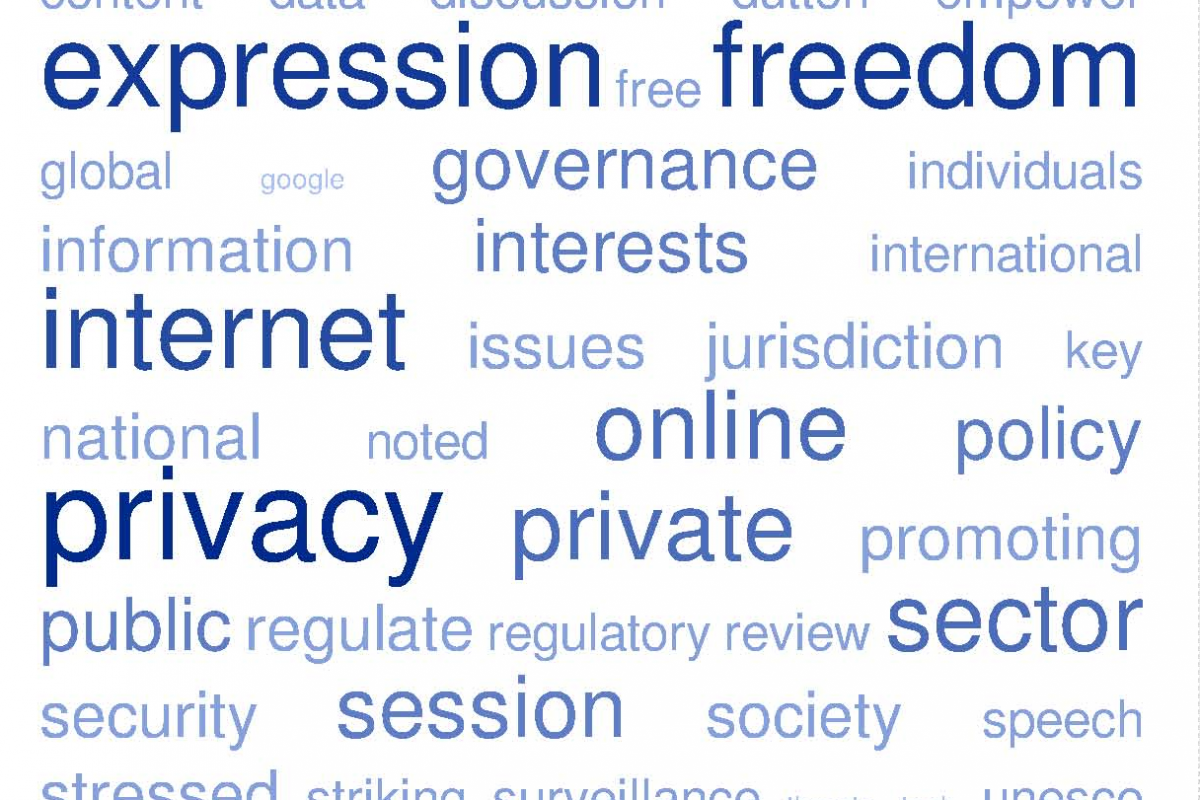
Striking a balance between freedom of expression and privacy on the internet was the focus of a panel discussion at a review of one decade after the World Summit of the Information Society (WSIS). The WSIS+10 Review meeting took place at the UNESCO headquarters in Paris, France, February 25-27, 2013.
What convergences and tensions exist between freedom of expression and privacy online? What are the implications of approaching the balance between free expression and privacy from a freedom of expression–centric point of view? What actions can governments, civil society, media and the private sector take to balance privacy with freedom of expression online? And what is the best way to empower users? These are some of the questions addressed at the session on ‘Promoting of Freedom of Expression and Privacy Online’. CIPESA’s Lillian Nalwoga was the remote moderator for the session.
The session built on earlier discussions held at the 7th Internet Governance Forum (IGF) in Baku, Azerbaijan on promoting both freedom of expression and privacy on the internet. It also drew from the Global Survey of Internet Privacy and Freedom of Expression – a UNESCO 2012 publication – which highlights a diverse international regulatory landscape, and the challenges posed by discrepancies in laws pertaining to the online and off-line spheres, and between national and international jurisdictions.
During the session, Pranesh Prakash from the India-based Center for Internet Society stressed the need for more relaxed regulations to govern the conduct of the private sector. He noted that “one must give the private sector enough leeway to safeguard them from responsibility for users’ actions and the requirement of taking down reasonable speech.” However, he added that the commercial sector has divergent interests and they do not necessarily align with public interests.
According to him, differing public and private sector interests coupled with unenforceability of self-regulation mechanisms and the jurisdictional issues of the internet mean that the conflict between freedom of expression and privacy cannot be easily resolved through public policy options that are only aimed at the private sector.
Patrick Ryan, a Policy Counsel from Google who was also a panelist, argued that the move to the “cloud” brings with it both enhanced privacy and security benefits, while at the same time putting data potentially at risk. Noting that government surveillance remained one of the biggest threats to privacy, he stressed that the private sector needs to share more information on government take down requests that violate individuals’ privacy and free speech.
Meanwhile, William Dutton, a professor of Internet Studies at Oxford Internet Institute, stressed the importance of recognising the power of the internet in empowering networked individuals and enabling freedom of expression, like never before. He cautioned that if nations do not approach the issue of striking a balance between freedom of expression and privacy appropriately, some of the key benefits of the internet may be lost. He noted that whilst some nations have taken progressive steps, many others are moving in the wrong direction and various global policy choices are increasingly restricting freedom of expression.
Indeed, this has been illustrated by worldwide trends towards more content filtering and censorship. Dutton said adopting inappropriate models for internet governance and regulation, such as disproportionate levels of surveillance in the name of security, reliance on intermediaries to regulate content, and assertion of national sovereignty and jurisdiction in the online world are threatening privacy and freedom of expression.
Key recommendations from this session were: avoiding a moral panic over privacy; creating widespread awareness of issues concerning privacy and data protection among users especially the young generation; updating policy and regulatory frameworks that address freedom of expression and privacy online; and having a clear definition on national security interests.
For more information, please visit – https://www.unesco-ci.org/cmscore/events
Promoting of Freedom of Expression and Privacy Online
Follow WSIS+10 on twitter at #WSIS
Monitoring Internet Openness in Africa
With internet usage continuing to spread across Africa, there are numerous purposes to which African users are putting the internet – from mobile banking, to connecting with fellow citizens and with leaders, tracking corruption and poor service delivery, innovating for social good, and just about everything else.
The increasing usage of the internet, however, has in some countries attracted the attention of authorities, who are eager to provide caveats on the openness of the internet and the range of freedoms which citizens enjoy online. The popularity of social media, the Wikileaks diplomatic cables saga and the Arab Spring uprisings have led many governments including those in Africa to recognise the power of online media.
The year 2012 saw a number of African states put curbs on Internet Rights, in what portends tougher times ahead for cyber security. According to the Freedom on the Net 2012 report published by Freedom House, both physical and technical mechanisms of filtering, monitoring or otherwise obstructing free speech online have been employed by states concerned with the power of internet-based technologies.
In its study, Freedom House covered developments in internet freedom in 47 countries around the world. Based on an examination of obstacles to access, limits to content, and violation of user rights on the internet, countries were scored as ‘Free’, Partly Free’ or ‘Not Free’. The study found that in Sub Saharan Africa, Ethiopia was the only country to implement nationwide internet filtering. Meanwhile, South Africa and Kenya were reported as the most free. The former was credited for its high internet usage compared to other countries at the same level of development and the latter for its “growing diversity in content and fewer cases of arrest or censorship than in previous years.”
Ethiopia was reported as using paid pro-government commentators to manipulate internet discussions. There were also crackdowns and prosecutions of online,journalists as well a law that since 2002 prohibits the use of VoIP (Voice Over Internet Protocol). In Zimbabwe, regime critics were said to often be faced with politically motivated cyber attacks.
Even Kenya, all its ICT sector positives notwithstanding, was reported as one of the governments seeking “less visible means” to control internet freedoms. The Country’s communications regulatory is reportedly setting up a surveillance system to monitor email communications due to cyber security threats. Pending legislation in South Africa, which requires telecommunications service providers to broaden their surveillance obligations, was also noted as having the potential to mass monitor communications.
Despite having relatively low restrictions on internet usage, Rwanda was reported as a ”country at risk” in 2013 owing to its “strict” controls over traditional media which are feared may extend to digital media.
Freedom House ranked Nigeria, Uganda, and Zimbabwe as ‘Partly Free’.
In 2013 through to 2014, CIPESA will be undertaking a project to monitor and promote internet freedoms in Ethiopia, Kenya, Rwanda, South Africa and Uganda. We shall be reporting on legal regimes on internet openness or the lack of it, censorship incidents and African initiatives that are promoting internet rights, among others.
Read more about CIPESA’s Internet Governance and Online Freedoms work.