Comments Submitted to Communications Regulator on Uganda’s Proposed New Telecoms Licencing Framework

By Daniel Mwesigwa |
According to the 2018 third quarter communication industry report by the Uganda Communications Commission (UCC), Uganda has 15 million users connected to the internet, representing a 38% internet penetration rate. However, the cost of access and usage is among the highest in the region, which has hampered the uptake of Information and Communications Technology (ICT). Through the national broadband policy, the government hopes to avert duplication of infrastructure and increase usage of  ICT resources, ensure universal access, and streamline licensing regimes for telecommunications and broadcast operators. On the latter, the UCC has embarked upon a review of the current licensing regime aimed at addressing current gaps and limitations to the access and usage of ICT nationally.
The Collaboration on International ICT Policy in East and Southern Africa (CIPESA) joined the Association for Progressive Communications (APC), Rhizomatica, AfChix Uganda chapter, BOSCO Uganda, and the Internet Society to submit comments to the ongoing review of the licensing framework for the telecommunications sector in Uganda.
The submission responded to key concerns raised by the UCC including on issues such as national roaming, effective spectrum allocation, infrastructure sharing, affordability, the gender digital divide, in addition to regulated and cost-oriented pricing.
Among the recommendations in the submission is the need to enable alternative approaches to broadband delivery that can complement existing network operator models. Such approaches include enabling affordable access to spectrum and also creating regulations for community networks and small scale operators to provide access to the underserved, especially in rural areas.
To curb capital flight from mostly foreign-owned telecommunications companies, the proposed licencing framework seeks to compel these companies to list on the local stock exchange. The submission proposes accessible ways through which shares can be traded for example through the mobile money platform. It further re-emphasizes the need for smaller and community run operators since multiple economic benefits from ownership to employment boost and contribute to the local economy.
On the issue of digital exclusivity, the submission stresses that it is unlikely that the gender digital divide in Uganda will be closed if policies and regulations do not actively enable the participation of more women in the telecommunication industry. It, therefore, recommends the adoption of gender-sensitive approaches to closing the gender access gap.
Meanwhile, CIPESA has previously submitted comments to UCC on improving access to ICT for Persons With Disabilities (PWDs). 
Find the full submission here.

CIPESA Submits Comments to Uganda Communications Commission on Improving Access to ICT for Persons With Disabilities

By Daniel Mwesigwa |

Last year, Uganda’s communications regulator commissioned a study to establish the status of access and usage of Information and Communications Technology (ICT) by Persons With Disabilities (PWDs). In response to a call for comments, CIPESA made submissions to the commission, which could help various government agencies to devise strategies that meaningfully improve usage of digital technologies by PWDs.

According to Uganda’s statistics bureau, persons with disabilities comprise 16% of the country’s population of 37.5 million. However, they face various limitations in accessing and using ICT tools and services. The draft report of the study commissioned by the Uganda Communications Commission (UCC) shows that national ownership of a radio and a mobile phone among PWDs was high at 70% and 69% respectively. Ownership of fixed-line telephones, desktop computers and laptops was very low at 0.5%, 1% and 3.9% respectively. However, 15% of respondents’ households had access to the internet.

Below are highlights from CIPESA’s submission:

1. Disaggregate results by type of disability

While the report highlights respondents’ type of disability (61% had a physical disability, 31% were visually impaired, and 2% had a hearing impairment), it does not show how the nature of disability affects access and usage of ICT. Persons with disabilities are not a homogeneous group and the nature of disability influences how they may perceive, be able to access and to use ICT. It may not be possible therefore to address the distinct needs of different categories of PWDs if data is not disaggregated by type of disability – as indeed it should be disaggregated based on gender, location, income, among other demographics.

2. Comparative analysis of data

The report provides ICT access and usage figures for PWDs (e.g. 69.4% mobile phone ownership; 3.9% had laptop computers and 1% desktop computers; 15% of households had access to the internet). However, these numbers need to be presented and analysed alongside overall national statistics on access and usage if they are to offer direction on the remedial actions needed.

3. Taxes deepening exclusion

Only 14% of respondents had access to a bank account compared to 86% that accessed financial services through other mechanisms such as mobile money, and village savings and loan associations. One third (33%) had access to mobile money, which is lower than the national average of 55%. Further, 41% of the respondents lacked access to any form of financial services, compared to the national average of 22% that is financially excluded.

Worryingly, majority of PWDs (66%) said their use of social media had reduced with the introduction last July of the Over The Top (OTT) tax, while 26% said they were no longer using social media. Only 8% had not changed their usage levels. According to the report, 52% of PWDs access social media on their phones, while 12% access it on their computers.

As CIPESA has previously found, OTT platforms and mobile money networks had considerably eased the lives of PWDs. For example, platforms like WhatsApp were used to disseminate critical information among individuals with hearing impairment before the added cost of using social media rendered them unaffordable to many, who already faced challenges in finding employment and often relied on financial support from others. For UCC and other relevant Uganda Government institutions, these findings should not be taken lightly and should inform policy in this area.

4. Awareness and usage of assistive technologies

Assistive technologies are products, devices, or equipment, used to maintain, increase, or improve the functional capabilities of individuals with disabilities. A very concerning finding in the Report is that 76% of PWDs were not aware of the low-cost Assistive Technologies like manual Perkins Brailler, hand-held magnifiers, hand frames/slates and communication boards. Only 14% of respondents were aware of the Perkins Brailler yet its usage was low at 4%. Just 13% of the respondents were aware of magnifiers yet only 2% used them. Issues of awareness of these technologies, their cost and availability, are apparent. The UCC should offer subsidies for assistive technologies through the universal service access fund, the Rural Communications Development Fund (RCDF).

5. Privacy and data protection

The right to privacy is a core entitlement for every individual under article 27 of the Uganda Constitution. The Persons With Disabilities Act, 2006, section 35 protects PWDs from arbitrary or unlawful interference with their privacy. However, the report does not assess PWDs awareness of their privacy rights or data security skills. Such an assessment is necessary to inform remedies including on capacity development.

6. Public and private sector compliance

Consistent with international conventions and instruments such as the UN Convention on the Rights of Persons with Disabilities (CRPD) and the Sustainable Development Goals (SDGs), as well as domestic laws such as the national constitution, Persons With Disabilities Act 2006, and the National IT and Disability Policy, the emphasis on inclusion and non-discrimination for PWDs cannot be overlooked if the country is to attain her development goals.

As the government works towards implementing the ICT and Disability Policy, the emphasis on Website Accessibility Guidelines (WAG) can be fast-tracked by auditing compliance with the 2014 ‘Guidelines for Development and Management of Government Websites’ which were developed by the National Information Technology Authority Uganda (NITA-U). Entities that do not comply with universal accessibility standards should be sanctioned.

Further, the Equal Opportunities Commission, working with other relevant entities, should require government ministries, departments and agencies (MDAs) and private enterprises which offer public services to prepare annual statements in which they report on how they have worked towards increasing accessibility and inclusiveness for PWDs.

The full submission can be read here.
Why Uganda’s Government Should Take a Different Path to Social Media and Mobile Money Taxation

Statement |
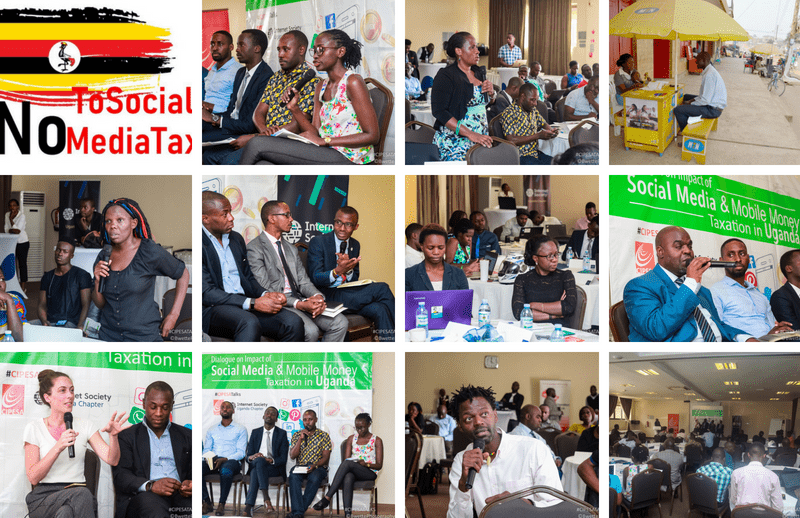
There has been widespread concern over newly introduced levies on social media access and mobile money transactions in Uganda, which are widely considered a threat to internet access and affordability, as well as to freedom of expression and access to information. The effects of the taxes that took effect on July 1, 2018, were the focus of discussions at a recent stakeholder dialogue  organised by the Collaboration on International ICT Policy for East and Southern Africa (CIPESA) and the Internet Society Uganda Chapter.
At the dialogue, entrepreneurs, journalists, lawyers, activists, technologists, and academics shared their perspectives and experiences, resulting in a set of recommendations to the government on alternatives to the current modes of taxation.
The government says the taxes are needed so as  to expand the country’s tax base. In the 2018/2019 national budget speech, the finance ministry estimates that up to UGX 486 billion (USD 131 million) could be collected annually by 2022 from taxes on social media Over-The-Top (OTT) services.
However,   presenting early results on an ongoing study on the impact of the taxes, Dr. Christopher Stork of Research ICT Solutions stated that the country’s rural-based users of social media and mobile money will be hardest hit by the taxes, increasing the percentage of the unconnected and resulting in decreased revenue for telecom/ internet operators. He said this would ultimately lead to reduced growth in the gross domestic product (GDP) and hamper job creation.

Image above: Comparison of taxes against average income across regions in Uganda | Source:  Research ICT Solutions

Image above: Prepaid products user tax burdens | Source:  Research ICT Solutions
This study’s preliminary results affirm earlier contentions, such as by the After Access researchers, that those who marginally afforded internet services before the taxes were introduced are likely to now find internet use totally unaffordable, thereby increasing the percentage of the unconnected.
Meanwhile, Dr. Abdul Busuulwa, Executive Director at Community Based Rehabilitation (CBR) Africa Network, said whereas social media and mobile money platforms had eased the lives of persons with disabilities (PWDs),However, the increased cost of accessing these platforms due to the new taxes had reversed these  gains. He said platforms like WhatsApp were helping in disseminating critical information among people with hearing difficulties before the added cost of using social media rendered them unaffordable to members of these groups, who he said already faced challenges in finding employment and often relied on financial support from others.
The impact of the taxes on the use of online platforms for civic engagement on local governance was described by Samuel Mumbere, ICT Officer at the Kasese District Local Government in Western Uganda. According to Mumbere, whereas introduction of the taxes had prompted a rise in the use of Virtual Private Networks (VPNs) by community members who needed to maintain avenues of social accountability and access to information in the district, many were concerned about the additional costs related to data usage by some VPN products.
On the access to justice front, the online legal knowledge and support platform, Barefoot Law, was cited as a social media-based service that had enabled citizens to access legal support and services which the poor are often excluded from due to financial constraints. Such platforms are also threatened with reduced use by citizens due to the taxes.
Those in e-commerce cited barriers to accessing their clients, and reduced competitiveness of their products and services, due to the taxes. The Managing Director of Jumia Uganda noted that the company’s work with some 3,000 different sellers, 1,000 hotels, and over 200 restaurants had experienced strained operations as their operations relied greatly on social media.
Although the mobile money transactions tax is under review, with a new bill tabled before parliament proposing to reduce the tax from 1% to 0.5%, this does little to address the impact the tax will still have on financial inclusion. Feminist and writer, Edna Ninsiima, highlighted the role that mobile money has played in empowering unbanked women. She said the new transaction fees are affecting the financial independence of women – including building a savings culture – where it had been growing steadily.
Meanwhile, Kojo Boakye, Public Policy Manager, Access and Connectivity, Facebook, cited the counter impact of the taxation on digital dividends including efforts to extend connectivity and broadband penetration. He questioned the likelihood of the tax raising the projected revenue, adding that  the tax could also have an impact on the investment decisions of investors in infrastructure. In 2017, Facebook, in partnership with Airtel Uganda and Bandwidth and Cloud Services (BCS) Uganda announced  a USD 100 million project to lay nearly 800 km of fibre optic cable in north-western Uganda. Like Facebook, Google has also worked to extend connectivity in Uganda with infrastructure investments including a wifi project in the capital, Kampala.
Overall, participants at the dialogue pointed out that the taxes are not only discriminatory in nature but also disenfranchise already marginalised and vulnerable communities including PWDs, women, youth and rural communities. They called on the government to reassess its position on the taxes without inhibiting growth in ICT usage and innovation. The dialogue was also introspective with many noting that more proactive and collaborative efforts should be pursued by non-state actors, especially research and participating in consultative policy processes, to enhance informed decision-making by the government.