Addressing Online Harms Ahead of Rwanda’s 2026 UPR Review

By Patricia Ainembabazi |

As the world commemorates the 16 Days of Activism Against Gender-Based Violence (November 25 to December 10), global attention is drawn to the rising risks women and girls face in digital environments. These harms increasingly undermine political participation, public discourse, and the safety of women across Africa.

Accordingly, the Collaboration on International ICT Policy for East and Southern Africa (CIPESA) and the Association for Progressive Communications (APC) have stressed the urgent need to address technology-facilitated gender-based violence (TFGBV) in Rwanda in written and oral submissions to the Universal Periodic Review (UPR) 51st pre-session for Rwanda at the United Nations Human Council in Geneva. In a joint CIPESA–APC fact sheet on human rights, the two organisations highlighted critical gaps in legal protections, online safety, and digital inclusion in Rwanda.

The joint UPR report notes that TFGBV has become a major deterrent to Rwandan women’s participation online, affecting women in politics, journalism, activism, and advocacy. The 2024 online smear campaign against opposition figure Victoire Ingabire Umuhoza illustrates the gendered nature of digital disinformation and harassment. Such attacks rely on misogynistic narratives designed to humiliate, silence, and delegitimise women’s public engagement. This pattern is not only a violation of rights; it also reinforces structural inequalities and dissuades other women from engaging in civic or political life.

These concerns reflect global trends. UN Women has warned of the rapid escalation of deepfake pornography, a form of digitally manipulated sexualised content disproportionately deployed against women and girls. Deepfakes can cause severe psychological, reputational, and professional harm, often leaving survivors without effective avenues for redress. They are increasingly used to silence women, distort electoral participation, and discourage women from entering political leadership. Such harms undermine democratic processes, distort public debate, and entrench gender inequality.

Rwanda’s obligations under the Convention on the Elimination of All Forms of Discrimination Against Women (CEDAW) require the state to take comprehensive measures to eliminate discrimination (Articles 2 and 3) and ensure women’s full participation in political and public life (Article 7). However, as documented in the joint UPR report and fact sheet, gaps persist. The 2018 Cybercrime Law lacks survivor-centred provisions, and its broad definitions have on occasion been applied in ways that disadvantage victims.

Moreover, enforcement remains inconsistent, and the absence of specialised mechanisms for investigating and prosecuting online violence limits accountability. In this context, TFGBV is not merely a digital phenomenon; it is a direct barrier to fulfilling Rwanda’s CEDAW obligations and achieving SDGs 5 and 16.

The gender digital divide further compounds these harms. Internet penetration in Rwanda stands at 34.2%, with women representing just 38.2% of social media users. Structural inequalities, including device affordability, income disparities, and limited digital literacy, restrict women’s participation in digital spaces. These inequalities heighten vulnerability to online harm and restrict access to safety tools, reporting mechanisms, and digital rights resources. As the joint CIPESA–APC evidence indicates, without targeted investment in digital literacy, device access, and connectivity for women, Rwanda risks deepening existing socio-economic and civic inequalities.

During the UPR pre-session, CIPESA and APC presented a set of recommendations aimed at promoting rights-respecting digital governance. These included adopting survivor-centred TFGBV protections aligned with CEDAW, strengthening investigative and prosecutorial capacities to effectively respond to online harms, and compelling technology platforms to improve reporting, moderation, and accountability mechanisms. The submission also called for amending restrictive provisions in the Penal Code and Cybercrime Law, establishing independent oversight over surveillance operations, and addressing the gender digital divide through targeted digital literacy and affordability initiatives.

The 16 Days of Activism provide an important reminder that violence against women is evolving in both form and reach. Digital technologies have expanded the avenues through which women are targeted, often enabling harm that is faster, more pervasive, and harder to remedy. Ending violence against women, therefore, requires recognising online spaces as critical sites of protection.

Rwanda enters its fourth UPR cycle with a number of unaddressed commitments. During the 2021 review, the Rwandan government received 32 recommendations on freedom of expression and media freedom, including 24 urging reforms to restrictive speech provisions and 17 calling for enhanced protections for journalists and human rights defenders. Yet implementation has been limited. Provisions in Rwanda’s 2018 Penal Code and 2018 Cybercrime Law continue to criminalise “false information”, edited content, and criticism of public authorities, enabling arrests of journalists and discouraging dissenting expression.

These laws have contributed to widespread self-censorship, shrinking civic space, and undermining public participation in digital environments. At the same time, reports of intrusive surveillance, such as the documented use of Pegasus spyware targeting thousands of journalists, activists, and diaspora members, further erode trust and violate privacy rights. The absence of independent oversight in surveillance practices intensifies this concern.

The Country’s ongoing engagement with the UPR process and its upcoming review scheduled for January 21, 2026, offers a timely opportunity to address these challenges. During the pre-sessions 51 from 26 -27 November 2025 in Geneva, several permanent missions expressed eagerness to advance strong recommendations for Rwanda, and there is hope that these delegations will amplify our proposals during the formal review.

CIPESA and APC remain committed to supporting evidence-based reforms that strengthen digital rights protections across Africa. Rwanda’s review presents a defining moment for the government to adopt meaningful, future-focused reforms that uphold human rights, ensure accountability, and create a digital environment where all citizens, especially women, can participate safely, freely, and equally in shaping the country’s democratic and digital future.

State of Internet Freedom In Africa Report

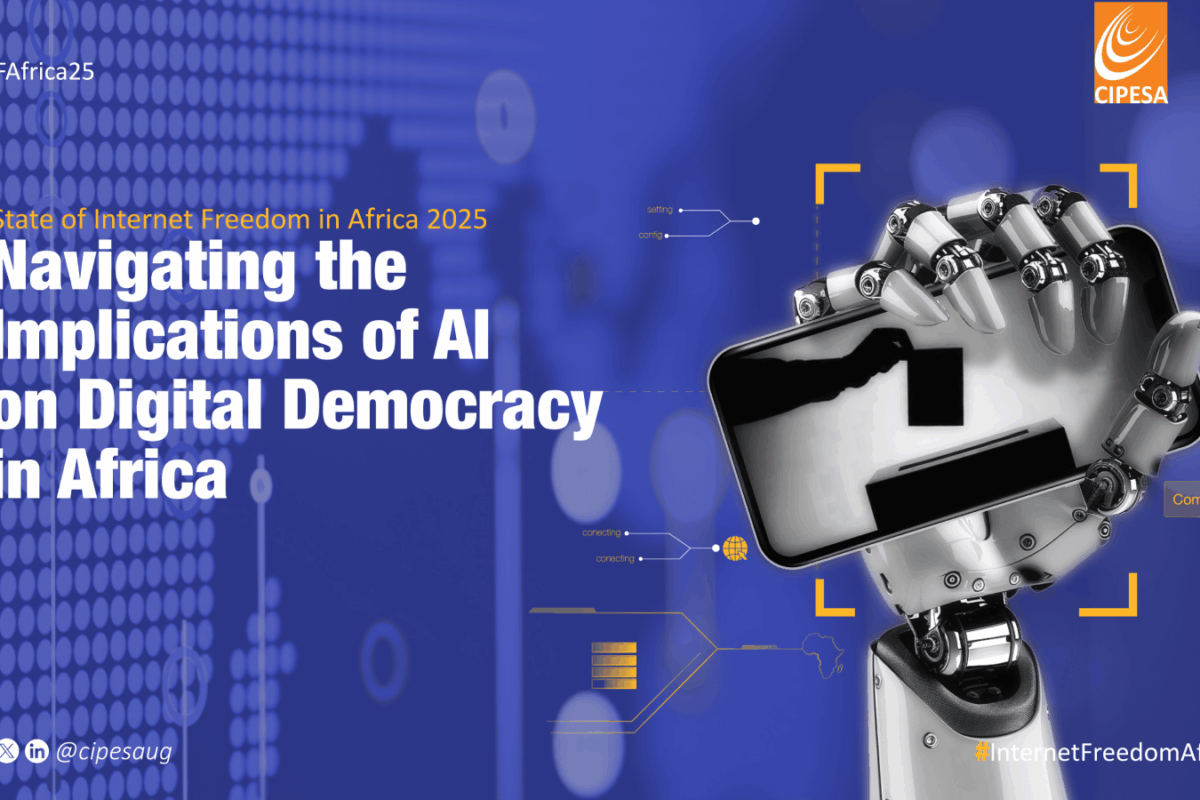
2025 State of Internet Freedom In Africa Report Documents the Implications of AI on Digital Democracy in Africa

By Juliet Nanfuka | 

The 2025 edition of the Forum on Internet Freedom in Africa (FIFAfrica25) concluded on a high note with the unveiling of the latest State of Internet Freedom in Africa (SIFA) report. Titled Navigating the Implications of AI on Digital Democracy in Africa, this landmark study unpacks how artificial intelligence is shaping, disrupting, and reimagining civic space and digital rights across the continent.

Drawing on research from 14 countries (Cameroon, Egypt, Ethiopia, Ghana, Kenya, Mozambique, Namibia, Nigeria, Rwanda, Senegal, South Africa, Tunisia, Uganda, and Zimbabwe), the report documents both the immense promise and the urgent perils of AI in Africa. It highlights AI’s potential to strengthen democratic participation, improve public services, and drive innovation, while also warning of its role in amplifying surveillance, disinformation, and exclusion. 

Using a qualitative approach, including literature review and key informant interviews, the report shows that AI is rapidly transforming how Africans interact with technology, yet AI also amplifies existing vulnerabilities, introduces new challenges that undermine fundamental freedoms, and deepens existing inequalities.

The report notes that the political environment is a crucial determinant of AI’s trajectory, with strong democracies generally enabling a positive outcome. Top performers in freedom and governance indices such as South Africa, Ghana, Namibia, and Senegal are more likely to set the standard to AI rollout in Africa. Conversely, countries with lower democratic credentials such as Cameroon, Egypt, Ethiopia, and Rwanda risk constraining AI’s potential or deploying it to amplify digital authoritarianism and political repression.  

Countries such as South Africa, Tunisia and Egypt that have a higher internet access and technological development, Gross Domestic Product (GDP) per capita, and score highly on the Human Development Index (HDI), are more likely to lead in AI. Meanwhile, countries with lower or weaker levels of digital infrastructure face greater challenges and higher risks of AI replicating and worsening existing divides. Such countries include Cameroon, Mozambique and Uganda.

The political environment is a crucial determinant of AI’s trajectory, with strong democracies generally enabling a positive outcome. Economic and developmental status also dictates the capacity for AI development and adoption. 

Despite these challenges, the report documents that AI offers substantial value to the public sector by improving service delivery and enhancing transparency. Governments are leveraging AI tools for efficiency, such as the South African Revenue Services (SARS) AI Assistant for tax assessments and Nigeria’s Service-Wise GPT for streamlined governance document access. In Kenya, the Sauti ya Bajeti (Voice of the Budget) platform fosters fiscal transparency by allowing citizens to query and track government expenditures. Furthermore, countries like Tunisia and Uganda are using AI models within tax bodies to detect fraud, while Rwanda is deploying AI for judicial system improvements and identity management at borders.

The private sector and academic institutions are driving AI-inspired innovation, particularly in the areas of FinTech, AgriTech, and Natural Language Processing (NLP). For the latter, notable efforts to localise AI include Tunisia’s TUNBERT model for Tunisian Arabic, and Ghana’s Khaya, an open-source AI-powered translator tailored for local languages. In Ghana, the DeafCanTalk, is an AI-powered app that enables bidirectional translation between sign language and spoken language, and has enhanced accessibility for deaf users. Rwanda has integrated AI into healthcare using drone delivery systems for medical supplies, while Cameroon and Uganda use AI to assist farmers with pest identification. 

However, despite increasing investment, such as the ongoing USD 720 million investment in compute power by Cassava Technologies across hubs in South Africa, Egypt, Kenya, Morocco, and Nigeria, Africa receives  significantly lower AI funding than global counterparts.

Moreover, while AI is gaining traction across many sectors, the proliferation of AI-generated misinformation and disinformation is a pervasive and growing challenge that poses a critical threat to electoral integrity. During South Africa’s 2024 elections, deepfake videos were circulated to manipulate perceptions and endorse political entities. Similarly, during elections and protests in Kenya and Namibia, deepfake technology and automated campaigns were used to discredit opponents. 

The report also documents that governments are deploying AI-powered surveillance technologies, which has led to widespread privacy violations and a chilling effect on freedoms. For example, pro-government propagandists in Rwanda utilised Large Language Models (LLMs) to mass-produce synthetic messages on social media, simulating authentic support and suppressing dissenting voices. Meanwhile, algorithmic bias and exclusion are producing discriminatory outcomes, particularly against low-resource African languages. Also, AI-based content moderation is often ineffective because it lacks contextual understanding and fails to capture local nuance.

A key finding in the report is that across the continent, the pace of AI development far outstrips regulatory readiness. None of the 14 study countries has AI-specific legislation. Instead, fragmented laws on data protection, cybercrime, and copyright are stretched to cover AI, but remain inadequate. Data protection authorities are under-resourced, under-staffed, and often lack the technical expertise required to audit or govern complex AI systems.

Although many national AI strategies are emerging, they prioritise economic growth while neglecting human rights and accountability. This is also fuelled by policy processes that are often opaque and dominated by state actors, with limited multistakeholder participation.

The report  stresses that without deliberate, inclusive, and rights-centred governance, AI risks entrenching authoritarianism and exacerbating inequalities. 

To avoid the current trajectory that AI is taking in Africa, in which AI risks entrenching authoritarianism and exacerbating inequalities, the report calls for a human-centred AI governance framework built on inclusivity, transparency, and context. 

It also makes recommendations, including enacting comprehensive AI-specific legislation, instituting mandatory human rights impact assessments, establishing empowered AI and data governance institutions, and promoting rights-based advocacy. Others are building technical capacity across governments, civil society and media, and developing policies that prioritise equity and human dignity alongside innovation.

AI offers Africa the opportunity to foster innovation, strengthen democracy, and drive sustainable development. This edition of the State of Internet Freedom in Africa report provides an evidence-based roadmap to ensure that Africa’s digital future remains open, inclusive, and rights-respecting.Find the report here.

Digital Access As A Tool To Defend Democracy

By Juliet Nanfuka | 

The link between digital access and democracy has come to inform civic engagement, access to information and freedom of expression in Africa. With most of the continent navigating flawed or fragile democracies, digital access has become a tool of both empowerment for citizens, and a tool of control by states. This makes the International Day of Democracy a vital commemoration of what is at risk if democracy is not defended. 

This year, in various African countries, through affronts to the media, clampdown on critical voices and opposition actors as well as network disruptions, states have used their position to undermine human rights and breed  distrust in electoral integrity.

Since July 2024, a block to internet access remains enforced in the Equatorial Guinean island of Annobón following public protest against environmental degradation by Somagec, a Moroccan construction company. Despite the public outcries, the company’s operations on the island continue. Equatorial Guinea, is headed by Teodoro Obiang Nguema Mbasogo, Africa’s longest-serving president. His son serves as the Vice President and is accused of spending state funds on a lavish lifestyle.

In Kenya, in the wake of a May 2025 landmark ruling against network disruptions, a Telegram block was initiated. The disruption occurred close to the anniversary of the June 2024 protests against the rising cost of living in the country that resulted in the #RejectThefinanceBill outcry. The May ruling noted that disruptions to digital access are unconstitutional and amount to the violation of fundamental rights.

On September 6, 2025, the online license of the popular online discussion group, JamiiForums was suspended by the Tanzania Communications Regulatory Authority (TCRA)  for three months for reportedly publishing content that violates the Electronic and Postal Communications Regulations regarding online content. In a public post, Jamii Forums noted that TCRA’s decision arose from the platform’s publication of details of share ownership in Tanzania’s largest coal mine (Ngaka), as well as reports about meetings between the President of Tanzania and controversial Zimbabwean businessman Wicknell Chivayo  “without verifying the facts.” In a statement, Community to Protect Journalists (CPJ) Regional Director Angela Quintal noted that, “JamiiForums’ suspension is the latest sign of the Tanzanian government’s deepening suppression of public discourse and raises concerns about access to information ahead of the October 29 elections.”

Meanwhile, Uganda remains in the shadow of a Facebook block initiated nearly five years ago ahead of the 2021 elections. On January 11, 2021 Facebook suspended the accounts of a number of government officials and members of the ruling National Resistance Movement (NRM) party  for what it described as Coordinated Inauthentic Behaviour (CIB) aimed at manipulating public debate. Twitter (now X) also suspended similar accounts. The state consequently blocked social media access and thereafter access to the entire internet and mobile money services. Although access to the internet and mobile money services was restored a few days after the January 14, 2021 election, access to Facebook remains blocked. Uganda heads to the polls in early 2026 and will see incumbent Yoweri Museveni run for re-election in a bid to extend his 40-year rule.

In the 2024 edition of the State of Internet Freedom in Africa report, the Collaboration on International ICT Policy for East and Southern Africa (CIPESA) highlighted the interplay between technology and elections and the practice of the majority of authoritarian governments to selectively limit access as a tool to exert power.

The report indicated various concerns including the intensification of digital authoritarianism amidst shrinking civic space. It noted that digital surveillance has become a defining tool of state power, moving beyond traditional intelligence agencies into everyday governance through digital ID  projects, biometric databases, Closed Circuit Television (CCTV) networks, and covert spyware. All this in contexts where there are weak safeguards for personal data and insufficient regulatory oversight, leaving citizens vulnerable.

Meanwhile, misinformation and disinformation, significantly enhanced by Artificial Intelligence (AI) generated content, adds yet another threat electoral processes. It is increasingly distorting public perception and undermines informed decision-making, particularly in contexts with low digital literacy. This is in addition to the use of bots and paid  influencers to amplify propaganda and “demote” opposing views, making inauthentic content appear genuine. Social media platforms are often criticised for deploying insufficient resources for content moderation in Africa, leading to slow responses and poor enforcement of policies against harmful content, including online gender-based violence.

Ultimately, more actors in the digital ecosystem including civil society organisations, the tech community, media and academia should leverage their watchdog role to document digital rights abuses; educate and raise awareness on the importance of access to information, free expression, data privacy; and promote equitable AI governance, in order to advance transparency and accountability of platforms and governments.
At the upcoming September 24-26, 2025, Forum on Internet Freedom in Africa (FIFafrica25), a series of sessions will critically examine digital democracy on the continent. The goal is to chart practical pathways for strengthening civic participation and ensuring that Africa’s digital future is inclusive, accountable, and rights-respecting.