Applications are Open for a New Round of Africa Digital Rights Funding!

Announcement |

The Collaboration on International ICT Policy for East and Southern Africa (CIPESA) is calling for proposals to support digital rights work across Africa.

This call for proposals is the 10th under the CIPESA-run Africa Digital Rights Fund (ADRF) initiative that provides rapid response and flexible grants to organisations and networks to implement activities that promote digital rights and digital democracy, including advocacy, litigation, research, policy analysis, skills development, and movement building.

 The current call is particularly interested in proposals for work related to:

  • Data governance including aspects of data localisation, cross-border data flows, biometric databases, and digital ID.
  • Digital resilience for human rights defenders, other activists and journalists.
  • Censorship and network disruptions.
  • Digital economy.
  • Digital inclusion, including aspects of accessibility for persons with disabilities.
  • Disinformation and related digital harms.
  • Technology-Facilitated Gender-Based Violence (TFGBV).
  • Platform accountability and content moderation.
  • Implications of Artificial Intelligence (AI).
  • Digital Public Infrastructure (DPI).

Grant amounts available range between USD 5,000 and USD 25,000 per applicant, depending on the need and scope of the proposed intervention. Cost-sharing is strongly encouraged, and the grant period should not exceed eight months. Applications will be accepted until November 17, 2025. 

Since its launch in April 2019, the ADRF has provided initiatives across Africa with more than one million US Dollars and contributed to building capacity and traction for digital rights advocacy on the continent.  

Application Guidelines

Geographical Coverage

The ADRF is open to organisations/networks based or operational in Africa and with interventions covering any country on the continent.

Size of Grants

Grant size shall range from USD 5,000 to USD 25,000. Cost sharing is strongly encouraged.

Eligible Activities

The activities that are eligible for funding are those that protect and advance digital rights and digital democracy. These may include but are not limited to research, advocacy, engagement in policy processes, litigation, digital literacy and digital security skills building. 

Duration

The grant funding shall be for a period not exceeding eight months.

Eligibility Requirements

  • The Fund is open to organisations and coalitions working to advance digital rights and digital democracy in Africa. This includes but is not limited to human rights defenders, media, activists, think tanks, legal aid groups, and tech hubs. Entities working on women’s rights, or with youth, refugees, persons with disabilities, and other marginalised groups are strongly encouraged to apply.
  • The initiatives to be funded will preferably have formal registration in an African country, but in some circumstances, organisations and coalitions that do not have formal registration may be considered. Such organisations need to show evidence that they are operational in a particular African country or countries.
  • The activities to be funded must be in/on an African country or countries.

Ineligible Activities

  • The Fund shall not fund any activity that does not directly advance digital rights or digital democracy.
  • The Fund will not support travel to attend conferences or workshops, except in exceptional circumstances where such travel is directly linked to an activity that is eligible.
  • Costs that have already been incurred are ineligible.
  • The Fund shall not provide scholarships.
  • The Fund shall not support equipment or asset acquisition.

Administration

The Fund is administered by CIPESA. An internal and external panel of experts will make decisions on beneficiaries based on the following criteria:

  • If the proposed intervention fits within the Fund’s digital rights priorities.
  • The relevance to the given context/country.
  • Commitment and experience of the applicant in advancing digital rights and digital democracy.
  • Potential impact of the intervention on digital rights and digital democracy policies or practices.

The deadline for submissions is Monday, November 17, 2025. The application form can be accessed here.

Uganda to Namibia: Biking for Digital Security and Internet Freedom in Africa

By FIFAfrica |

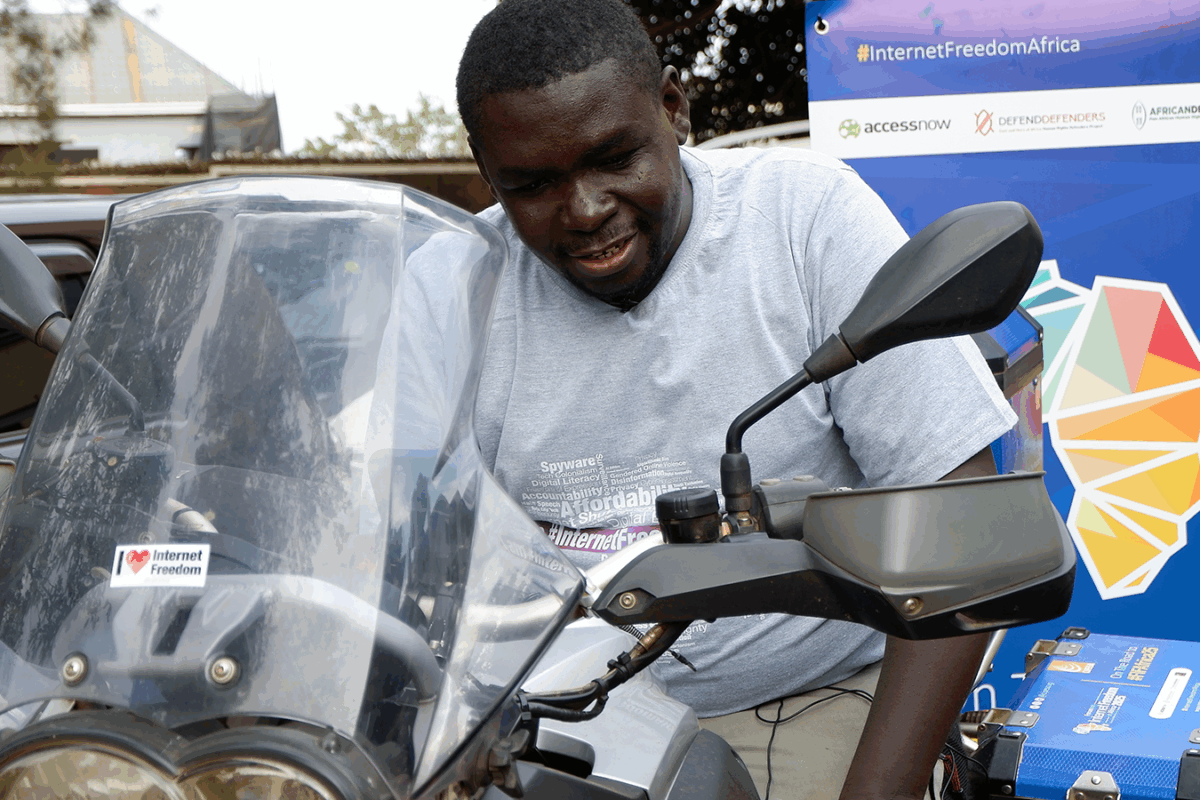
On Friday September 12, 2025, digital security expert and biker, Andrew Gole will set off on a solo motorbike journey spreading awareness about safety and security online. This will be the third time that Gole will travel across various countries on the continent ahead of the annual Forum on Internet in Africa (FIFAfrica). The effort is supported by the Collaboration on International ICT Policy for East and Southern Africa (CIPESA), Defend Defenders and Access Now.

Gole will commence his trip in Kampala, Uganda and over a round trip distance of 13,000 kilometers (km) traverse through Kenya, Tanzania, Malawi, Mozambique, Zimbabwe, and Botswana,  culminating in  Windhoek, Namibia, where the 2025 edition of FIFAfrica will convene this September 24-26, 2025. On his return journey to Uganda, Gole will also ride through Zambia and Rwanda, making it a total of 10 countries travelled through over the course of the journey. 

“I am truly excited to be hitting the road once again as part of the upcoming Forum on Internet Freedom in Africa. On my previous trips, I had the privilege of witnessing firsthand how diverse communities warmly embrace digital security as a key practice that empowers and protects their daily lives online and offline. These communities are often those left on the margins of mainstream efforts to enhance digital security, yet their eagerness to adopt these measures have been inspiring. I look forward to engaging with new communities on this trip and to  continuing this important work and deepening these connections as we move forward together.” – Andrew Gole, Digital Security Expert

Gole notes that traveling on his motorbike allowed him the mobility to connect directly with grassroots organisations. His “Digital Security on Wheels” initiative started in 2020 during the Covid-19 pandemic to address urgent digital security concerns beyond urban centers in Uganda and grew into a regional effort across East and Southern Africa through FIFAfrica.

In September 2022, ahead of the Forum which was held in Lusaka, Zambia and also served as the return to in-person meetings following a two year hiatus due to Covid-19, Gole pioneered the the #RoadToFiFAfrica Digital Security campaign. Gole embarked on the ambitious solo motorbike journey traversing approximately 3,300 kilometers.

The following year in 2023, ahead of the Tanzania edition of FIFAfrica, Gole led a major expedition that involved a team doing a round trip covering almost 10,000 km from Uganda through Kenya to Tanzania (and into the Indian Ocean island of Zanzibar via ferry). Gole was once again on his motorbike, supported by a team of digital rights experts from the Defenders Protection Initiative (DPI) in a passenger van.

We applaud Gole’s effort and celebrate the spirit he carries every mile to Windhoek. Andrew’s ride is a testament to the ongoing effort of building Africa’s internet freedom community. It embodies the practical, peer-led approach to digital safety that empowers often-overlooked communities. His journey to Windhoek mirrors CIPESA’s core mission of promoting the inclusive and effective use of ICT for improved governance and livelihoods in Africa. Gole’s remarkable endurance underscores that protecting our digital spaces demands mobility, resilience, and solidarity. We applaud his effort as he carries this message all the way from Kampala to Windhoek.”
– Brian Byaruhanga, Technology Officer, CIPESA

In all instances, Gole’s efforts culminated in the Digital Security Hub that has become a staple at FIFAfrica and serves as a one-stop-shop for attendees online and offline to secure their devices while also attaining practical skills and information on how to navigate online spaces safely. 

The Digital Security Hub convened by CIPESA has featured experts from across the world and this year will include experts from Africa Interactive Media, Base Iota, Co-creation HUB, Defenders Protection Initiative (DPI), Digital Society Africa, Greenhost/Frontline Defenders and Defend Defenders alongside SocialTic, and Foundacion Accesso bringing learnings and expertise from South America.

About the Forum on Internet Freedom in Africa: Now in its 12th year, the annual Forum on Internet Freedom in Africa (#FIFAfrica25) is the continent’s leading platform for shaping digital rights, inclusion, and governance conversations. This year, the Forum will be held in Windhoek, Namibia, a beacon of press freedom, gender equity, and progressive jurisprudence, and is set to take place on September 24–26, 2025. 

FIFAfrica offers a unique, multi-stakeholder platform where key stakeholders, including policymakers, journalists, global platform operators, telecommunications companies, regulators, human rights defenders, academia, and law enforcement representatives convene to deliberate and craft rights-based responses for a resilient and inclusive digital society for Africans. 

FIFAfrica25 will be the third edition to be hosted in Southern Africa. Previous editions have been hosted in Uganda, South Africa, Ghana, Ethiopia, Zambia, Tanzania and Senegal. Namibia, with its strong democratic credentials and progressive stance on digital transformation, provides a fitting host for FIFAfrica25.

About the Digital Security Hub: At the heart of FIFAfrica has been a Digital Security Hub designed to equip participants with practical knowledge and tools for staying safe in an increasingly digital environment. The Hub offers practical demonstrations and expert guidance on how to strengthen digital safety and resilience practices.

The Hub serves as a meeting for digital security trainers, technologists, and frontline users from across Africa and this year, Latin America as well. Digital security practices shared by the teams include advice on encryption and secure communications, through to countering online harassment and building safer digital infrastructures. 

The Digital Security hub is a vital feature of FIFAfrica25 and continues to serve as a space where communities can tangibly build their capacity to navigate the  constantly evolving digital ecosystem.

About the Collaboration on International ICT Policy for East and Southern Africa (CIPESA): CIPESA works to promote inclusive and effective use of Information and Communication Technology. (ICT) in Africa for improved governance and livelihoods. CIPESA was established in 2004 in response to the findings of the Louder Voices Report for the UK’s then Department for International Development (DFID), which cited the lack of easy, affordable and timely access to information about ICT-related issues and processes as a key barrier to effective and inclusive ICT policy making in Africa. CIPESA’s work continues to respond to a shortage of information, resources and actors consistently working at the nexus of technology, human rights and society.

Initially set up with a focus on research in East and Southern African countries, CIPESA has since expanded its work to include advocacy, capacity development and movement building across the African continent.

Today CIPESA is a leading ICT policy and governance think tank in Africa. CIPESA has strongly exhibited its passion about raising the capacity of African stakeholders in effective ICT policy making and in engendering ICT in development and poverty reduction, as per its mandate. 

For Queries about CIPESA and the Digital Resilience Hub

[email protected]
[email protected]

A Partnership to Advance Digital Rights and Internet Development in Africa

By Israel Nyoh |

The Internet Society and the Collaboration on International ICT Policy in East and Southern Africa (CIPESA) recently signed an agreement to work together for an open, secure, and trustworthy Internet for Africa.

A digital revolution is transforming markets and societies across Africa. Digitalization is helping governments to generate more income, while enabling e-commerce, e-health, and automation, which is strengthening African economies. But, as is often the case, with each technological promise there is also a threat. Because many African countries grapple with digital literacy and security challenges, digital technologies are being used to foster cyber criminality and cyber surveillance, while governments sometimes deny citizens their digital rights.

The agreement commits the Internet Society and CIPESA to advancing progressive Internet policy, advocating for the Internet way of networking, encryption, and measuring the health of digital infrastructure in the region.

Actions that promote a “trustworthy Internet to every African are of critical importance for the digital transformation plans that many African countries are implementing,” says Dawit Bekele, Regional Vice President for Africa, Internet Society.

The two organizations have further committed to:

  • Share knowledge, ideas, and lessons learned in Internet policy, encryption, and the Internet way of networking in Africa.
  • Pool efforts and expertise in responding to Internet policy issues in Africa.
  • Undertake joint research and stakeholder engagements, and lead advocacy on critical Internet policy and Internet development issues in the region.

CIPESA has a history of advocating for digital rights and building capacity on digital security in Africa, mostly through research, stakeholder engagements, and knowledge sharing. This agreement with the Internet Society will strengthen CIPESA’s efforts while enabling it to also reach new constituencies in Africa.

Wairagala Wakabi, Executive Director of CIPESA, says, “The key to meaningfully promoting digital rights and Internet development in Africa lies in multi-sector partnerships that leverage varied expertise, address the critical and emerging issues, and steadily reach wider constituencies of multiple stakeholders.”

History of Collaboration

The Internet Society and CIPESA have been working together for close to a decade to advance digital rights in Africa.

Their work has focused on strengthening the development of personal data protection guidelines for Africa, fighting against Internet shutdown and restrictions, and growing the community of people advancing digital rights and Internet development in Africa, through the Forum on Internet Freedom in Africa (FIFAfrica).

This article was first published by the Internet Society on August 19, 2021.

Skilling Distributed Digital Security Trainers Amidst Growing Digital Rights Attacks

By Neil Blazevic, Andrew Gole and Ashnah Kalemera |

Amidst increased attacks on digital rights activists, journalists, and human rights defenders (HRDs) during the Covid-19 pandemic, it has become crucial to grow the capacity of these actors to operate securely. A key concern is that, in many African countries, skills in digital security and safety are lacking among some of the most at-risk groups, yet trainers and support networks are in short supply.

Without adequate digital security capacity, activists and HRDs are not able to meaningfully continue advocacy and engagements around human rights, transparent and accountable governance, during and in the aftermath of Covid-19. Accordingly, through the Level-Up programme, the Collaboration on International ICT Policy for East and Southern Africa (CIPESA) has provided security support to 16 HRD organisations in Kenya, Ethiopia, Tanzania, South Sudan and Uganda. 

The initiative helped to strengthen the participating entities’ organisational and information systems security capacity, entailed a Training of Trainers (ToT) component – which benefitted 19 individuals – to grow the network of individuals and organisations that offer digital security training and support to journalists, activists, and HRDs, and organisational security assessments. The training and support were delivered through innovative approaches to geographically distributed individuals that could not meet physically due to Covid-19 social distancing and travel restrictions.

Covid-19 and Digital Attacks

In the wake of the global outbreak of the Covid-19 pandemic and government measures to curb its spread, digital technologies have played a vital role in enhancing disease surveillance, coordinating response mechanisms, and promoting public awareness in Africa. The potential of technology to facilitate containment of the spread of the coronavirus on the continent notwithstanding, concerns over surveillance, violation of rights to privacy, freedom of expression, access to information, and freedom of association and assembly were prevalent. 

Scores of journalists and bloggers in Kenya, Guinea, Uganda, Egypt, among others, were assaulted, detained, and/or prosecuted over their reporting on Covid-19; while some countries such as Kenya, Uganda and South Africa were reported to be conducting cell phone tracking of Covid-19 suspected patients and their contacts. Some others passed regulations and/or invoked laws that criminalised the spreading of false Covid-19 information. Accordingly, there have been fears that in the aftermath of the pandemic, some governments could shift the Covid-19 surveillance apparatus and lessons learnt to undermine digital rights, by surveilling and silencing critics and opponents. 

Meanwhile, hackers and adversaries are capitalising on the increased time spent online and remote working by a large portion of the population by designing new attacks through phishing and hijacking of virtual meetings, among others. Worryingly, despite a large gender disparity in digital access, more women face various forms of online violence than their male counterparts, which continues to undermine their participation online. With Covid-19 resulting in increased incidents of gender-based violence, it is imperative to continue activism and equip activists with digital security and safety skills.

Organisations supported Technologists supported 
Countries: Uganda (8) | Tanzania (4) | South Sudan (2) | Kenya (1) | Ethiopia (1)

Sectors: Sexual minorities (4), Environmental/resource extraction (1) Feminist/women’s rights organisations (3), Information access (1), Journalists/media (1), Human rights, democracy, human rights defenders (6)

Gender: Female (7) |Male (12)

Nationality: Uganda (8) | Ethiopia (3) | South Sudan (1) | Tanzania (4) | Kenya (3)

Assessing Organisational Security

Following an initial training on conducting organisational security assessments, the technologists led assessments to determine the status, challenges, past and potential future threats, and attacks on organisations, as well as the capacity of the organisations. The results of the assessments provided insight into the needs and vulnerabilities of the organisations and served as an opportunity to provide feedback to organisational IT staff on quick fixes and strategies to address some of the challenges or incidents identified. Technology solutions explored included the use of Umbrella for DNS server protection, Automox for patch management, and Microsoft 365 hosted tenants for an organisational management and security suite.

The findings of the assessments indicated a need to bolster capacity, organisational practices, and implementation of security and safety measures related to social media platforms usage by the organisations and staff. Several organisations reported losing access to their brand assets, experiencing hacking, and harassment on social media platforms. To this end, a Social Media Asset Continuity and Security Tool was designed and another  training for technologists conducted focused on 1) Continuity of organisation control of organisational Facebook/Twitter/Whatsapp for Business accounts; 2) Security of individual staff accounts; and 3) Staff ability to deal with harassment and unwanted messaging on platforms. The technologists went on to conduct safety and security on social media training sessions which  benefitted 120 staff of the participating organisations. Other skill-up sessions conducted included on organisational management suites and website security. 

Overall, the programme found that skills and protections (software and hardware) were low and inadequate among many HRD organisations and individuals. Also, there were variable levels of technology integration within the organisations. 

The various gaps identified were rising during the pandemic when many entities could not readily access support networks and training skills due to restrictions on gatherings arising from Covid-19, making the intervention particularly timely. Indeed, the ToT model helped to transfer skills and knowledge among distributed beneficiaries and build support networks in-country.

#WomenAtWebUg Media Masterclass and Reporting Grant Programme

Announcement |

The Collaboration on International ICT Policy for East and Southern Africa (CIPESA) is pleased to announce the Women At Web Uganda (#WomenAtWebUg) Masterclass and Reporting Grant Programme. The two-phase programme builds on research conducted and engagements held as part of the Women At Web project of the DW.

The first phase of the programme will see successful applicants participate in a #WomenAtWebUg Masterclass – a workshop on digital rights and digital security. In the second phase, outstanding participants from the Masterclass will receive guided mentorship and a reporting grant aimed at improving the sometimes biased reporting on the violations of women’s online rights in Uganda.  Meanwhile, the mentorship will explore themes such as affordability, digital literacy, data privacy, digital economy, women and elections, women in the media, censorship, and self-censorship, the impact of COVID-19, and much more, through a gendered lens. It will relate these to current laws and the role that the media plays in addressing perceptions, supporting advocacy, and holding the state accountable to its obligations.

It is expected that the Women At Web Uganda Masterclass and Reporting Grant Programme will contribute to the increased visibility of the dynamics faced by Ugandan women online, and improved balance, quality and regularity of reporting.

Compensation: Successful grantees will be expected to create various outputs, which may include print articles such as features, broadcast content, multimedia content (animations and infographics) and social media content. A modest allowance will be provided to cater for expenses related to the production of the outputs as part of the programme.

Eligibility: Applicants should be early to mid-career print, broadcast, online or multi-media journalists. Individuals passionate about media platforms such as bloggers and social media enthusiasts with relevant skills are also welcome to apply. Applicants must be based in Uganda.

Application process

To apply, email [email protected] with a subject line stating #WomenAtWebUg Media Masterclass and Reporting Grant Programme. Submissions should include:

  • Your CV
  • A short statement of interest (maximum 500 words) that mentions the outputs you intend to produce if selected to proceed past the #WomenAtWebUg Masterclass accompanied with an indicative  budget
  • Two samples of your work (written or other)

Timeframes

  • Apply by: Monday October 26, 2020
  • #WomenAtWebUg Masterclass: November 3-4, 2020
  • #WomenAtWebUg Media Mentoring and Reporting Grant: November 10-30, 2020