Applications are Open for a New Round of Africa Digital Rights Funding!

Announcement |

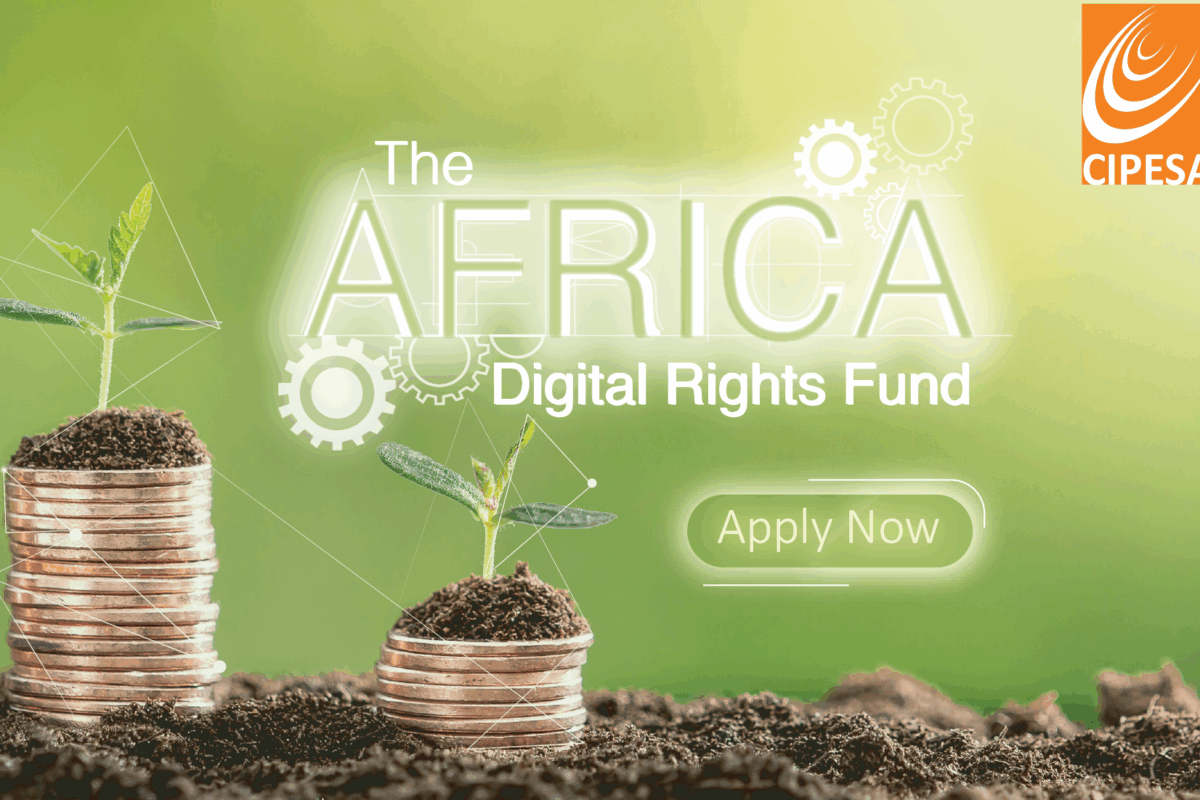
The Collaboration on International ICT Policy for East and Southern Africa (CIPESA) is calling for proposals to support digital rights work across Africa.

This call for proposals is the 10th under the CIPESA-run Africa Digital Rights Fund (ADRF) initiative that provides rapid response and flexible grants to organisations and networks to implement activities that promote digital rights and digital democracy, including advocacy, litigation, research, policy analysis, skills development, and movement building.

 The current call is particularly interested in proposals for work related to:

  • Data governance including aspects of data localisation, cross-border data flows, biometric databases, and digital ID.
  • Digital resilience for human rights defenders, other activists and journalists.
  • Censorship and network disruptions.
  • Digital economy.
  • Digital inclusion, including aspects of accessibility for persons with disabilities.
  • Disinformation and related digital harms.
  • Technology-Facilitated Gender-Based Violence (TFGBV).
  • Platform accountability and content moderation.
  • Implications of Artificial Intelligence (AI).
  • Digital Public Infrastructure (DPI).

Grant amounts available range between USD 5,000 and USD 25,000 per applicant, depending on the need and scope of the proposed intervention. Cost-sharing is strongly encouraged, and the grant period should not exceed eight months. Applications will be accepted until November 17, 2025. 

Since its launch in April 2019, the ADRF has provided initiatives across Africa with more than one million US Dollars and contributed to building capacity and traction for digital rights advocacy on the continent.  

Application Guidelines

Geographical Coverage

The ADRF is open to organisations/networks based or operational in Africa and with interventions covering any country on the continent.

Size of Grants

Grant size shall range from USD 5,000 to USD 25,000. Cost sharing is strongly encouraged.

Eligible Activities

The activities that are eligible for funding are those that protect and advance digital rights and digital democracy. These may include but are not limited to research, advocacy, engagement in policy processes, litigation, digital literacy and digital security skills building. 

Duration

The grant funding shall be for a period not exceeding eight months.

Eligibility Requirements

  • The Fund is open to organisations and coalitions working to advance digital rights and digital democracy in Africa. This includes but is not limited to human rights defenders, media, activists, think tanks, legal aid groups, and tech hubs. Entities working on women’s rights, or with youth, refugees, persons with disabilities, and other marginalised groups are strongly encouraged to apply.
  • The initiatives to be funded will preferably have formal registration in an African country, but in some circumstances, organisations and coalitions that do not have formal registration may be considered. Such organisations need to show evidence that they are operational in a particular African country or countries.
  • The activities to be funded must be in/on an African country or countries.

Ineligible Activities

  • The Fund shall not fund any activity that does not directly advance digital rights or digital democracy.
  • The Fund will not support travel to attend conferences or workshops, except in exceptional circumstances where such travel is directly linked to an activity that is eligible.
  • Costs that have already been incurred are ineligible.
  • The Fund shall not provide scholarships.
  • The Fund shall not support equipment or asset acquisition.

Administration

The Fund is administered by CIPESA. An internal and external panel of experts will make decisions on beneficiaries based on the following criteria:

  • If the proposed intervention fits within the Fund’s digital rights priorities.
  • The relevance to the given context/country.
  • Commitment and experience of the applicant in advancing digital rights and digital democracy.
  • Potential impact of the intervention on digital rights and digital democracy policies or practices.

The deadline for submissions is Monday, November 17, 2025. The application form can be accessed here.

Digital Access As A Tool To Defend Democracy

By Juliet Nanfuka | 

The link between digital access and democracy has come to inform civic engagement, access to information and freedom of expression in Africa. With most of the continent navigating flawed or fragile democracies, digital access has become a tool of both empowerment for citizens, and a tool of control by states. This makes the International Day of Democracy a vital commemoration of what is at risk if democracy is not defended. 

This year, in various African countries, through affronts to the media, clampdown on critical voices and opposition actors as well as network disruptions, states have used their position to undermine human rights and breed  distrust in electoral integrity.

Since July 2024, a block to internet access remains enforced in the Equatorial Guinean island of Annobón following public protest against environmental degradation by Somagec, a Moroccan construction company. Despite the public outcries, the company’s operations on the island continue. Equatorial Guinea, is headed by Teodoro Obiang Nguema Mbasogo, Africa’s longest-serving president. His son serves as the Vice President and is accused of spending state funds on a lavish lifestyle.

In Kenya, in the wake of a May 2025 landmark ruling against network disruptions, a Telegram block was initiated. The disruption occurred close to the anniversary of the June 2024 protests against the rising cost of living in the country that resulted in the #RejectThefinanceBill outcry. The May ruling noted that disruptions to digital access are unconstitutional and amount to the violation of fundamental rights.

On September 6, 2025, the online license of the popular online discussion group, JamiiForums was suspended by the Tanzania Communications Regulatory Authority (TCRA)  for three months for reportedly publishing content that violates the Electronic and Postal Communications Regulations regarding online content. In a public post, Jamii Forums noted that TCRA’s decision arose from the platform’s publication of details of share ownership in Tanzania’s largest coal mine (Ngaka), as well as reports about meetings between the President of Tanzania and controversial Zimbabwean businessman Wicknell Chivayo  “without verifying the facts.” In a statement, Community to Protect Journalists (CPJ) Regional Director Angela Quintal noted that, “JamiiForums’ suspension is the latest sign of the Tanzanian government’s deepening suppression of public discourse and raises concerns about access to information ahead of the October 29 elections.”

Meanwhile, Uganda remains in the shadow of a Facebook block initiated nearly five years ago ahead of the 2021 elections. On January 11, 2021 Facebook suspended the accounts of a number of government officials and members of the ruling National Resistance Movement (NRM) party  for what it described as Coordinated Inauthentic Behaviour (CIB) aimed at manipulating public debate. Twitter (now X) also suspended similar accounts. The state consequently blocked social media access and thereafter access to the entire internet and mobile money services. Although access to the internet and mobile money services was restored a few days after the January 14, 2021 election, access to Facebook remains blocked. Uganda heads to the polls in early 2026 and will see incumbent Yoweri Museveni run for re-election in a bid to extend his 40-year rule.

In the 2024 edition of the State of Internet Freedom in Africa report, the Collaboration on International ICT Policy for East and Southern Africa (CIPESA) highlighted the interplay between technology and elections and the practice of the majority of authoritarian governments to selectively limit access as a tool to exert power.

The report indicated various concerns including the intensification of digital authoritarianism amidst shrinking civic space. It noted that digital surveillance has become a defining tool of state power, moving beyond traditional intelligence agencies into everyday governance through digital ID  projects, biometric databases, Closed Circuit Television (CCTV) networks, and covert spyware. All this in contexts where there are weak safeguards for personal data and insufficient regulatory oversight, leaving citizens vulnerable.

Meanwhile, misinformation and disinformation, significantly enhanced by Artificial Intelligence (AI) generated content, adds yet another threat electoral processes. It is increasingly distorting public perception and undermines informed decision-making, particularly in contexts with low digital literacy. This is in addition to the use of bots and paid  influencers to amplify propaganda and “demote” opposing views, making inauthentic content appear genuine. Social media platforms are often criticised for deploying insufficient resources for content moderation in Africa, leading to slow responses and poor enforcement of policies against harmful content, including online gender-based violence.

Ultimately, more actors in the digital ecosystem including civil society organisations, the tech community, media and academia should leverage their watchdog role to document digital rights abuses; educate and raise awareness on the importance of access to information, free expression, data privacy; and promote equitable AI governance, in order to advance transparency and accountability of platforms and governments.
At the upcoming September 24-26, 2025, Forum on Internet Freedom in Africa (FIFafrica25), a series of sessions will critically examine digital democracy on the continent. The goal is to chart practical pathways for strengthening civic participation and ensuring that Africa’s digital future is inclusive, accountable, and rights-respecting.