
State of Internet Freedom In Africa Report

2025 State of Internet Freedom In Africa Report Documents the Implications of AI on Digital Democracy in Africa

By Juliet Nanfuka | 

The 2025 edition of the Forum on Internet Freedom in Africa (FIFAfrica25) concluded on a high note with the unveiling of the latest State of Internet Freedom in Africa (SIFA) report. Titled Navigating the Implications of AI on Digital Democracy in Africa, this landmark study unpacks how artificial intelligence is shaping, disrupting, and reimagining civic space and digital rights across the continent.

Drawing on research from 14 countries (Cameroon, Egypt, Ethiopia, Ghana, Kenya, Mozambique, Namibia, Nigeria, Rwanda, Senegal, South Africa, Tunisia, Uganda, and Zimbabwe), the report documents both the immense promise and the urgent perils of AI in Africa. It highlights AI’s potential to strengthen democratic participation, improve public services, and drive innovation, while also warning of its role in amplifying surveillance, disinformation, and exclusion. 

Using a qualitative approach, including literature review and key informant interviews, the report shows that AI is rapidly transforming how Africans interact with technology, yet AI also amplifies existing vulnerabilities, introduces new challenges that undermine fundamental freedoms, and deepens existing inequalities.

The report notes that the political environment is a crucial determinant of AI’s trajectory, with strong democracies generally enabling a positive outcome. Top performers in freedom and governance indices such as South Africa, Ghana, Namibia, and Senegal are more likely to set the standard to AI rollout in Africa. Conversely, countries with lower democratic credentials such as Cameroon, Egypt, Ethiopia, and Rwanda risk constraining AI’s potential or deploying it to amplify digital authoritarianism and political repression.  

Countries such as South Africa, Tunisia and Egypt that have a higher internet access and technological development, Gross Domestic Product (GDP) per capita, and score highly on the Human Development Index (HDI), are more likely to lead in AI. Meanwhile, countries with lower or weaker levels of digital infrastructure face greater challenges and higher risks of AI replicating and worsening existing divides. Such countries include Cameroon, Mozambique and Uganda.

The political environment is a crucial determinant of AI’s trajectory, with strong democracies generally enabling a positive outcome. Economic and developmental status also dictates the capacity for AI development and adoption. 

Despite these challenges, the report documents that AI offers substantial value to the public sector by improving service delivery and enhancing transparency. Governments are leveraging AI tools for efficiency, such as the South African Revenue Services (SARS) AI Assistant for tax assessments and Nigeria’s Service-Wise GPT for streamlined governance document access. In Kenya, the Sauti ya Bajeti (Voice of the Budget) platform fosters fiscal transparency by allowing citizens to query and track government expenditures. Furthermore, countries like Tunisia and Uganda are using AI models within tax bodies to detect fraud, while Rwanda is deploying AI for judicial system improvements and identity management at borders.

The private sector and academic institutions are driving AI-inspired innovation, particularly in the areas of FinTech, AgriTech, and Natural Language Processing (NLP). For the latter, notable efforts to localise AI include Tunisia’s TUNBERT model for Tunisian Arabic, and Ghana’s Khaya, an open-source AI-powered translator tailored for local languages. In Ghana, the DeafCanTalk, is an AI-powered app that enables bidirectional translation between sign language and spoken language, and has enhanced accessibility for deaf users. Rwanda has integrated AI into healthcare using drone delivery systems for medical supplies, while Cameroon and Uganda use AI to assist farmers with pest identification. 

However, despite increasing investment, such as the ongoing USD 720 million investment in compute power by Cassava Technologies across hubs in South Africa, Egypt, Kenya, Morocco, and Nigeria, Africa receives  significantly lower AI funding than global counterparts.

Moreover, while AI is gaining traction across many sectors, the proliferation of AI-generated misinformation and disinformation is a pervasive and growing challenge that poses a critical threat to electoral integrity. During South Africa’s 2024 elections, deepfake videos were circulated to manipulate perceptions and endorse political entities. Similarly, during elections and protests in Kenya and Namibia, deepfake technology and automated campaigns were used to discredit opponents. 

The report also documents that governments are deploying AI-powered surveillance technologies, which has led to widespread privacy violations and a chilling effect on freedoms. For example, pro-government propagandists in Rwanda utilised Large Language Models (LLMs) to mass-produce synthetic messages on social media, simulating authentic support and suppressing dissenting voices. Meanwhile, algorithmic bias and exclusion are producing discriminatory outcomes, particularly against low-resource African languages. Also, AI-based content moderation is often ineffective because it lacks contextual understanding and fails to capture local nuance.

A key finding in the report is that across the continent, the pace of AI development far outstrips regulatory readiness. None of the 14 study countries has AI-specific legislation. Instead, fragmented laws on data protection, cybercrime, and copyright are stretched to cover AI, but remain inadequate. Data protection authorities are under-resourced, under-staffed, and often lack the technical expertise required to audit or govern complex AI systems.

Although many national AI strategies are emerging, they prioritise economic growth while neglecting human rights and accountability. This is also fuelled by policy processes that are often opaque and dominated by state actors, with limited multistakeholder participation.

The report  stresses that without deliberate, inclusive, and rights-centred governance, AI risks entrenching authoritarianism and exacerbating inequalities. 

To avoid the current trajectory that AI is taking in Africa, in which AI risks entrenching authoritarianism and exacerbating inequalities, the report calls for a human-centred AI governance framework built on inclusivity, transparency, and context. 

It also makes recommendations, including enacting comprehensive AI-specific legislation, instituting mandatory human rights impact assessments, establishing empowered AI and data governance institutions, and promoting rights-based advocacy. Others are building technical capacity across governments, civil society and media, and developing policies that prioritise equity and human dignity alongside innovation.

AI offers Africa the opportunity to foster innovation, strengthen democracy, and drive sustainable development. This edition of the State of Internet Freedom in Africa report provides an evidence-based roadmap to ensure that Africa’s digital future remains open, inclusive, and rights-respecting.Find the report here.
Lesotho Charts a Progressive Path on Data Governance

Patricia Ainembabazi |

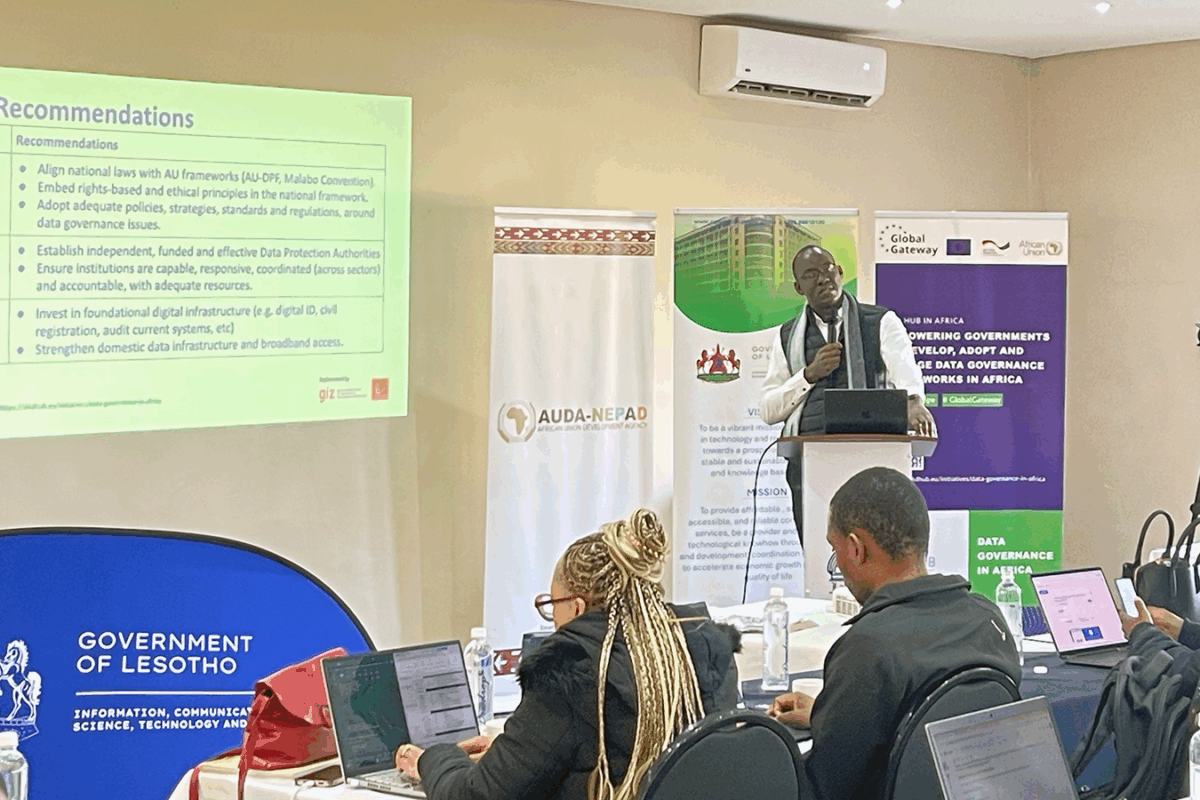
From July 28-31, Lesotho’s highland capital of Maseru buzzed with the energy of a data governance sprint. Government officials, academics, civil society, and the private sector assembled for an intensive workshop convened by the African Union Development Agency-NEPAD and AU-GIZ with support from the Lesotho Ministry of Information, Communications, Science, Technology and Innovation (MICSTI), the Collaboration on International ICT Policy for East and Southern Africa (CIPESA) and the Kenya ICT Action Network (KICTANet). 

The gathering drew over 60 participants with a shared proposition: get everyone on the same page about what good data governance should look like in Lesotho and how to achieve it. The workshop charted a pathway for Lesotho to domesticate the African Union Data Policy Framework (AUDPF), which was adopted by the African Union in 2022. The framework provides guidance to Member States on building harmonised, rights-respecting data governance policies that support digital transformation, innovation, and secure cross-border data flows. 

Lesotho’s efforts to domesticate this framework come at a crucial time, as the country seeks to modernise its digital policy environment and position itself within the continent’s increasingly data-driven economy. These efforts, including the workshop, demonstrate Lesotho’s political will to align with continental digitalisation and data governance blueprints such as the AUDPF and to build an inclusive digital future.

Lesotho’s Minister for Information, Communications, Science, Technology and Innovation,  Nthati Moorosi, stated that the various workshop sessions aimed to “instill more understanding on data governance for clear domestication of the [AUDPF] policy framework.” Sessions saw participants introduced to key concepts such as data as a public good, the importance of ethics and accountability, and the need for harmonised cross-border data policies. Case studies from across Africa helped illustrate how sound data governance could unlock value in sectors such as agriculture, health, and education.  

CIPESA led practical sessions during which participants examined Lesotho’s Data Protection Act and the draft Data Management Policy (2025) in relation to key African instruments, including the AUDPF, the Malabo Convention, the African Continental Free Trade Area (AfCFTA), and the Digital Transformation Strategy for Africa. Participants noted areas of alignment between the national and continental frameworks but also identified gaps in the national data governance framework

As such, effort went into mapping out where Lesotho is already aligned with the AUDPF and which specific areas need to be prioritised in revising the country’s legal and policy framework. Recommendations from this mapping exercise included establishing an independent Data Protection Commission, clarifying categories of personal and sensitive data, improving inter-agency coordination, and investing in digital literacy and data privacy skills across the public and private sectors. 

The workshop was complemented by a strategic stakeholder survey to assess perceptions on Lesotho’s data governance framework. The survey revealed a minimal understanding of the country’s data governance frameworks. Over half of the respondents stated that existing policies were outdated and unable to address current challenges such as cross-border data flows, cloud computing, and evolving digital privacy threats. Respondents identified digital trade, innovation, health research, and public trust as key benefits of robust data governance. Responses further emphasised the importance of inclusive policymaking, public awareness on data governance campaigns in both English and Sesotho, alongside targeted support for rural and marginalised communities. 

By the conclusion of the meeting, participants had agreed on a national data governance strengthening roadmap. With contributions coming from the broad spectrum of participants, who included Princess Senate Mohato Seeiso, through to Principal Secretary Kanono Leronti Ramashamole of the MICSTI, who noted that “data is no longer a by-product of administration but a strategic national asset”, the meeting reinforced the value multistakeholderism holds in digital governance. 

Undeniably, no single institution can carry the policymaking load by itself. The real story from Maseru is the multistakeholder collaboration, with the MICSTI anchoring at home, the AUDA-NEPAD and AU-GIZ bringing continental scaffolding, civic and technical communities translating frameworks into practice, and a steady emphasis that data governance has to work for everyone. Ultimately, this process could enable Lesotho to not just catch up with the AUDPF, but to help show what a people-centred, innovation-friendly data ecosystem looks like in the region. 

As regional leaders in digital rights and digital governance, CIPESA is committed to providing continued support to Lesotho as it works to reform its policies and institutionalise stronger data governance mechanisms. Our involvement helps to ensure that national efforts are grounded in best practices and aligned with continental and global standards, such as those set by the African Union.

Amplifying African Voices in Global Digital Governance

By CIPESA Writer |

The Collaboration on International ICT Policy for East and Southern Africa (CIPESA) will be participating at the 2025 Internet Governance Forum (IGF) in Norway. The IGF serves as key  global multistakeholder platform that facilitates the discussion of public policy issues pertaining to the Internet. This year, the Forum takes place from June 23-27, 2025 in Lillestrom, Norway under the overarching theme of Building Our Multistakeholder Digital Future.

CIPESA will contribute expertise across multiple sessions that examine digital rights in the Global South. These include discussions on repressive cyber laws and their impact on civic space, inclusive and harmonised data governance frameworks for Africa, and the barriers to participation in global technical standards development. CIPESA will also join sessions highlighting cross-regional cooperation on data governance, digital inclusion of marginalised groups, and the need for multilingual accessibility in global digital processes. CIPESA will also support a booth (number #57) hosted by the Civil Society Alliances for Digital Empowerment (CADE)  of which it is a member. The booth will showcase activities and resources, including the winners of the AI Artivism for Digital Rights Competition, the Youth Voices for Digital Rights programme, and much more. Through these engagements, CIPESA enhance and amplify African perspectives on platform accountability, digital justice, and rights-based approaches to internet governance.The insights gathered and shared at the IGF will also inform the upcoming 2025 edition of the Forum on Internet Freedom in Africa (FIFAfrica25) – an event convened annually by CIPESA. The Forum, now in its 12th year ranks as Africa’s leading platform for shaping digital rights, inclusion, and governance conversations. This year, the Forum will be hosted in  Windhoek, Namibia and will take place on September 24–26, 2025.

Here is where to find CIPESA @ IGF2025 ..

Monday, June 23 | 16:00-17:00 (CEST) – Workshop Room 3

Day 0 Event #257:  Enhancing Data Governance in the Public Sector  

This session will examine the state of data governance in the public sector of developing countries, emphasizing the importance of inclusive, multi-stakeholder engagement. It highlights how current frameworks often centre government institutions while neglecting interoperability, collaboration, and broader policy cohesion. Using global case studies—particularly from Papua New Guinea—it will spotlight challenges and propose innovations like centralized oversight bodies, interoperable platforms, and adaptive governance. Best practices such as real-time analytics, data partnerships, and capacity building will be explored to support scalable and context-specific governance solutions.

Tuesday, June 24 |  14:45–15:45 (CEST) – Workshop Room 4

Open Forum #56: Shaping Africa’s Digital Future: Multi-Stakeholder Panel on Data Governance

As Africa advances its digital transformation, harmonized data governance is critical to unlocking the continent’s potential for inclusive growth and digital trade. Fragmented national policies and inconsistent cross-border data frameworks create barriers to innovation, privacy, and cybersecurity. This session will convene stakeholders from government, industry, and civil society to explore strategies for regulatory alignment, trusted data flows, and climate-resilient governance models. Aligned with the AU Data Policy Framework, it will highlight best practices to build a unified, rights-respecting digital economy in Africa.

Tuesday, June 24 | 13:30-15:30 (CEST) –  Room  Studio N

Parliamentary session 4: From dialogue to action: Advancing digital cooperation across regions and stakeholder groups

Host: UN, Stortinget (Norwegian Parliament) and Inter Parliamentary UnionInternet (IPU)

Building on the outputs of the 2024 IGF Parliamentary Track and the discussions held so far in 2025, this multi-stakeholder consultation will bring together MPs and key digital players to reflect on how to operationalize concrete, inclusive and collaborative policymaking efforts. All groups will be invited to propose cooperative approaches to building digital governance and identify practical steps for sustaining cooperation beyond the IGF.

Wednesday, June 25 | 17:30 -19:00(CEST) – Workshop room 4, NOVA Spektrum 

Side event: Aspirations for the India AI Impact Summit

Hosts: CIPESA, Centre for Communication Governance at National Law University Delhi (CCG), United Nations Office for Digital and Emerging Technologies (UN ODET).

This closed-door dialogue aims to spark early conversations toward an inclusive and representative Global AI Impact Summit, focusing on the participation of Global Majority experts. It will explore meaningful engagement in Summit working groups, side events, and knowledge sharing, especially building on insights from the Paris Summit. The session is part of a broader effort to host multiple convenings that strengthen diverse stakeholder participation in global AI governance. By addressing foundational questions now, the dialogue seeks to shape intentional, impactful, and inclusive discussions at the upcoming Summit.

Wednesday June 25 | 09:00-09:45 (CEST) – Workshop Room 4

Networking Session #93: Cyber Laws and Civic Space – Global South–North Advocacy Strategies

Host: CADE

Many governments are enacting cyber laws to address online crime, but these often contain vague provisions that enable repression of journalists, activists, and ordinary citizens. In practice, such laws have facilitated mass surveillance, curtailed privacy, and been weaponised to stifle dissent, particularly under authoritarian regimes. This session brings together Global North and Global South civil society actors to exchange experiences, resources, and strategies for resisting repressive cyber legislation. It will focus on how collaborative advocacy can support legal reform and safeguard digital rights through shared tools, solidarity, and policy influence.

Wednesday, June 25 | 14:15–15:30 (CEST) – Workshop Room 4

Open Forum #7: Advancing Data Governance Together – Across Regions

Hosts: CIPESA, Deutsche Gesellschaft für Internationale Zusammenarbeit (GIZ) GmbH, The Republic of The Gambia

As cross-border data flows grow rapidly, effective data governance is essential for fostering trust, security, and inclusive digital development. However, fragmented national regulations and inconsistent privacy and cybersecurity standards pose challenges to regional and global cooperation. This session brings together stakeholders from Africa, the Eastern Partnership, and the Western Balkans to explore harmonized, interoperable governance models that support responsible data sharing and economic growth. Through collaborative dialogue, the session will identify strategies for aligning data governance with digital rights, innovation, and sustainable development across diverse regional contexts.

Thursday, June 26 | 12:30–13:00 (CEST) – Open Stage

Lightning Talk #90: Tower of Babel Chaos – Tackling the Challenges of Multilingualism for Inclusive Communication

Host: CADE

This interactive session, led by members of the Civil Alliances for Digital Empowerment (CADE), highlights the communication challenges faced in global digital forums due to linguistic, gender, and geographic diversity. Using a flash-mob-style simulation, participants will experience firsthand the difficulties of multistakeholder dialogue when multiple native languages intersect without common understanding. The session underscores that language is often the most significant barrier to meaningful inclusion in global digital governance. It aims to provoke thought on the urgent need for more multilingual and accessible participation in international digital policy spaces.

Thursday, June 26 | 16:00-17:00 (CEST) – Workshop Room 6

WS #214: AI Readiness in Africa in a Shifting Geopolitical Landscape

Host: German Federal Ministry for Economic Cooperation and Development (BMZ), supported by GIZ

AI has vast potential, but without proper governance, it risks deepening inequality and reinforcing Africa’s dependency on global tech powers. Despite growing local engagement, Africa remains underrepresented in global AI development due to limited investment, regulatory gaps, and the dominance of multinational firms, raising concerns about digital exploitation. This session will bring together diverse voices to explore how Africa can build inclusive, locally rooted AI ecosystems that protect rights and serve regional needs.

Friday, June 27 | 09:00–10:00 (CEST) – Workshop Room 2

Open Forum #34: How Technical Standards Shape Connectivity and Inclusion

Host: Freedom Online Coalition

Technical standards are essential to enabling global connectivity, interoperability, and inclusive digital access, but their development often excludes voices from the Global Majority and marginalized communities. This session will examine how open and interoperable standards can bridge the digital divide, focusing on infrastructure such as undersea cables, network protocols, and security frameworks. It will explore barriers to inclusive participation in standard-setting bodies like the ITU, IETF, IEEE, and W3C, and identify strategies for transparency and multistakeholder engagement. By promoting equitable, rights-respecting technical governance, the session aims to support digital inclusion and advance sustainable development goals.

Friday, June 27 | 11:45–12:30 (CEST) – Workshop Room 6

Networking Session #74: Mapping Digital Rights Capacities and Threats

Host: Oxfam

This session will present findings from multi-country research on digital rights capacities and threats, with a focus on historically marginalised groups in the Global South. It will showcase innovative strategies and tools used to build digital literacy and awareness, using poster presentations from Bolivia, Cambodia, Palestine, Somalia, and Vietnam. Participants will engage in a moderated discussion to share practical approaches and collaborate on building a more inclusive, rights-based digital ecosystem. The session will also contribute to a shared online repository of tools, fostering international cooperation and capacity-building through the ReCIPE program led by Oxfam.

Friday, June 27 | 11:45–12:30 (CEST) – Workshop Room 5

Networking Session #200 – Cross-Regional Connections for Information Resilience 

Host: Proboxve

This networking session brings together participants from diverse regions to connect, share experiences, and develop collaborative strategies for safeguarding information integrity in electoral processes while upholding internet freedoms. The session will address critical challenges such as disinformation, censorship, foreign interference, platform manipulation, and civic education, emphasizing the importance of protecting digital rights, especially during elections.