By CIPESA Writer |
The right to freedom of information, access to information, and democratic engagement belongs equally to all citizens. Yet across Africa, women and girls continue to face significant barriers that prevent them from exercising these foundational rights in digital spaces. This calls for urgent legal and enforcement mechanisms to ensure that women and girls can safely access, contribute to, and participate in information ecosystems. Furthermore, social media and Artificial Intelligence (AI) platforms must address the gendered concerns that impact women’s experiences in online spaces, including disproportionate online harassment, algorithmic discrimination, and digital exclusion. See more here.
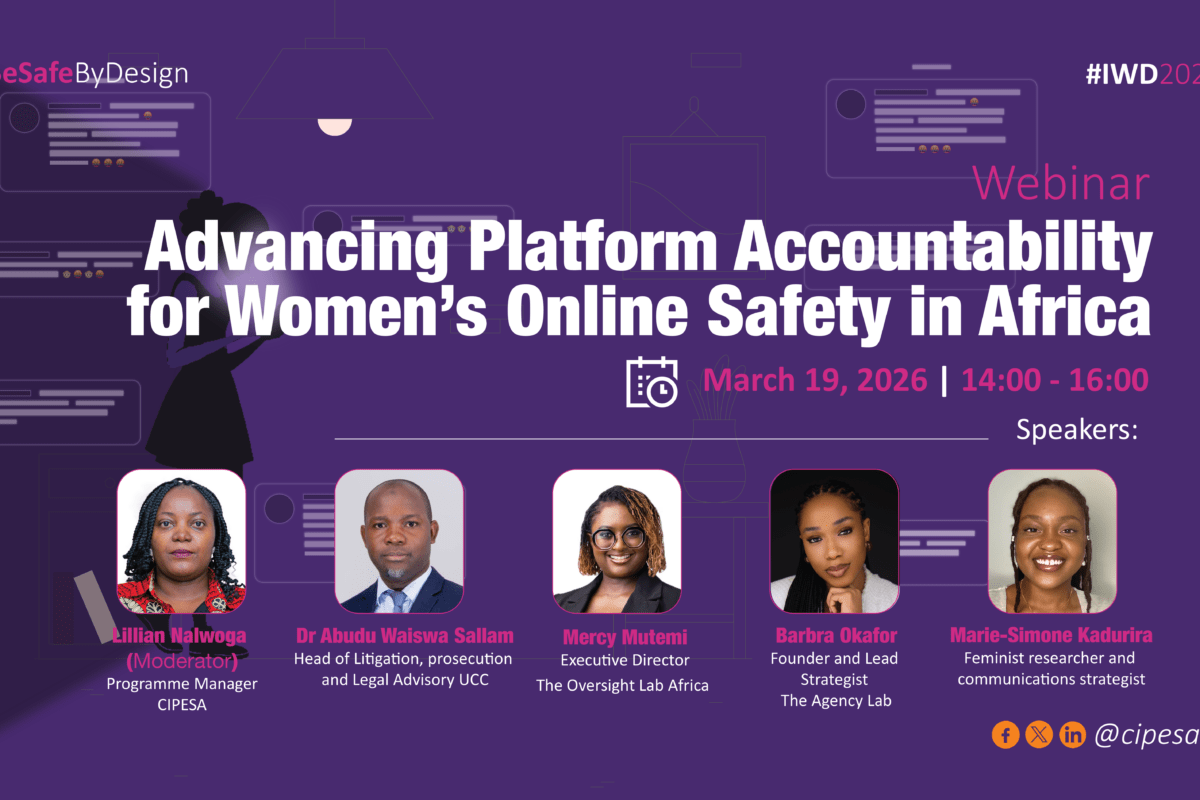
In support of this year’s International Women’s Day (IWD) commemoration, the Collaboration on International ICT Policy for East and Southern Africa (CIPESA) is hosting a webinar titled “Advancing Platform Accountability for Women’s Online Safety in Africa” on Thursday, 19 March 2026 (14:00–15:30 EAT). The webinar resonates with this year’s IWD theme: “Rights. Justice. Action. For ALL Women and Girls.”
Register for the webinar here.
The webinar brings together experts to discuss what efforts are being made to enhance the safety of women in online spaces and to hold platforms accountable. It supports the sentiments of United Nations (UN) General Assembly President Annalena Baerbock, who last week, in her opening remarks at the 70th UN Commission on the Status of Women, noted that the gaps in legal rights afforded to women are deliberate. She stated that “these are not oversights but deliberate choices — choices that violate the UN Charter, the Universal Declaration of Human Rights, and 70 years of commitments made in this Commission.”
This webinar serves as a platform for discussion and insight into the various efforts needed to address these gaps. The discussion is open to all and features expert panelists from diverse backgrounds with a vested interest in advancing the safety of women in online spaces.
Meet the Panelists
Barbra Okafor | Founder and Lead Strategist, The Agency Lab
Barbra is the Founder of The Agency Lab, an initiative empowering African creatives and organisations to secure data ownership, protect Intellectual Property (IP), and navigate fair compensation in the AI economy. Drawing on her previous roles as Content Programming Lead at TikTok Sub-Saharan Africa and Senior Producer at BBC Media Action, Barbra translates complex digital transitions into actionable strategies. Her work sits at the critical intersection of the African creator economy, technology, and governance.
Marie-Simone Kadurira | Feminist researcher and communications strategist
Marie-Simone works at the intersection of gender, technology, and social justice. Her work focuses on technology-facilitated gender-based violence (TFGBV), digital rights, and the ways in which online platforms shape access, safety, and agency for women and marginalised communities. She has contributed to research and advocacy efforts examining how online harms disproportionately affect women, particularly in the Global South, and has worked with international organisations to develop policy and communications strategies aimed at strengthening platform accountability and advancing safer digital environments. Her work engages with questions of governance, content moderation, and the structural inequalities embedded within digital ecosystems. She is currently engaged in research on gender-based violence prevention and supports initiatives that centre community-led approaches to justice, safety, and digital inclusion.
Mercy Mutemi | Executive Director, The Oversight Lab Africa
Mercy’s work advocates for fair regulation and deployment of technology across Africa. She focuses on restorative and retributive justice solutions for those who have been harmed by technology. This includes workers who have been exploited to build and maintain technological systems and those who have been harmed by algorithms. She has worked on several cases and initiatives focused on addressing inequality and the unconsidered consequences of tech algorithms for African communities and societies. She currently represents a cohort of content moderators based throughout Africa in a suit over workplace human rights violations.
Abdul Waiswa | Head of Litigation, Prosecution and Legal Advisory, Uganda Communications Commission
Waiswa works as the Head of Litigation, Prosecution and Legal Advice at the Uganda Communications Commission (UCC), which is the statutory regulator of the converged communications sector in Uganda, with a mandate to license, supervise, and facilitate the development of a robust communication sector in Uganda. He oversees the legal advisory, licensing, and enforcement functions of UCC and supports the implementation of the Government of Uganda’s policies on ICT. Waiswa is a regular participant in national, regional, and international engagements on internet jurisdiction, data, and other ICT-related policy matters.
Lilian Nalwoga | Programme Manager, CIPESA
Lillian has several years of ICT policy research and advocacy experience, having joined the CIPESA as a Policy Officer in 2007. She has facilitated and coordinated ICT policy workshops – including coordinating the East African Internet Governance Forum. Lillian has a Bachelors of Development Studies (Makerere University, Uganda) with a Postgraduate Diploma in Project Management as well as advanced training in Internet studies. She holds a Master’s in Digital Media and Society from Uppsala University, Sweden. She is also the former President of the Internet Society (ISOC) Uganda.
The webinar forms part of the #BeSafeByDesign campaign, which calls for improved platform accountability in Africa. The campaign is part of a project supported by the Irene M. Staehelin Foundation. Since December 2025, the project has pursued a series of collaborative activities aimed at improving online safety and governance. These included a convening in Nairobi, Kenya, which served as the launch of the #BeSafeByDesign campaign. The convening assembled human rights defenders and activists from eight African countries for upskilling in digital resilience. In February 2026, a meeting held in Port Louis, Mauritius brought together 30 participants — including judges, magistrates, law enforcement officers, communications regulators, data protection authorities, and National Human Rights Institutions (NHRIs). Participants recommended that African governments strengthen their engagement with big tech companies through regional mechanisms, such as the African Union, to present a more coordinated voice on issues of platform accountability.