CIPESA-Run ADRF Awards USD 140,000 to Eleven Digital Democracy Non-Profits Amidst Funding Cuts

By Ashnah Kalemera |

With many funders shifting their funding priorities about human rights, governance and livelihood issues, African Civil Society Organisations (CSOs), human rights defenders and activists have been severely impacted. As a result, critical programming on civic participation, tech accountability, digital rights and digital inclusion, which was scoring wins in the face of growing authoritarianism on the continent, has been crippled. 

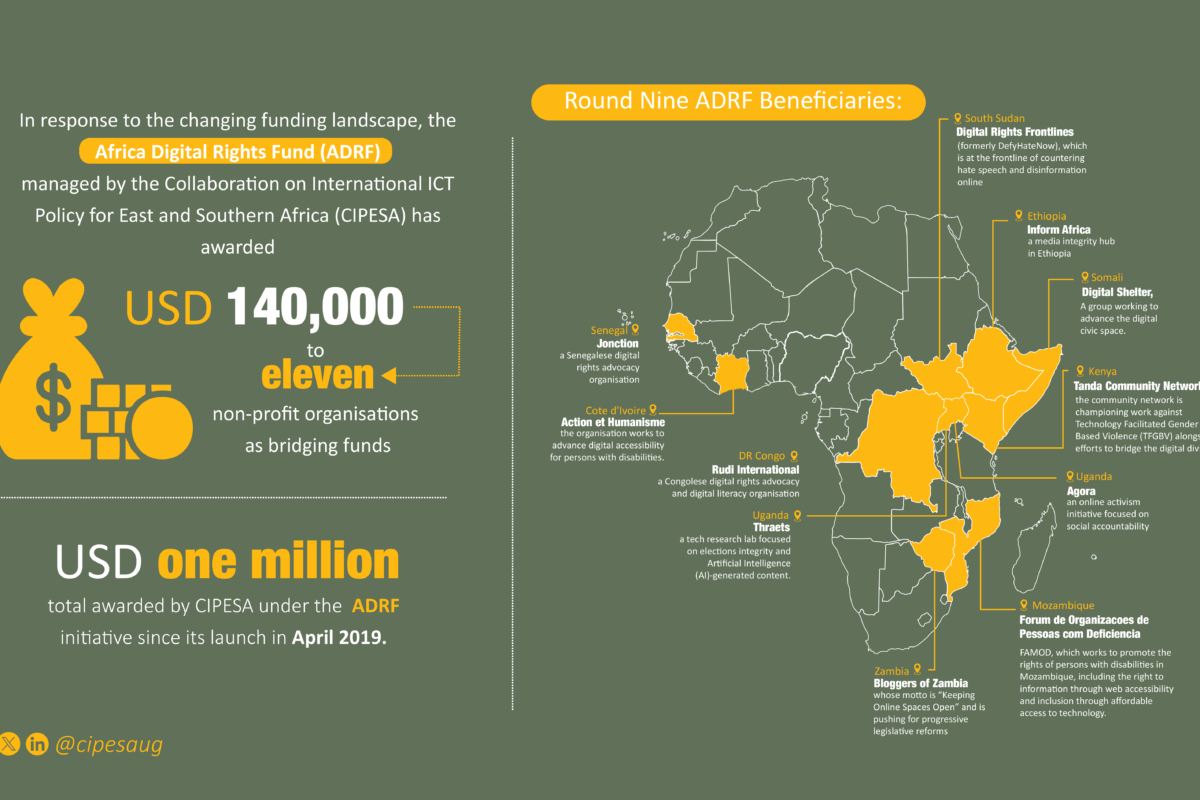
In response to this changing funding landscape, the Africa Digital Rights Fund (ADRF) managed by the Collaboration on International ICT Policy for East and Southern Africa (CIPESA) has awarded USD 140,000 to eleven non-profit organisations as bridging funds. The discretionary awards are aimed at bridging the gap in operations and programming faced by CIPESA’s past and present partners and subgrantees. The funds bring to USD one million the total awarded by CIPESA under the  ADRF initiative since its launch in April 2019.

According to CIPESA’s Executive Director, Dr. Wairagala Wakabi, “anchor institutions such as CIPESA have lost funding and that means many crucial but smaller actors across the continent have equally been affected”. Nonetheless, CIPESA is committed to “defending digital democracy amidst the steady  democratic regression we are witnessing, and the cruciality of funding organisations that are battling rising authoritarianism cannot be overemphasised,” said Wakabi.

The recipient organisations work on various digital democracy issues in 10 countries – Cote d’Ivorie, the Democratic Republic of Congo (DR Congo), Ethiopia, Kenya, Mozambique, Senegal, Somalia, South Sudan, Uganda and Zambia. These organisations work on catalytic issues in difficult contexts and have established track records. The selection of beneficiaries was guided by a survey on the impact of funding termination by the United States (US) government. 

Round Nine ADRF Beneficiaries:

  1. Action et Humanisme – based in Cote d’Ivoire, the organisation works to advance digital accessibility for persons with disabilities. 
  2. Agora, an online activism initiative focused on social accountability in Uganda.
  3. Bloggers of Zambia, whose motto is “Keeping Online Spaces Open” and is pushing for progressive legislative reforms in Zambia.
  4. Digital Rights Frontlines (formerly DefyHateNow), which is at the frontline of countering hate speech and disinformation online in South Sudan.
  5. Digital Shelter, a Somali group working to advance the digital civic space.
  6. Forum de Organizacoes de Pessoas com Deficiencia – FAMOD, which works to promote the rights of persons with disabilities in Mozambique, including the right to information through web accessibility and inclusion through affordable access to technology.
  7. Inform Africa, a media integrity hub in Ethiopia.
  8. Jonction, a Senegalese digital rights advocacy organisation.
  9. Thraets, a tech research lab focused on elections integrity and Artificial Intelligence (AI)-generated content.
  10. Rudi International, a Congolese digital rights advocacy and digital literacy organisation.
  11. Tanda Community Network, based in Kibera, Nairobi, Kenya, the community network is championing work against Technology Facilitated Gender Based Violence (TFGBV) alongside efforts to bridge the digital divide.

The survey revealed that following the suspension and eventual termination of U.S. funding, many organisations had reduced the scope of their activities, scaled back staff salaries and benefits, and in a number of cases laid off staff. Over 90% of the organisations surveyed  were uncertain about their ability to maintain operations beyond two months. Only one of the surveyed organisations said it would remain fully operational if it did not receive additional funding.

A staggering 92% of respondents had reduced programming scope and one in three respondent organisations reported that they had slashed staff. For one recipient, over 60% of the team was “not able to continue working in any capacity going forward”. The percentage of US funding was between 20% and 60% of the annual budgets of the organisations surveyed.

Even in the face of a grim funding future, civil society organisations that face harassment and operate in volatile political environments remain resilient. As the head of one of the grant beneficiary organisations stated: “Unfortunately, we do not have the luxury to cease activities”. The same unwavering commitment to continue operations was demonstrated by the DR Congo-based recipient whose digital literacy training centre was robbed during the January 2025 rebel attacks in Goma.

The ADRF provides financial support to organisations and networks to overcome barriers to accessing funding and building a stronger movement of digital and human rights advocates in Africa. The Fund has also built the capacity of initiatives in advocacy, public communication, research and data-for-advocacy. Supported initiatives commend the ADRF as a unique funding initiative that has broken ranks with traditional funders’ structure. See previous ADRF recipients here.

The discretionary round of the ADRF was supported by funding from the Skoll Foundation, the Wellspring Philanthropic Fund and the Ford Foundation. Other supporters of the ADRF in the past include the Center for International Private Enterprise (CIPE), the Swedish International Development Cooperation Agency (Sida), the German Society for International Cooperation Agency (GIZ), the Omidyar Network, the Hewlett Foundation, the Open Society Foundations and New Venture Fund (NVF).
Call for Proposals: Round Three of the Africa Digital Rights Fund (ADRF)

Call for Proposals |

The Collaboration on International ICT Policy for East and Southern Africa (CIPESA) is pleased to issue the third call for proposals to the Africa Digital Rights Fund (ADRF), which supports digital rights work across the continent through flexible and rapid response grants.

The current call is particularly interested in proposals for work related to Covid-19 response measures, how they affect the internet rights landscape, and how to redress any resulting harms to rights and freedoms. This effort is essential because, even in pandemic times, governments must respect rights and not abuse emergency powers. Moreover, many actors need access to credible information and research to inform their own work on awareness-raising and holding authorities to account during and in the aftermath of Covid-19.

Digital technologies are playing a role in enhancing Covid-19 disease surveillance, coordinating response mechanisms, and promoting public awareness. However, some technology-based response measures could harm the enjoyment of digital rights, particularly the right to privacy and personal data protection, freedom of expression and association online during and post- Covid-19. Indeed, since the Covid-19 pandemic outbreak, CIPESA and a number of digital rights organisations have taken a keen interest in issues of misinformation, censorship and surveillance.

However, while the current scenario requires proactive and sustained digital rights advocacy, many digital rights organisations, especially smaller ones, need funds to sustain their work, credible research to inform their engagements, and support for their advocacy campaigns.

Launched in April 2019, the ADRF supports organisations and networks to implement activities that advance digital rights, including advocacy, litigation, research, policy analysis, movement building, digital literacy and digital security skills building. The inaugural round of ADRF awarded USD 65,000 to 10 initiatives advancing digital rights in Algeria, Burundi, Egypt, Ethiopia, Gambia, Mozambique, Namibia, Nigeria, Sierra Leone, Senegal, South Sudan, Tanzania, Tunisia, Uganda, Zambia and Zimbabwe.

The second call for applications saw a total of USD 152,000 awarded to 14 initiatives that are advancing digital rights through various projects in 18 African countries – Algeria, Cameroon, Democratic Republic of Congo (DR Congo), Ethiopia, Ghana, Ivory Coast, Kenya, Malawi, Mozambique, Nigeria, Rwanda, Somalia, Somaliland, Sudan, Tanzania, Tunisia, Uganda and Zimbabwe.

Grant amounts for this round will range between USD 1,000 and USD 20,000, depending on the need and scope of the proposed intervention. The ADRF strongly encourages cost-sharing. The grant period will not exceed six months.

The deadline for submissions is Friday August 7, 2020. Read more about the ADRF round three guidelines here.  The application form can be accessed here.

Call For Applications: Africa Digital Rights Fund

Call for Applications |
With a quarter of Africa’s population using the internet and with 76 mobile phone connection for every 100 individuals, Information and Communications Technology (ICT) has become pivotal to improving livelihoods and promoting human rights on the continent. However, with rising digital rights violations such as arrests and intimidation of internet users, network shutdowns, and a proliferation of laws and regulations that hamper internet access and affordability, the potential of digital technologies to catalyse free expression and civic participation or to drive innovation is under threat in Africa. Yet many organisations working to defend and promote digital rights face limitations of reach, skills, resources, and consistency in engagement in this area.
To address this, the Collaboration on International ICT Policy for East and Southern Africa (CIPESA) has established the Africa Digital Rights Fund (ADRF) to offer flexible and rapid response grants to select initiatives in Africa to implement activities that advance digital rights, including advocacy, litigation, research, policy analysis, digital literacy and digital security skills building.
Assessments have found that whereas digital rights advocacy in the region has a large pool of interest, ”it is very shallow, spread very thinly and difficult to sustain”. The policy and practice developments in the region, coupled with the challenges faced by civil society organisations, necessitate partnerships that bring together various competences for advancing digital rights. The ADRF has been developed to strengthen local capacity in evidence-based research, collaborative advocacy and impactful policy engagements responsive to regulatory and practice developments that affect internet freedom in the region.  
The ADRF grant amounts will range between US$ 1,000 and US$ 10,000 based on the  need and scope of the proposed intervention. The grant period will not exceed six months with an average of 15 grants to be awarded per year.
The Fund will benefit small organisations, including those that do not qualify for support from most funders for lack of registration and institutional capacity to develop applications and manage big projects. It  will also benefit organisations and initiatives that need rapid response support to respond swiftly to emerging issues that can not wait for many funders’ lengthy application procedures.
Applications are now open  for the period July-December 2019. The deadline for submissions is Friday May 31, 2019. Read more about the Fund and the eligibility criteria here.  The application form can be accessed here.