
MOSIP Connect 2026 Calls for Scalable, Country-Driven Digital Public Infrastructure

By Milliam Murigi |

African governments have been urged to move beyond pilot projects and develop a Digital Public Infrastructure (DPI) that is open, secure, nationally owned and capable of operating at a full national scale to truly serve citizens.

This call was made today in Morocco during the launch of the MOSIP Connect 2026 conference. Speaking at the event, Prof. Debabrata Das, Director of the International Institute of Information Technology (IIIT) – Bangalore, emphasized that DPI cannot remain at the pilot stage indefinitely.

“DPI must be scaled to operate at national levels,” he said, highlighting that such systems are not just technology projects but national assets that underpin citizens’ access to services like education, health, social protection, and payments.

DPI refers to government-backed digital systems and platforms designed to provide citizens with secure, accessible, and efficient services. These systems include national digital IDs, e-government portals, digital payment platforms, and health and social service databases.

Across Africa, countries are making significant strides in implementing DPI, though progress varies widely. Ghana’s national ID system, the Ghana Card, has been linked to banking, mobile verification, and social services, while Rwanda has achieved over 90 percent coverage of adults with digital IDs integrated into multiple government services.

Kenya’s Maisha Namba program seeks to consolidate several identity databases into a single, unified platform. Despite these advances, many initiatives remain fragmented or confined to pilot projects, limiting their ability to deliver services nationwide.

Prof. Das stressed that for DPI to deliver real public value, it must be open-source, secure, respect national and data sovereignty, and be designed to evolve with changing policies, technologies, and citizen needs.

“DPI is not regular software development. When embraced, it becomes part of the relationship between citizens and the state. That means it must be based on evidence, transparency, accountability and continuous learning.”

According to him, six principles should guide next-generation DPI development: open-source technology, respect for national and data sovereignty, neutrality in partnerships, reusability of systems, commitment to national-scale deployment and the ability to evolve as policies, technologies and citizens’ needs change.

Additionally, he added that building successful national digital systems requires three elements working together: strong technology platforms and standards, governance structures that ensure accountability, and institutional and user capacity to adopt the systems. Without all three, pilot programs risk failing to scale.

“Data creates power. Countries must retain control over the data generated through digital systems. This is why sovereignty considerations are central to MOSIP’s approach when working with governments,” he added.

The Modular Open Source Identity Platform (MOSIP) a IIIT-Bangalore project, offers countries modular and open-source technology to build and own their national identity systems. The project aims to provide governments with the tools for meaningful digital transformation, established on a bedrock of good principles and human-centric design.

Speaking at the same event, Abdelhak Harrak, Director of Information Systems and Telecommunications, Ministry of the Interior, Kingdom of Morocco said that the success of a digital identification system does not rely solely on technical solutions, however advanced they may be, it also depends on strong governance and the sustained mobilization of teams responsible for rigorously managing complex transformations involving numerous field actors. It is this synergy that ensures both the security and the sustainability of a national identification system.

“Technology alone cannot drive change; it is the alignment of people, processes, and purpose that turns innovation into lasting impact,” said Harrak.

He also highlighted the role of private-sector and civil-society partners in building sustainable digital ecosystems. He described them as “essential” rather than peripheral, noting that innovation often comes from organizations that build localized solutions on top of open platforms.

This article was first published by Science Africa on February 12, 2026.

Strengthening Media Reporting on Digital Public Infrastructure in Eastern Africa

By Juliet Nanfuka |

On October 13-15, 2025, the Collaboration on International ICT Policy for East and Southern Africa (CIPESA), in partnership with Co-Develop hosted 20 journalists in a workshop as part of the Digital Public Infrastructure (DPI) Journalism Fellowship for Eastern Africa. This is a regional initiative aimed at strengthening journalists’ capacity to report knowledgeably and critically on DPI and Digital Public Goods (DPGs) in the region.

The workshop took place in Nairobi, Kenya and brought together journalists from Burundi, the Democratic Republic of the Congo, Ethiopia, Kenya, Rwanda, Somalia, South Sudan, Tanzania, and Uganda, who are receiving both knowledge-and skills-based training alongside a reporting grant to produce in-depth DPI stories.

At an inaugural virtual workshop held in August 2025, the Fellows examined among others, Digitalisation and digital rights in Eastern Africa; UN and African Union frameworks on DPI; the DPI ecosystem in Eastern Africa; and Media coverage of DPI across nine countries, based on CIPESA’s ongoing research. The workshop also provided practical training in journalism skills, including technology beat reporting, conceptualising story ideas, writing effective pitches, data storytelling, and the use of AI in storytelling.

Report Launch

Following the workshop, a regional public event was hosted on October 16, 2025, and served to showcase findings from a multi-country media monitoring study on DPI coverage conducted y CIPESA. 

The report presents the findings of a baseline study on media coverage of Digital Public Infrastructure (DPI) and Digital Public Goods (DPGs) across seven Eastern African countries in 2024: Democratic Republic of Congo (DRC), Ethiopia, Kenya, Rwanda, South Sudan, Tanzania, and Uganda. Using a mixed-methods approach that combined quantitative content analysis and key informant interviews, the study analysed 680 DPI- and DPG-related stories published in 28 major print and online outlets between January and December 2024. 

The study assessed the volume, prominence, themes, sourcing patterns, and framing of stories and complemented the findings with interviews and focus group discussions involving journalists, editors, and experts. The study reveals that while media in the region are actively reporting on digital transformation, the coverage is largely event-driven, government-centric, and male-dominated. It focuses primarily on the functional benefits of DPI—such as service delivery and innovation—while giving limited attention to critical issues of governance, data privacy, equity, and citizen inclusion.

Find the report summary here

The G20 Should Challenge the Power Dynamics in Digital Public Infrastructure

Juliet Nanfuka |

Data plays a crucial role in T20 discussions at the G20, influencing online interaction and civic engagement. The G20 should use its influence to create a multi-stakeholder agenda for Digital Public Infrastructure design.

Data is at the heart of T20 discussions around the G20, as it informs the architecture of online interaction, civic participation (and exclusion) and the governance of digital society. As such, it is also central to digital public infrastructure (DPI), serving as a foundational requirement and an enabler of new data generation and data mobility. Data drives the three key pillars of DPI – digital identification, digital payments and data exchange – in addition to other emerging features such as geospatial data and data aggregation. However, the expanding role of DPI raises questions about its alignment with constitutional guarantees, data protection frameworks and the lived realities of end users across Africa.

In 2023, India’s G20 presidency laid the foundation for discourse on DPI with great precision. A year later, the 2024 G20 Rio de Janeiro Leaders’ Declaration acknowledged ‘the contribution of digital public infrastructure to an equitable digital transformation’. It went on to note ‘the transformative power of digital technologies to bridge existing divides and empower societies and individuals including all women and girls and people in vulnerable situations. 

Consequently, DPI has been positioned as a necessary tool for international trade facilitation and industrialisation in developing countries. In Africa, this momentum has been supported by strategies such as the AU’s Digital Transformation Strategy for Africa (2020–2030), the African Continental Free Trade Area (AfCFTA) and the 2024 adoption of the Continental AI Strategy. Various countries across the continent have integrated DPI into their national strategies.

The pace of DPI integration is mirrored by growing financial investment in DPI. Examples include the $200 million Ghana Digital Acceleration Project by the World Bank in 2022 to expand broadband access and strengthen digital innovation ecosystems. In June 2025, the AfCFTA Adjustment Fund Credit Facility funded $10 million to support private sector adaptation to AfCFTA frameworks, with initial commitments to Telecel Global Services to enhance connectivity and regional integration. The company provides wholesale voice and SMS services and enterprise connectivity solutions to more than 250 telecom operators across Africa and globally.

While the expansion of DPI is often framed as a progressive step, it also carries significant governance trade-offs. The expansion of DPI in countries with weak democratic safeguards heightens the risk of state overreach, mass surveillance and reduced civic freedoms, making it essential to set clear limits on state access to citizens’ data to safeguard participation and accountability. Further, concerns over data sovereignty also loom.

Other T20 commentaries have stressed the urgent need for multi-stakeholder engagement to align DPI with the realities of developing countries. Without this alignment, DPI could increase existing regulatory gaps that compromise civic rights and consumer protection, fraud prevention and privacy. Meanwhile, the current wave of DPI design could exclude smaller economies that lack the capacity to engage in complex cross-border arrangements, such as those established between India’s Unified Payments Interface and Singapore’s PayNow. However, efforts such as the East African Community’s Cross-Border Payment System Masterplan aimed at inclusive, secure, efficient and interoperable cross-border payments in the region are underway.

If DPI is deployed without further interrogation, especially within the contexts of lower-income and developing countries that are often still navigating authoritarian systems, there is a risk of introducing yet another form or layer of digital exclusion from the global ecosystem. This could amplify existing national exclusions emerging from lack of access to the basics promised by DPI, such as national identity documents as keys to financial inclusion or access to basic services and civic rights.

When governments replace human interaction with automated systems, they risk ignoring the real-life experiences and needs of people who use – or could use – DPI. Thus, while DPI is being positioned as a solution to the challenges many developing countries are facing, it is important to keep in mind that infrastructure is not neutral. Its built-in biases, risks and design choices will ultimately impact citizens. Thus, for the real impact of DPI to be realised, it is necessary for the G20 to address concerns on:

  • The power affordances embedded in DPI design. The architecture of DPI prioritises the interests of those who design and fund it. The G20 should require that DPI initiatives undergo power mapping to identify who holds decision-making authority, how data flows are controlled and which actors stand to benefit or be marginalised by the design and deployment of DPI.
  • The institutionalisation of regulatory sandboxing. Regulatory sandboxes offer a controlled, transparent environment where DPI tools and policies can be tested for fairness, legality, inclusivity and public interest alignment before full-scale implementation. The G20 should promote the use of regulatory sandboxes as a mechanism to scrutinise DPI systems and their governance frameworks.
  • Strengthen multi-stakeholder inclusion. DPI needs to be built with the participation of more stakeholders – including civil society, private sector actors, academia and marginalised communities – in decision-making. The G20 should use its convening power to set the multi-stakeholder agenda in the design of DPI interventions. 
  • Safeguard data sovereignty. African countries developing data governance frameworks need to balance sovereignty with interoperability, and prevent a dependency on foreign-controlled systems.
  • Enhance public awareness interventions. Despite significant DPI developments, many citizens remain unaware of their implications. The media plays a critical role in bridging this gap. There should be more integration with media partners in furthering public awareness of DPI, its functions and consequences. The G20 should not negate the role of the media in driving public awareness on DPI interventions.

This commentary was first published on the T20 website on October 06, 2025.

Meet the Next Generation of Journalists Covering Africa’s Digital Public Infrastructure

DPI Fellowship |

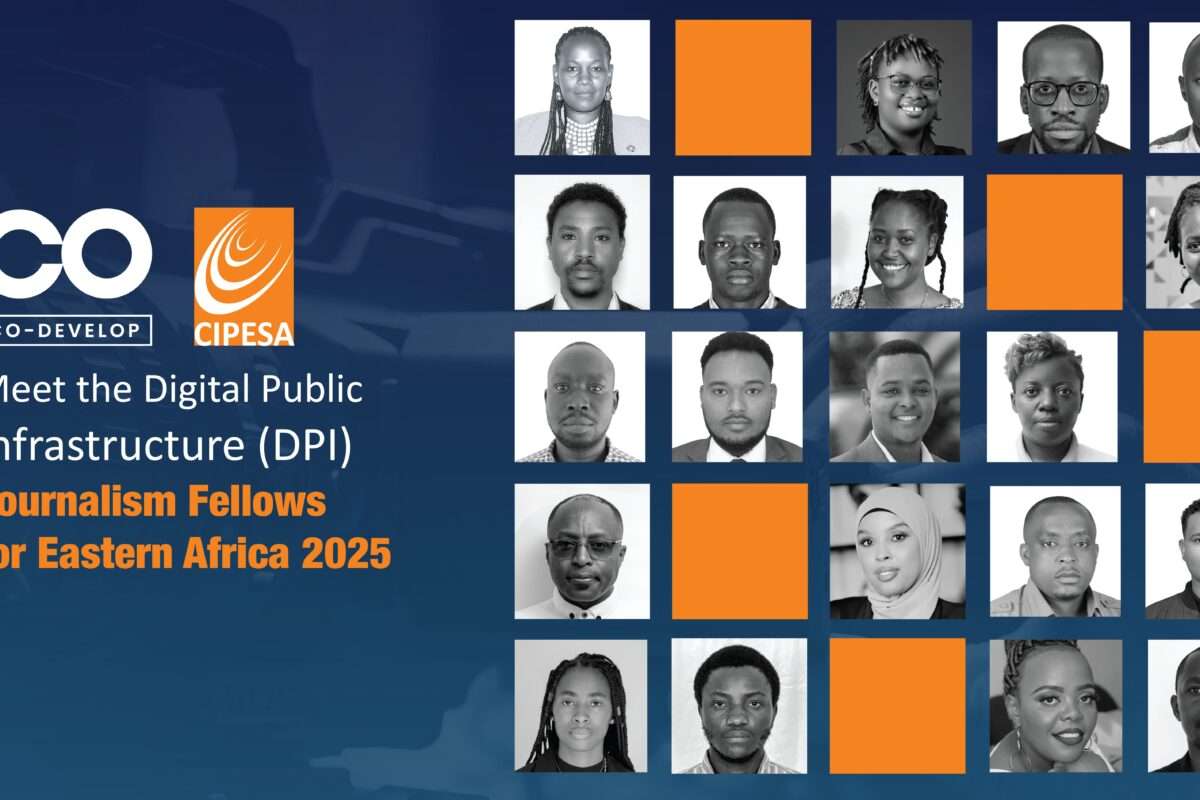
The Collaboration on International ICT Policy for East and Southern Africa (CIPESA), in partnership with Co-Develop, is pleased to announce the inaugural cohort of Fellows selected for the Digital Public Infrastructure (DPI) Journalism Fellowship for Eastern Africa following an open call in April 2025. 

This six-month regional fellowship aims to cultivate a new generation of journalists with the knowledge and skills to investigate and report on DPI and Digital Public Goods (DPGs). Fellows will participate in specialised training sessions, receive mentorship, and receive financial support to develop and produce impactful stories in diverse formats and languages. The stories will interrogate the development and deployment of DPI and DPGs with a focus on their implications for governance, inclusion, equity, and citizens’ everyday lives.

The fellowship brings together 20 journalists from nine countries (Burundi, DR Congo, Ethiopia, Kenya, Rwanda, Somalia, South Sudan, Tanzania, and Uganda) who work across online, broadcast, and print platforms.

The call in April attracted 214 applications, which were assessed through a rigorous selection process to identify fellows who demonstrated a strong interest and capacity to report on emerging digital public infrastructure issues with clarity, depth, and integrity. 

“This fellowship is about more than capacity building. It is about empowering African journalists to shape the public narrative around digital transformation in ways that reflect citizens’ rights, challenges, and aspirations,” said Dr. Wairagala Wakabi, CIPESA’s Executive Director. “We are thrilled to support these pioneering journalists as they lead the charge in demystifying digital infrastructure and holding power to account.”

The launch of this fellowship is significant as the digital transformation agenda of many African countries is evolving. Yet, media coverage of DPI and DPGs remains limited. The fellowship aims to close that gap by building the capacity of the media to cover DPI and DPI in ways that create awareness and informed public discourse on digital governance.

The fellowship is inspired by a similar Co-Develop-funded initiative implemented by the Media Foundation for West Africa (MFWA), which supported fellows to produce over 100 impactful stories that spurred public debate and influenced policy.

At Co-Develop, we believe that sustainable digital public infrastructure requires more than innovation and technology, it demands informed ecosystems. By supporting journalists across nine East African countries, this fellowship helps create a critical layer of engagement and accountability around Digital Public Infrastructure. We’re proud to invest in a future where DPI is not only built, but deeply understood, safeguarded, and shaped by those it serves.
– Desire Kachenje, Senior Investment Principal, Co-Develop

Follow the Fellows’ Stories
Stay engaged with the work of the DPI Journalism Fellows throughout 2025 using the hashtags #DPIJournalism #DPIFellows2025. Follow their stories and insights via CIPESA and Co-Develop’s online platforms, and join the conversation on how digital public infrastructure is shaping the future of governance and inclusion in Africa.

Read more about the DPI Journalism Fellows 2025 here.

Co-Develop & CIPESA Empowering East Africa’s Journalists to Shape the Future of Digital Public Infrastructure Discourse

Partnership |

What if the future of digital public infrastructure (DPI) was shaped not just by policymakers and technologists, but by the stories that journalists tell? At Co-Develop, we believe that the stories told about DPI can drive awareness, accountability, and action. This is why Co-Develop is pleased to announce a new partnership with the Collaboration on International ICT Policy for East and Southern Africa (CIPESA) to launch a DPI Journalism Fellowship in Eastern Africa. 

Whatever it is, the way you tell your story online can make all the difference.

Building on the success of our West African program, this initiative will equip journalists across Burundi, the Democratic Republic of the Congo, Ethiopia, Kenya, Rwanda, Somalia, South Sudan, Tanzania, and Uganda with the skills, resources, and networks needed to report on DPI and Digital Public Goods (DPGs) with depth and clarity. By promoting informed public discourse, the program aims to make digital transformation more accessible and transparent to the communities it serves. 

Digital public infrastructure refers to the foundational digital systems, platforms, and services that enable secure, efficient, and inclusive delivery of public and private services. Examples of DPI include digital identity (ID) systems, instant payment platforms, data exchange frameworks, open data platforms, and eGovernment platforms. 

The West African fellowship trained 20 journalists who produced over 115 impactful stories, leading to policy debates and meaningful reforms—such as the digitization of birth certificates in Nigeria following a corruption exposé. Inspired by this success, we are excited to bring this model to Eastern Africa, where digital transformation is rapidly advancing, yet public engagement remains limited.

Despite significant DPI developments, many citizens remain unaware of their implications. The media plays a critical role in bridging this gap. The new journalism fellowship will empower journalists to report on DPI in ways that highlight its benefits, challenges, and impact on everyday lives.

Through a structured program of training, reporting grants, and collaborations with regional media houses, the fellowship will amplify DPI narratives, encourage investigative journalism, and promote greater transparency and accountability. Drawing from insights gained in West Africa, we aim to build a scalable and sustainable model that strengthens public understanding of DPI, ensuring it is not just a policy conversation but a lived reality for millions. 

“We welcome this timely initiative, which will strengthen the role of journalism in shaping the future of DPI in Eastern Africa and we look forward to seeing the transformative impact of this collaboration”, said Dr. Wairagala Wakabi, the CIPESA Executive Director. “As digital transformation accelerates, journalists can play a vital role in ensuring that the public remains informed about the opportunities and challenges associated with DPI.”

He added that the fellowship will help bridge the gap between policymakers and the public, enhancing transparency and accountability in digital governance.

We look forward to seeing the transformative impact of this collaboration.

“This fellowship aligns with CIPESA’s commitment to promoting and protecting digital rights, the digital economy, and inclusive digital societies across Africa,” Dr. Wakabi said. “We expect this program to produce a new cadre of investigative journalists who will drive meaningful public discourse on DPI and DPGs. We hope that this will in turn contribute to policies and practices that ensure digital public infrastructure serves all citizens equitably while remaining rights-respecting.” 

This article was first published on the Co-Develop Website