Inform Africa Expands OSINT Training and DISARM-Based Research With CIPESA

ADRF |

Information integrity work is only as strong as the methods behind it. In Ethiopia’s fast-changing information environment, fact-checkers and researchers are expected to move quickly while maintaining accuracy, transparency, and ethical care. Inform Africa has expanded two practical capabilities to address this reality: advanced OSINT-based fact-checking training and structured disinformation research using the DISARM framework, in collaboration with the Collaboration on International ICT Policy for East and Southern Africa (CIPESA).

This work was advanced with support from the Africa Digital Rights Fund (ADRF), administered by CIPESA. At a time when many civic actors face uncertainty, the fund’s adaptable support helped Inform Africa sustain day-to-day operations and protect continuity, while still investing in verification and research methods designed to endure beyond a single project cycle.

The collaboration with CIPESA was not only administrative. It was anchored in shared priorities around digital rights, information integrity, and capacity building. Through structured coordination and learning exchange, CIPESA provided a partnership channel that strengthened the work’s clarity and relevance, and helped position the outputs as reusable methods that can be applied beyond a single team. The collaboration also reinforced a regional ecosystem approach: improving practice in one context while keeping the methods legible for peer learning, adaptation, and future joint work.

The implementation followed a phased timetable across the project activity period from April through November 2025. Early work focused on scoping and method design, aligning the training and research approaches with practical realities in newsrooms and civil society. Mid-phase work concentrated on developing the OSINT module and applying DISARM as a structured research lens, with iterative refinement as materials matured. The final phase focused on consolidation, documentation discipline, and packaging the outputs to support repeatable use, including onboarding, internal training, and incident review workflows.

A central focus has been an advanced OSINT training module built to move beyond tool familiarity into a complete verification workflow. Verification is treated as a chain of decisions that must be consistent and auditable: how to intake a claim, determine whether it is fact-checkable, plan the evidence, trace sources, verify images and videos, confirm the place and time, and document each step clearly enough for an editor or peer to reproduce the work. The aim is not only to reach accurate conclusions but also to show the route taken, including which evidence was prioritized and how uncertainty was handled.

This documentation discipline is not bureaucracy. It is a trust technology. In high-risk information environments, preserved sources, verification logs, and clear decision trails protect credibility, strengthen editorial oversight, and reduce avoidable errors. The module prioritizes hands-on, production-style assignments that mirror real newsroom constraints and trains participants to avoid overclaiming, communicate uncertainty responsibly, and present evidence in ways that non-expert audiences can follow.

In parallel, Inform Africa has applied the DISARM framework to disinformation research. DISARM provides a shared language for describing influence activity through observable behaviors and techniques, without drifting into assumptions. The priority has been to remain evidence-bound: collecting and preserving artifacts responsibly, maintaining a structured evidence log, reducing harm by avoiding unnecessary reproduction of inflammatory content, and avoiding claims of attribution beyond what the evidence supports. This DISARM-informed approach has improved internal briefs, strengthened consistency, and made incidents easier to compare over time and across partners.

Three lessons stand out from this work with CIPESA and ADRF. First, quality scales through workflow, not only through talent. Second, evidence discipline is a strategic choice that protects credibility and reduces harm in both fact-checking and research. Third, shared frameworks reduce friction by improving clarity and consistency across teams. Looking ahead, Inform Africa will integrate the OSINT module into routine training and onboarding and continue to apply DISARM-informed analysis in future incident reviews and deeper studies, reinforcing information integrity as a public good.

This article was first published by Informa Africa on December 15, 2025

Addressing Online Harms Ahead of Rwanda’s 2026 UPR Review

By Patricia Ainembabazi |

As the world commemorates the 16 Days of Activism Against Gender-Based Violence (November 25 to December 10), global attention is drawn to the rising risks women and girls face in digital environments. These harms increasingly undermine political participation, public discourse, and the safety of women across Africa.

Accordingly, the Collaboration on International ICT Policy for East and Southern Africa (CIPESA) and the Association for Progressive Communications (APC) have stressed the urgent need to address technology-facilitated gender-based violence (TFGBV) in Rwanda in written and oral submissions to the Universal Periodic Review (UPR) 51st pre-session for Rwanda at the United Nations Human Council in Geneva. In a joint CIPESA–APC fact sheet on human rights, the two organisations highlighted critical gaps in legal protections, online safety, and digital inclusion in Rwanda.

The joint UPR report notes that TFGBV has become a major deterrent to Rwandan women’s participation online, affecting women in politics, journalism, activism, and advocacy. The 2024 online smear campaign against opposition figure Victoire Ingabire Umuhoza illustrates the gendered nature of digital disinformation and harassment. Such attacks rely on misogynistic narratives designed to humiliate, silence, and delegitimise women’s public engagement. This pattern is not only a violation of rights; it also reinforces structural inequalities and dissuades other women from engaging in civic or political life.

These concerns reflect global trends. UN Women has warned of the rapid escalation of deepfake pornography, a form of digitally manipulated sexualised content disproportionately deployed against women and girls. Deepfakes can cause severe psychological, reputational, and professional harm, often leaving survivors without effective avenues for redress. They are increasingly used to silence women, distort electoral participation, and discourage women from entering political leadership. Such harms undermine democratic processes, distort public debate, and entrench gender inequality.

Rwanda’s obligations under the Convention on the Elimination of All Forms of Discrimination Against Women (CEDAW) require the state to take comprehensive measures to eliminate discrimination (Articles 2 and 3) and ensure women’s full participation in political and public life (Article 7). However, as documented in the joint UPR report and fact sheet, gaps persist. The 2018 Cybercrime Law lacks survivor-centred provisions, and its broad definitions have on occasion been applied in ways that disadvantage victims.

Moreover, enforcement remains inconsistent, and the absence of specialised mechanisms for investigating and prosecuting online violence limits accountability. In this context, TFGBV is not merely a digital phenomenon; it is a direct barrier to fulfilling Rwanda’s CEDAW obligations and achieving SDGs 5 and 16.

The gender digital divide further compounds these harms. Internet penetration in Rwanda stands at 34.2%, with women representing just 38.2% of social media users. Structural inequalities, including device affordability, income disparities, and limited digital literacy, restrict women’s participation in digital spaces. These inequalities heighten vulnerability to online harm and restrict access to safety tools, reporting mechanisms, and digital rights resources. As the joint CIPESA–APC evidence indicates, without targeted investment in digital literacy, device access, and connectivity for women, Rwanda risks deepening existing socio-economic and civic inequalities.

During the UPR pre-session, CIPESA and APC presented a set of recommendations aimed at promoting rights-respecting digital governance. These included adopting survivor-centred TFGBV protections aligned with CEDAW, strengthening investigative and prosecutorial capacities to effectively respond to online harms, and compelling technology platforms to improve reporting, moderation, and accountability mechanisms. The submission also called for amending restrictive provisions in the Penal Code and Cybercrime Law, establishing independent oversight over surveillance operations, and addressing the gender digital divide through targeted digital literacy and affordability initiatives.

The 16 Days of Activism provide an important reminder that violence against women is evolving in both form and reach. Digital technologies have expanded the avenues through which women are targeted, often enabling harm that is faster, more pervasive, and harder to remedy. Ending violence against women, therefore, requires recognising online spaces as critical sites of protection.

Rwanda enters its fourth UPR cycle with a number of unaddressed commitments. During the 2021 review, the Rwandan government received 32 recommendations on freedom of expression and media freedom, including 24 urging reforms to restrictive speech provisions and 17 calling for enhanced protections for journalists and human rights defenders. Yet implementation has been limited. Provisions in Rwanda’s 2018 Penal Code and 2018 Cybercrime Law continue to criminalise “false information”, edited content, and criticism of public authorities, enabling arrests of journalists and discouraging dissenting expression.

These laws have contributed to widespread self-censorship, shrinking civic space, and undermining public participation in digital environments. At the same time, reports of intrusive surveillance, such as the documented use of Pegasus spyware targeting thousands of journalists, activists, and diaspora members, further erode trust and violate privacy rights. The absence of independent oversight in surveillance practices intensifies this concern.

The Country’s ongoing engagement with the UPR process and its upcoming review scheduled for January 21, 2026, offers a timely opportunity to address these challenges. During the pre-sessions 51 from 26 -27 November 2025 in Geneva, several permanent missions expressed eagerness to advance strong recommendations for Rwanda, and there is hope that these delegations will amplify our proposals during the formal review.

CIPESA and APC remain committed to supporting evidence-based reforms that strengthen digital rights protections across Africa. Rwanda’s review presents a defining moment for the government to adopt meaningful, future-focused reforms that uphold human rights, ensure accountability, and create a digital environment where all citizens, especially women, can participate safely, freely, and equally in shaping the country’s democratic and digital future.

#BeSafeByDesign: A Call To Platforms To Ensure Women’s Online Safety

By CIPESA Writer |

Across Eastern and Southern Africa, activists, journalists, and women human rights defenders (WHRDs) are leveraging online spaces to mobilise for justice, equality, and accountability.  However, the growth of online harms such as Technology-Facilitated Gender-Based Violence (TFGBV), disinformation, digital surveillance, and Artificial Intelligence (AI)-driven discrimination and attacks has outpaced the development of robust protections.

Notably, human rights defenders, journalists, and activists face unique and disproportionate digital security threats, including harassment, doxxing, and data breaches, that limit their participation and silence dissent.

It is against this background that the Collaboration on International ICT Policy for East and Southern Africa (CIPESA), in partnership with Irene M. Staehelin Foundation, is implementing a project aimed at combating online harms so as to advance digital rights. Through upskilling, advocacy, research, and movement building, the initiative addresses the growing threats in digital spaces, particularly affecting women journalists and human rights defenders.

The first of the upskilling engagements kicked off in Nairobi, Kenya, at the start of December 2025, with 25 women human rights defenders and activists in a three-day digital resilience skills share workshop hosted by CIPESA and the Digital Society Africa. Participants came from the Democratic Republic of Congo, Madagascar, Malawi, South Africa, Tanzania, Uganda, Zambia, and Zimbabwe. It coincides with the December 16 Days Of Activism campaign, which this year is themed “Unite to End Digital Violence against All Women and Girls”.

According to the United Nations Population Fund (UNFPA), TFGBV is “an act of violence perpetrated by one or more individuals that is committed, assisted, aggravated, and amplified in part or fully by the use of information and communication technologies or digital media against a person based on their gender.” It includes cyberstalking, doxing, non-consensual sharing of intimate images, cyberbullying, and other forms of online harassment.

Women in Sub-Saharan Africa are 32% less likely than men to use the internet, with the key impediments being literacy and digital skills, affordability, safety, and security. On top of this gender digital divide, more women than men face various forms of digital violence. Accordingly, the African Commission on Human and Peoples’ Rights (ACHPR) Resolution 522 of 2022 has underscored the urgent need for African states to address online violence against women and girls.

Women who advocate for gender equality, feminism, and sexual minority rights face higher levels of online violence. Indeed, women human rights defenders, journalists and politicians are the most affected by TFGBV, and many of them have withdrawn from the digital public sphere due to gendered disinformation, trolling, cyber harassment, and other forms of digital violence. The online trolling of women is growing exponentially and often takes the form of gendered and sexualised attacks and body shaming.

Several specific challenges must be considered when designing interventions to combat TFGBV. These challenges are shaped by legal, social, technological, and cultural factors, which affect both the prevalence of digital harms and violence and the ability to respond effectively. They include weak and inadequate legal frameworks; a lack of awareness about TFGBV among policymakers, law enforcement officers, and the general public; the gender digital divide; and normalised online abuse against women, with victims often blamed rather than supported.

Moreover, there is a shortage of comprehensive response mechanisms and support services for survivors of online harassment, such as digital security helplines, psychosocial support, and legal aid. On the other hand, there is limited regional and cross-sector collaboration between CSOs, government agencies, and the private sector (including tech companies).

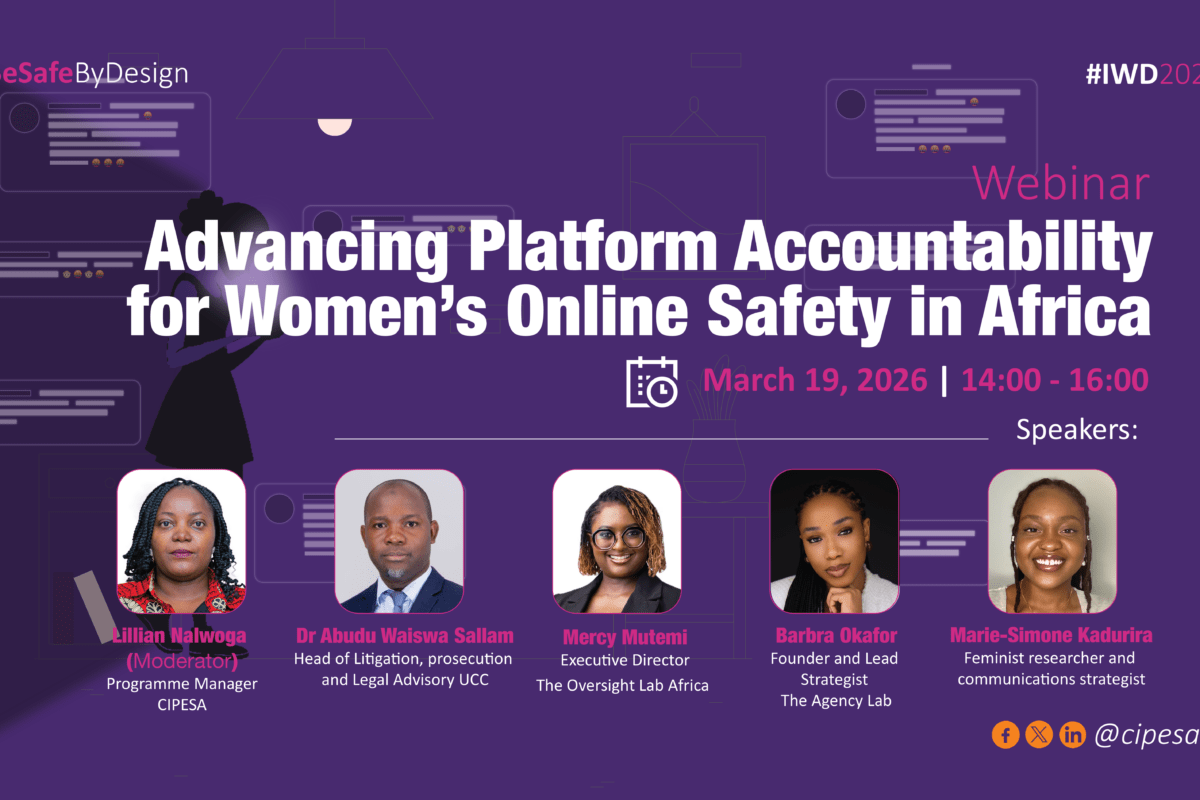
A guiding strand for these efforts will be the #BeSafeByDesign campaign that highlights the necessity of safe platforms for women as well as the consequences when safety is missing. The #BeSafeByDesign obligation shifts the burden of responsibility of ensuring safety in online spaces away from women and places it on platforms where more efforts on risk assessments, accessible and stronger reporting pathways, proactive detection of abuse, and transparent accountability mechanisms are required. The initiative will also involve the practical upskilling of at-risk women in practical cybersecurity.

CIPESA @Africa BitCoin Conference

Update |

Every year, the event brings together activists, innovators, and decision-makers to explore how Bitcoin safeguards fundamental freedoms, strengthens economic autonomy, and paves the way for lasting sovereignty. The event is taking place between December 3-5, 2025, at Caudan Arts Centre, Port Louis, Mauritius.

Click here for information on the event.

CIPESA @African Economic Research Consortium (AERC) Summit 2025

Update |

This year, the African Economic Research Consortium (AERC) is holding its first Summit in the context of its new 10-year Strategic Plan (2025-2035), Nairobi, Kenya. The three-day Summit themed ‘A Renewed AERC for Africa’s New Development Priorities’, is designed to hardwire the research-policy bridge.

This event is taking place from November 30 to December 02, 2025. For more information, click here.