
By Nadhifah Muhammad |
It has been 12 months since the Collaboration on International ICT Policy for East and Southern Africa (CIPESA) championed the Civil Society (CSO) Fund for digital rights in Uganda’s business sector. Across 12 districts, the supported initiatives have implemented action plans to advance advocacy and awareness on digital rights for businesses.
Radio and television programmes, social media campaigns, community forums, stakeholder dialogues, and caravans were part of the awareness campaigns conducted by partners. As a result, more than 17 million citizens, including district leaders, youths, and the general public, have been sensitised on business and digital rights. In parallel, CIPESA has supported Small and Medium Enterprises (SMEs) in tourism and travel, education, digital marketing, IT development, legal services, lifestyle and health to conduct digital security self assessment and to integrate digital rights within their business models.
Before the interventions were rolled out, CIPESA built the partners’ capacity in implementing awareness raising and advocacy campaigns. At a March 2026 bootcamp, CIPESA re-convened the CSOs and SMEs, alongside innovators, researchers, local government officials and human rights advocates, to reflect on progress and take stock of their interventions. The 30 participants at the bootcamp also explored how to sustain, deepen, and institutionalise this work beyond the Advancing Respect for Human Rights by Businesses (ARBHR) project funded by the European Union and implemented with the support of Enabel.
A participant appreciated CIPESA’s approach to equipping them with skills and knowledge on digital rights and business and human rights ahead of rolling out the initiatives, stating: “It played a fundamental role in helping us appreciate the issues for us trickle them down to the communities.”
During the bootcamp, partners shared lessons and experiences from their action plans across the project focus regions: Busoga (Iganga, Mayuge, Bugiri, and Bugweri), the Albertine region (Hoima, Kikuube, Masindi, Buliisa, and Kiryandongo) and the Kampala Metropolitan area (Kampala, Mukono, and Wakiso).
Key lessons learnt included framing failure to respect digital rights as business risks to increase private sector engagement, prioritising multi-stakeholder engagements to foster ownership of initiatives, using local languages and simplified text while interfacing with grassroots communities, partnering with media to amplify awareness campaigns and consistent engagement with beneficiaries to ensure they grasp the context of the project initiatives.
However, despite the project’s wide reach, surveys conducted by project partners show that the majority of SMEs continue to face numerous digital vulnerabilities. For instance, a study by Girls for Climate Action on digital inclusion among 924 women-led green businesses in the Busoga region revealed an 85.9% digital skills gap. In Kampala, a mapping by Boundless Minds of 119 youth-led SMEs found that 49% were unaware of the existence of the Data Protection and Privacy Act, Cap 97 .
Similarly, the Capacity Needs Analysis conducted by the Private Sector Foundation Uganda (PSFU) on 79 Business Member Associations showed that while 72% of the businesses collect customer data, only 38% are aware of the Data Protection and Privacy Act, and only 16% have internal cybersecurity policies. These findings reinforce the need for continued support to help Ugandan businesses to understand and uphold digital rights in their operations.
However, the question of resources to continue the business and digital rights work beyond the ARBHR seed funding remained a concern. With the changing funding landscape, advocates were urged to rethink strategies for sustainability and reduce dependence on grants. As one participant noted, “Budget limitations greatly affected effective execution of some awareness campaigns,” which hampered the reach and depth of engagements.
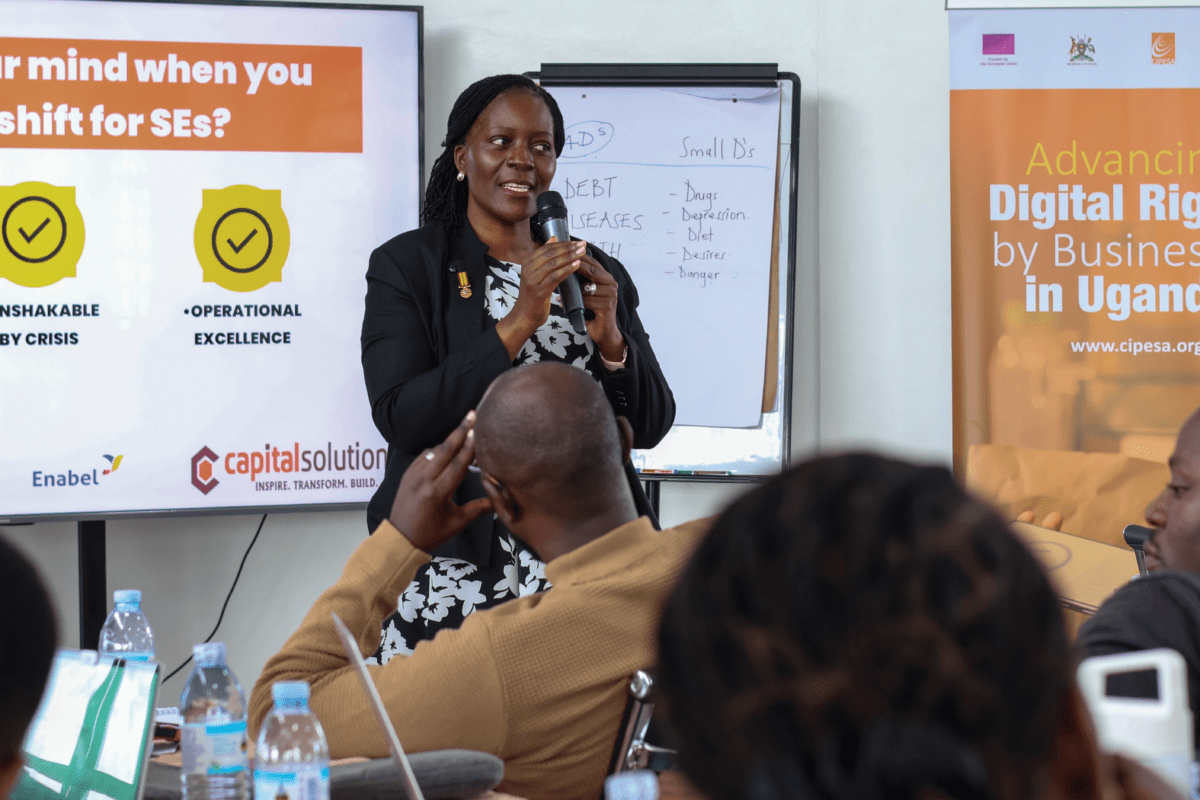
Dr. Joyce Tamale, of Capital Solutions Ltd who facilitated a session on financial resilience, addressed this challenge by demonstrating how organisations can strengthen institutional sustainability and build long-term financing models to sustain their work. Framing the issue through a “mindset cycle,” she argued that resilience begins with a shift in thinking that shapes attitudes, actions, and ultimately results. She paired this with practical strategies such as building operating reserves, diversifying funding streams, and adopting long-term financial planning. Emphasising social entrepreneurship, she encouraged organisations to monetise their assets without compromising their mission.
To put this into practice, organisations were encouraged to codify financial health within their institutions through operating reserve policies, building emergency funds, and the use of financial instruments such as bonds and unit trusts, while also strengthening their own financial literacy.
To consolidate these gains and sustainability of efforts under the project, partners were rallied to mainstream digital rights and the Business and Human Rights agenda in their institutional programming.