Advancing Awareness of the UNESCO Internet Universality Assessments in Africa

By Juliet Nanfuka |

In 2015, the 38th General Conference of the United Nations Educational, Scientific and Cultural Organization (UNESCO) endorsed a new definition on the universality of the internet. It was based upon four principles, namely Rights, Openness, Accessibility to all and Multi-stakeholder participation, or the ROAM principles. 

The addition of cross-cutting indicators in 2018 resulted in the ROAM-X Indicator framework comprising 303 indicators that assess the extent to which national stakeholders, including governments, businesses and civil society, comply with the ROAM principles. It was recognised that these indicators were central to the growth and evolution of the internet, and the achievement of the Sustainable Development Goals.  

Over the years, UNESCO has partnered with the Collaboration on International ICT Policy for East and Southern Africa (CIPESA) to increase awareness of the Internet Universality Indicators (IUI’s) and the ROAM-X framework. In 2015, at the CIPESA-convened Forum on Internet Freedom in Africa (FIFAfrica), the ROAM principles were featured in the opening discussion of the event, with then UNESCO regional advisor for Communication and Information, Jaco du Toit, explaining the practical use of the Internet Universality principles of human-rights, openness, accessibility and multi-stakeholder participation and their link to African development.

The  2018 edition of FIFAfrica again provided a collaborative platform for experts, policymakers, activists, and technologists to exchange ideas and strategies for advancing a more inclusive and accessible digital space. CIPESA also contributed to discussions at the 2018 Internet Governance Forum (IGF) where the link between internet shutdowns and the need for national assessments through the use of the ROAM-X framework was stressed.

At the October 2020 Africa IGF, CIPESA contributed to a discussion that served as a launch of the IGF Dynamic Coalition on Internet Universality Indicators (IUIs). The Dynamic Coalition is a shared space for advocating Internet Universality ROAM principles worldwide, sharing experiences and raising awareness of the value of the related indicators and good practice in applying them in more countries. Further discussions were held at the global IGF in November 2020. 

In March 2022, CIPESA hosted a regional dialogue on the Indicators, which highlighted lessons from countries where IUI assessments had been conducted, namely  Benin, Ethiopia, Ghana, Kenya, Niger and Senegal. This effort aimed to garner best practices in conducting national assessments of media and internet ecosystems using the indicators.

Later that year, CIPESA convened a regional training webinar to raise awareness of the Internet Universality ROAM-X indicators and their potential to promote internet development to advance media freedom and digital rights in Africa. The UNESCO Information for All Programme (IFAP) and International Programme for the Development of Communication (IPDC) jointly supported the training which targeted participants from Cameroon, Malawi, Namibia,  Somalia and Uganda. Outputs from the webinar went on to feed into discussions at the 2022 IGF which included sessions on the ROAM-X indicators and a session on the Internet Universality Indicators as part of the Dynamic Coalition.

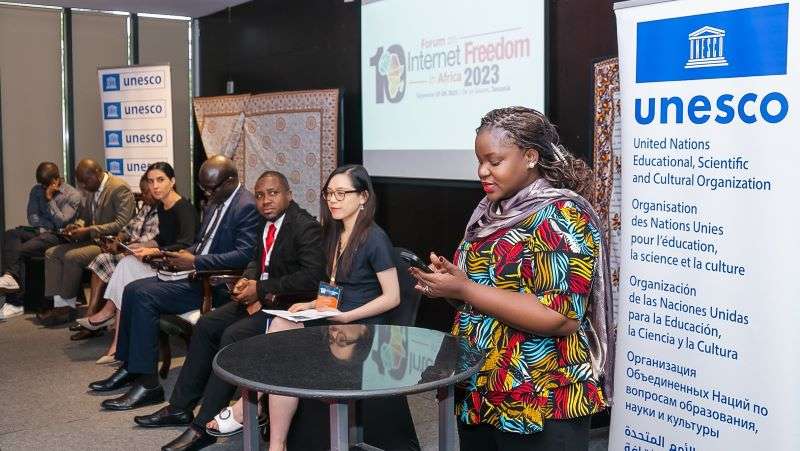
At the 2023 edition of  FIFAfrica held in September in Tanzania, UNESCO hosted a session titled “Foster Internet Freedom in Africa through UNESCO’s ROAM-X Internet Universality Indicators Assessments”. The panel consisted of UNESCO experts, including John Okande, Programme Officer, Tatevik Grigoryan, Associate Programme Specialist; and Xiaojie Sun, Junior Professional Officer. Also on the panel were participants from earlier UNESCO/CIPESA collaborative efforts on ROAM-X, including Asrat M. Beyene from the Internet Society Ethiopia Chapter and Addis Ababa Science and Technology University; Grace Githaiga, Convenor of the Kenya ICT Action Network (KICTANet); and Dr. Simon-Peter Kafui Aheto of the University of Ghana.

The various speakers showcased the main findings and recommendations from the IUI  assessments they conducted,  and impacts of ongoing and completed ROAM-X national assessments in Africa (see some assessments here). They also shared best practices and lessons learnt during the implementation process. Panelists also highlighted that the IUI is due for revision following the amount of data collected over the years and the evolving digital landscape globally.   Since its introduction, ROAM-X has been integrated into discussions at FIFAfrica and into CIPESA programming, both of which have served as collaborative platforms for experts and policymakers to advance inclusivity and accessibility in the digital space.
Digital Rights Hub of African Civil Society Organisations

By Edrine Wanyama |

Since 2016, the Collaboration on International ICT Policy for East and Southern Africa (CIPESA) has been partnering with the International Center for Not-for-Profit Law (ICNL) to improve African digital civic spaces. 

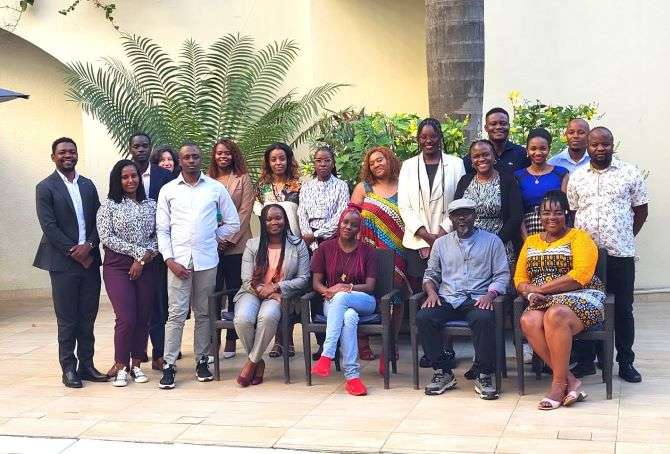
At the September  Forum on internet Freedoms in Africa, CIPESA and ICNL convened a digital rights hub in Dar es Salaam, Tanzania aimed at promoting the digital civic space in Africa. The hub brought together civil society organisations (CSOs) representatives from 10 African countries. 

Across the continent, there is increased demand for democratic rule yet civic spaces continue to be undermined by state autocracy which still prevails in at least half the continent.  Rights and freedoms such as assembly, association, access to information and data privacy in the online space continue to be curtailed. This is despite that 2016  UN Human Rights Council Resolution  that called for the protection of rights afforded offline, to be applied in equal measure online.

The hub  held discussions on the relationship between digital civic space and its importance to CSOs and the internet infrastructure governance. 

Further insights were drawn from developments on artificial intelligence, surveillance, privacy rights, network disruptions, online content moderation, and the burgeoning concerns on  disinformation and its impact on the digital society. 

The hub concluded by defining the  role of CSOs in protecting the digital civic space through effective advocacy strategies such as litigation, legal analysis and the law making process, capacity building of key stakeholders including parliamentarians and making use of regional human rights monitoring mechanisms such as the United Nations Human Rights Council mechanisms like Universal Periodic Review and Special Rapporteurs and the African Commission on Human and Peoples Rights monitoring mechanisms were enumerated.  

The emerging statement from the convening can be accessed here

Inscrivez-vous au Forum sur la liberté d’Internet en Afrique (#FIFAfrica23) !

Par FIFAfrica |

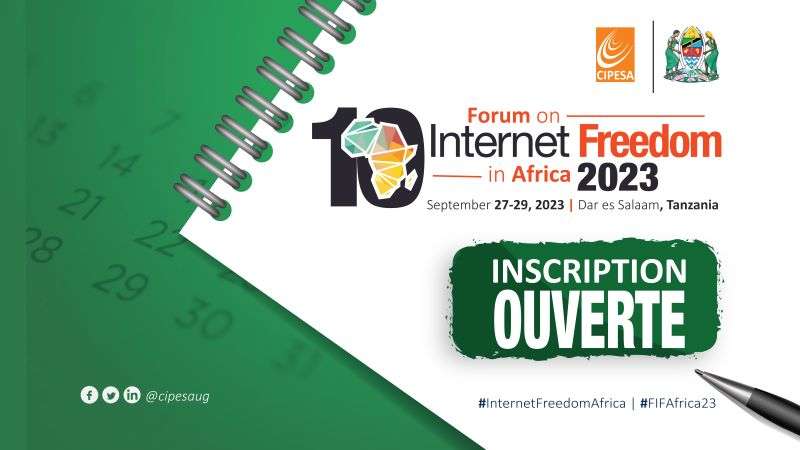
Êtes-vous passionné par la liberté d’Internet et les droits numériques en Afrique ? Souhaitez-vous rejoindre et vous engager avec la communauté qui fait avancer les droits numériques en Afrique ? Inscrivez-vous pour participer à l’édition 2023 du Forum sur la liberté d’Internet en Afrique (FIFAfrica23), et rejoignez une communauté de diverses parties prenantes de tout le continent et d’ailleurs, pour débattre des questions les plus urgentes et des opportunités pour améliorer les libertés en ligne. Les inscriptions sont ouvertes pour une participation en présentiel ou à distance !

FIFAfrica23 se tiendra à Dar es Salam, en Tanzanie, les 26 et 27 septembre (pré-événements uniquement sur invitation) et les 28 et 29 septembre (conférence principale) 2023. L’événement est organisé par la Collaboration sur la politique internationale des TIC pour l’Afrique de l’Est et australe (CIPESA), en partenariat avec le ministère tanzanien de l’information, des communications et des technologies de l’information. L’événement aura lieu au Hyatt Regency Dar es Salaam.

Le Forum marquera une décennie de rassemblement de décideurs politiques, de régulateurs, de défenseurs des droits de l’homme, d’universitaires, de représentants de la loi, de médias et d’autres acteurs pour discuter des lacunes, des préoccupations et des possibilités de promotion de la vie privée, de la libre d’expression, de la non-discrimination, de la libre circulation de l’information et de l’innovation en ligne.

Le programme de FIFAfrica23 comprend 10 thèmes sur une diversité de sujets émergeant des soumissions retenues dans le cadre d’un récent appel à sessions.  Ces thèmes comprennent des panels, des présentations, des conférences éclair, des discours liminaires et des ateliers méticuleusement sélectionnés, à travers lesquels les participants au Forum pourront sonder le paysage des droits numériques et de la liberté de l’internet en Afrique, ainsi que les interventions collaboratives pour relever les défis et exploiter les opportunités d’un internet plus ouvert et plus inclusif en Afrique.

Vous pouvez vous inscrire ici et prendre note du Code de Conduite de l’événement et de la Note de voyage qui comprend des informations logistiques.

Ne manquez pas l’occasion de participer à cet événement historique et de contribuer à faire progresser la liberté de l’internet en Afrique !

Ne manquez pas de suivre @cipesaug sur les médias sociaux et de participer à la conversation en ligne en utilisant les hashtags #FIFAfrica23 #InternetFreedomAfrica.

Register for the Forum on Internet Freedom in Africa (#FIFAfrica23)!

By FIFAfrica |

Are you passionate about internet freedom and digital rights in Africa? Do you want to engage with and join the community advancing digital rights in Africa? Register to attend the upcoming 2023 edition of the  Forum on Internet Freedom in Africa (FIFAfrica23) and join a diverse community of stakeholders from across the continent and beyond to deliberate on the most pressing issues and opportunities for advancing online freedom. Registration is open for both in-person and remote attendance! 

FIFAfrica23 will take place in Dar es Salam, Tanzania on September 26-27 (pre-events by invitation only) and September 28-29 (main conference), 2023, hosted by the Collaboration on International ICT Policy for East and Southern Africa (CIPESA) in partnership with the Tanzanian Ministry of Information, Communications and Information Technology. The event will take place at the Hyatt Regency Dar es Salaam.

The Forum will mark a decade of bringing together policy makers, regulators, human rights defenders, academia, law enforcement representatives, media, and other actors to deliberate on gaps, concerns and opportunities for promoting privacy, free expression, non-discrimination, free flow of information and innovation online.

The FIFAfrica23 agenda will feature 10 tracks on a diversity of topics emerging from successful submissions to a recent open call for sessions.  The tracks include carefully curated panels, presentations, lightning talks, keynote addresses and workshops, through which participants at the Forum will have the opportunity to delve into the deeper layers of the digital rights and internet freedom landscape in Africa and collaborative interventions to address the challenges and harness the opportunities of a more open and inclusive internet in Africa.

You can register here and also take note of the event Code of Conduct and Travel note which includes logistical information.

Don’t miss this chance to be part of this landmark event and contribute to advancing internet freedom in Africa!

Be sure to follow @cipesaug on social media and join the online conversation using the hashtags #FIFAfrica23 #InternetFreedomAfrica.

Tanzania Ministry of ICT to Co-Host the 2023 Forum on Internet Freedom in Africa

Announcement |

The Ministry of Information, Communication and Information Technology of the United Republic of Tanzania has announced that it will co-host the 2023 edition of Forum on Internet Freedom in Africa (FIFAfrica23). The move is in line with the country’s digital transformation and wider digitalisation efforts.  

“We are pleased to support such an important event in Africa. In recent years, we have steadily worked at enhancing our digital transformation through the Tanzania Digital Economy Framework to enhance our capacities within the government and for the citizens of Tanzania to enjoy digital services. We value this opportunity to showcase our commitment to promoting internet access in the country and the region. As a Ministry, we have made significant strides in expanding internet access and are committed to ensuring that the internet is a safe and enabling space for all users, especially women, youth, and marginalised groups,” stated Hon. Nape Nnauye, the Minister of Information, Communication and Information Technology.

An initiative of the Collaboration on International ICT Policy for East and Southern Africa (CIPESA), FIFAfrica is the largest and most influential gathering on technology’s role in driving socio-economic and political development in Africa. It brings together policymakers, regulators, human rights defenders, academia, law enforcement representatives, media, and other stakeholders from across Africa and beyond to discuss the most pressing issues and opportunities for advancing privacy, free expression, inclusion, free flow of information, civic participation, and innovation online.

The government of Tanzania, joins those of Ethiopia (2019) and Zambia (2022), as well as the Slovenia Presidency of the European Union (2021), in partnering with CIPESA to co-host FIFAfrica. Scheduled to take place in Dar es Salaam, Tanzania, September 27-29, 2023, the Forum, now in its 10th year, will feature diverse voices and perspectives through carefully curated sessions (training workshops, alliance meetings, panel discussions, exhibitions and lightning talks) which emerged from a public call. 

“We are pleased to co-host FIFAfrica23 alongside the Tanzania Ministry of Information, Communication and Information Technology. This partnership is a testament to the shared vision and commitment of CIPESA and the Government of Tanzania to promote an open and inclusive internet in Africa,” said Dr. Wairagala Wakabi, CIPESA’s Executive Director.

CIPESA announced that its decision to host FIFAfrica in Tanzania is in recognition of the country’s progressive shift to advance digitalisation for sustainable development. Under the leadership of its first female President, Samia Suluhu Hassan, a proponent for civil rights and women’s rights, the country has undergone political and legal reforms aimed at enhancing civic space and the digitalisation agenda. Notably, a data protection law has been enacted, the law governing media operations is being revised, and the  Online Content Regulations 2020 were revised to make them more supportive of online speech, privacy and access to information.

The Forum has previously been held in Uganda, Ghana, Ethiopia, Zambia and South Africa. As a platform for unpacking challenges and developing collaborative responses, hosting FIFAfrica in different countries opens up the space for experience sharing, learning and exchange, but also gives life to the CIPESA’s commitment to ensuring broader regional representation and deepening dialogue across the continent.
FIFAfrica23 will be hosted at the Hyatt Regency Dar es Salaam, The Kilimanjaro and is expected to assemble at least 400 participants from across the continent and beyond. Follow @cipesaug on social media for updates. Use the hashtags #FIFAfrica23 and #InternetFreedomAfrica to share your vision for digital rights in Africa.