

African Governments are Using “Smart City” Systems to Monitor Dissent and Consolidate State Control

By CIVICUS |

CIVICUS discusses the spread of AI-powered surveillance in Africa with Wairagala Wakabi, executive director of the Collaboration on International ICT Policy for East and Southern Africa (CIPESA) and co-editor of Smart City Surveillance in Africa: Mapping Chinese AI Surveillance Across 11 Countries, the latest report by the African Digital Rights Network (ADRN) and the Institute of Development Studies (IDS).
At least 11 African governments have spent over US$2 billion on Chinese-built surveillance infrastructure that uses AI-powered cameras, biometric data collection and facial recognition to monitor public spaces. Marketed as ‘smart city’ solutions to reduce crime and manage urban growth, these systems have been rolled out with little regulation and no independent evidence of their effectiveness. This technology is instead being used to monitor activists, track protesters and silence dissent, with a chilling effect on freedoms of assembly and expression.

How widespread is AI-powered surveillance in Africa?

Under the guise of reducing crime and fighting terrorism, at least 11 governments have invested over US$2 billion in AI-powered ‘smart city’ surveillance infrastructure: Algeria, Egypt, Kenya, Mauritius, Mozambique, Nigeria, Rwanda, Senegal, Uganda, Zambia and Zimbabwe.

Governments are installing thousands of CCTV cameras linked to central command centres, paired with tools such as automatic number-plate recognition, biometric ID systems and facial recognition to track people and vehicles. The largest known investments are in Nigeria (over US$470 million), Mauritius (US$456 million) and Kenya (US$219 million), though the real total is likely much higher, since surveillance spending is often secret and the report covers only 11 of Africa’s 55 countries.

Despite being presented as tools for crime prevention, counter-terrorism, modernisation and urban management, these are not targeted security measures. They represent a broader shift toward continuous, population-level monitoring of public spaces, rolled out over the past five to ten years almost always without clear legal limits or public debate.

Are these systems achieving their stated purpose?

No, there is no compelling evidence that they have in any of the countries studied. Instead, the data points to a pattern of use that raises serious human rights concerns.

In Uganda and Zimbabwe, AI-powered surveillance including facial recognition is being used to suppress dissent rather than ensure public safety. Activists, critics of the government, opposition leaders and protesters are identified and monitored through this system, even after protests have ended. In Mozambique, smart CCTV systems have reportedly been installed in areas of strong political opposition, suggesting targeted rather than neutral surveillance.

In Senegal and Zambia, countries with relatively low terrorism threats, governments have still invested heavily, which calls into question the stated security rationale.

Across the countries studied, the scale of surveillance far exceeds any actual or perceived security threat, and the infrastructure is consistently being used to monitor dissent and consolidate state control rather than address genuine public safety needs.

Who’s supplying this technology?

While firms from Israel, South Korea and the USA supply surveillance technologies, Chinese companies are the primary suppliers and financiers. They typically offer end-to-end ‘smart city’ packages that include cameras, software platforms, data analytics systems, training and ongoing technical support. Many projects are backed by loans from Chinese state-linked banks, which makes them financially accessible in the short term but creates long-term dependencies on external vendors for maintenance, system management and upgrades.

This model undermines transparency. Procurement processes are opaque and civil society, the public and oversight institutions including parliaments rarely have information about how these systems operate, how data is stored or who has access to it. That lack of accountability is what makes abuse not just possible, but hard to detect or challenge.

What impact is this having on civic space?

This large-scale surveillance of public spaces is not legal, necessary or proportionate to the legitimate aim of providing security. Recording, analysing and retaining facial images of people in public without their consent interferes with their right to privacy and, over time, their willingness to move, assemble and speak freely.

The most immediate consequence is a chilling effect, particularly where civic space is already restricted. Knowing they can be identified and tracked, activists and journalists are less willing to attend protests for fear of later arrest or reprisals, and end up self-censoring. Civil society organisations also report heightened anxiety about the risks for their members and partners.

What should governments and civil society do?

None of the 11 countries studied have a legal framework capable of balancing the state’s security needs with its commitments to protect fundamental human rights. That must change. Governments must adopt clear regulations on surveillance, including restrictions on facial recognition and other AI tools, require independent human rights impact assessments before introducing new systems, make procurement and deployment processes transparent and establish strong oversight mechanisms, including judicial and parliamentary scrutiny, to prevent abuse.

Civil society should continue documenting abuses, raising public awareness and advocating for accountability, while also supporting affected people and communities through digital security support and legal assistance.

Technology-exporting states and donors must enforce stricter controls and safeguards on the export and financing of these tools, support rights-based approaches to digital governance and help fund independent monitoring and advocacy across Africa.

Without urgent action, these systems will continue to expand, and the rights of people across Africa will continue to shrink.

CIVICUS interviews a wide range of civil society activists, experts and leaders to gather diverse perspectives on civil society action and current issues for publication on its CIVICUS Lens platform. The views expressed in interviews are the interviewees’ and do not necessarily reflect those of CIVICUS. Publication does not imply endorsement of interviewees or the organisations they represent.

This article was first published on the Website of CIVICUS LENS on April 07, 2026
State of Internet Freedom In Africa Report

2025 State of Internet Freedom In Africa Report Documents the Implications of AI on Digital Democracy in Africa

By Juliet Nanfuka | 

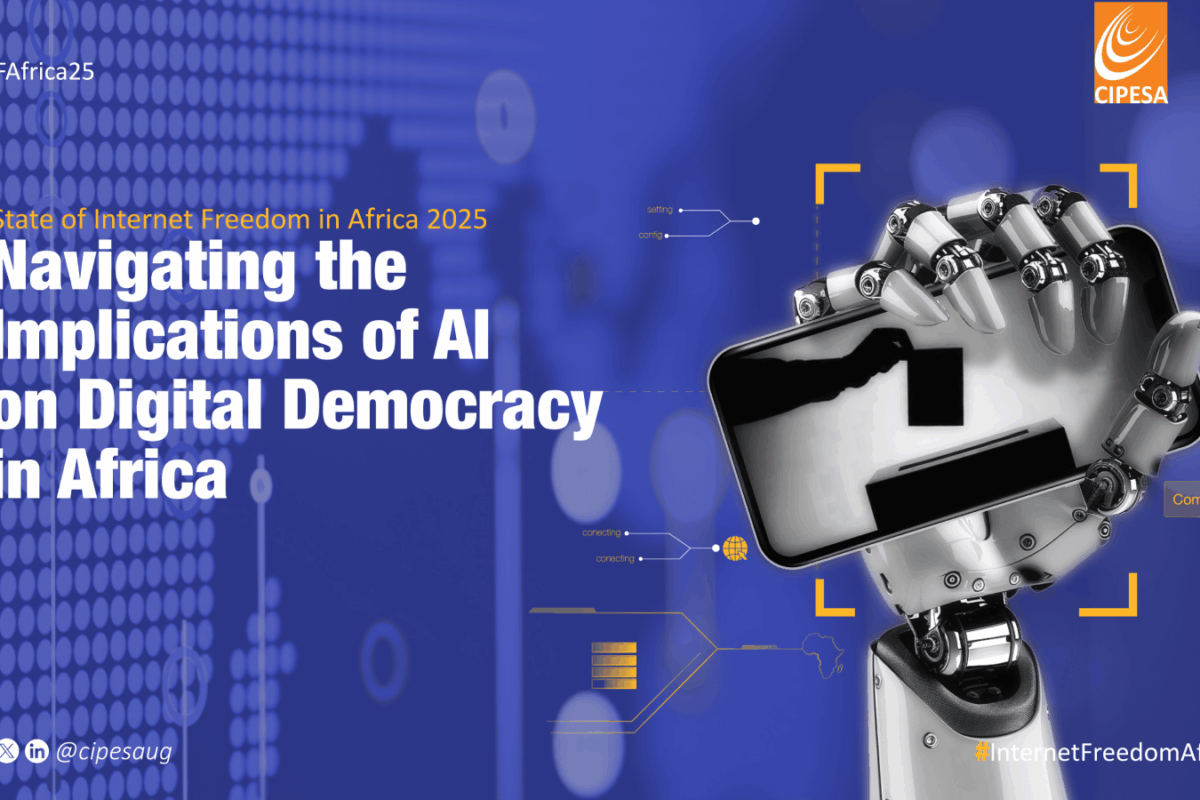
The 2025 edition of the Forum on Internet Freedom in Africa (FIFAfrica25) concluded on a high note with the unveiling of the latest State of Internet Freedom in Africa (SIFA) report. Titled Navigating the Implications of AI on Digital Democracy in Africa, this landmark study unpacks how artificial intelligence is shaping, disrupting, and reimagining civic space and digital rights across the continent.

Drawing on research from 14 countries (Cameroon, Egypt, Ethiopia, Ghana, Kenya, Mozambique, Namibia, Nigeria, Rwanda, Senegal, South Africa, Tunisia, Uganda, and Zimbabwe), the report documents both the immense promise and the urgent perils of AI in Africa. It highlights AI’s potential to strengthen democratic participation, improve public services, and drive innovation, while also warning of its role in amplifying surveillance, disinformation, and exclusion. 

Using a qualitative approach, including literature review and key informant interviews, the report shows that AI is rapidly transforming how Africans interact with technology, yet AI also amplifies existing vulnerabilities, introduces new challenges that undermine fundamental freedoms, and deepens existing inequalities.

The report notes that the political environment is a crucial determinant of AI’s trajectory, with strong democracies generally enabling a positive outcome. Top performers in freedom and governance indices such as South Africa, Ghana, Namibia, and Senegal are more likely to set the standard to AI rollout in Africa. Conversely, countries with lower democratic credentials such as Cameroon, Egypt, Ethiopia, and Rwanda risk constraining AI’s potential or deploying it to amplify digital authoritarianism and political repression.  

Countries such as South Africa, Tunisia and Egypt that have a higher internet access and technological development, Gross Domestic Product (GDP) per capita, and score highly on the Human Development Index (HDI), are more likely to lead in AI. Meanwhile, countries with lower or weaker levels of digital infrastructure face greater challenges and higher risks of AI replicating and worsening existing divides. Such countries include Cameroon, Mozambique and Uganda.

The political environment is a crucial determinant of AI’s trajectory, with strong democracies generally enabling a positive outcome. Economic and developmental status also dictates the capacity for AI development and adoption. 

Despite these challenges, the report documents that AI offers substantial value to the public sector by improving service delivery and enhancing transparency. Governments are leveraging AI tools for efficiency, such as the South African Revenue Services (SARS) AI Assistant for tax assessments and Nigeria’s Service-Wise GPT for streamlined governance document access. In Kenya, the Sauti ya Bajeti (Voice of the Budget) platform fosters fiscal transparency by allowing citizens to query and track government expenditures. Furthermore, countries like Tunisia and Uganda are using AI models within tax bodies to detect fraud, while Rwanda is deploying AI for judicial system improvements and identity management at borders.

The private sector and academic institutions are driving AI-inspired innovation, particularly in the areas of FinTech, AgriTech, and Natural Language Processing (NLP). For the latter, notable efforts to localise AI include Tunisia’s TUNBERT model for Tunisian Arabic, and Ghana’s Khaya, an open-source AI-powered translator tailored for local languages. In Ghana, the DeafCanTalk, is an AI-powered app that enables bidirectional translation between sign language and spoken language, and has enhanced accessibility for deaf users. Rwanda has integrated AI into healthcare using drone delivery systems for medical supplies, while Cameroon and Uganda use AI to assist farmers with pest identification. 

However, despite increasing investment, such as the ongoing USD 720 million investment in compute power by Cassava Technologies across hubs in South Africa, Egypt, Kenya, Morocco, and Nigeria, Africa receives  significantly lower AI funding than global counterparts.

Moreover, while AI is gaining traction across many sectors, the proliferation of AI-generated misinformation and disinformation is a pervasive and growing challenge that poses a critical threat to electoral integrity. During South Africa’s 2024 elections, deepfake videos were circulated to manipulate perceptions and endorse political entities. Similarly, during elections and protests in Kenya and Namibia, deepfake technology and automated campaigns were used to discredit opponents. 

The report also documents that governments are deploying AI-powered surveillance technologies, which has led to widespread privacy violations and a chilling effect on freedoms. For example, pro-government propagandists in Rwanda utilised Large Language Models (LLMs) to mass-produce synthetic messages on social media, simulating authentic support and suppressing dissenting voices. Meanwhile, algorithmic bias and exclusion are producing discriminatory outcomes, particularly against low-resource African languages. Also, AI-based content moderation is often ineffective because it lacks contextual understanding and fails to capture local nuance.

A key finding in the report is that across the continent, the pace of AI development far outstrips regulatory readiness. None of the 14 study countries has AI-specific legislation. Instead, fragmented laws on data protection, cybercrime, and copyright are stretched to cover AI, but remain inadequate. Data protection authorities are under-resourced, under-staffed, and often lack the technical expertise required to audit or govern complex AI systems.

Although many national AI strategies are emerging, they prioritise economic growth while neglecting human rights and accountability. This is also fuelled by policy processes that are often opaque and dominated by state actors, with limited multistakeholder participation.

The report  stresses that without deliberate, inclusive, and rights-centred governance, AI risks entrenching authoritarianism and exacerbating inequalities. 

To avoid the current trajectory that AI is taking in Africa, in which AI risks entrenching authoritarianism and exacerbating inequalities, the report calls for a human-centred AI governance framework built on inclusivity, transparency, and context. 

It also makes recommendations, including enacting comprehensive AI-specific legislation, instituting mandatory human rights impact assessments, establishing empowered AI and data governance institutions, and promoting rights-based advocacy. Others are building technical capacity across governments, civil society and media, and developing policies that prioritise equity and human dignity alongside innovation.

AI offers Africa the opportunity to foster innovation, strengthen democracy, and drive sustainable development. This edition of the State of Internet Freedom in Africa report provides an evidence-based roadmap to ensure that Africa’s digital future remains open, inclusive, and rights-respecting.Find the report here.