

Kenya Doesn’t Have an AI Regulation Gap, It Has an Accountability Gap

By Brian Byaruhanga |

Kenya was reported, in a recent global update, to hold the world’s highest rate of Artificial Intelligence (AI) tools usage – 42.1% of surveyed internet-using adults. The figure has travelled quickly. It now adds to a familiar story: Kenya as Africa’s AI frontrunner, sprinting ahead of its regulatory infrastructure, in need of a comprehensive AI law to close the gap. While the claim might seem true, is the story built around it accurate?

The 42.1% does not measure Kenyan AI capability. It measures Kenyan consumption of AI built elsewhere. The chatbots – OpenAI’s GPT, Google’s Gemini, and Anthropic’s Claude – run on compute owned by foreign firms, are trained on data scraped without Kenyan consent, and are monetised in jurisdictions outside Kenya. To call this “adoption” is to mistake dependence for agency. The frontrunner framing flatters us into thinking Kenya is racing, yet, in reality, it is being driven.

Furthermore, AI-powered tools in current Kenyan usage are not only chatbots. They include algorithmic feeds – TikTok’s For You Page, Instagram’s Reels, X’s recommended timeline, YouTube’s autoplay, and Facebook’s News Feed, used by the country’s 18.4 million social media users. These algorithms shape the perception of information consumed by every Kenyan on social media. Most users do not experience or recognise these systems as AI. They experience them as the internet. That is the most pervasive form of AI adoption: Kenyans do not need to log into an AI chatbot to be governed by foreign machine-learning systems; they need only to scroll.

In 2022, a Mozilla investigation by Odanga Madung showed how TikTok’s For You Page algorithm boosted election disinformation in Kenya far beyond the reach of any individual post – proof that recommender systems are themselves political infrastructure. The 2025 State of Internet Freedom in Africa report flags this issue, directly pointing out that algorithmic recommendations, content curation, and automated moderation “profoundly affect how citizens access news, engage politically, and mobilise digitally.” Yet, this usage is not factored in as part of the 42.1%, and neither does the recently proposed Kenya AI Bill 2026 provide an oversight or regulatory mechanism to address the potential harms.

This is where Kenya’s emerging AI governance architecture, as outlined in the Bill, the National AI Strategy, and the regulation-versus-innovation commentary that frames them, falls short. In treating AI as a commodity, Kenya is integrating – a thing to be permitted, audited, and made fair. But the labour that trains these systems is Kenyan: the data annotators in Nairobi’s outsourcing centres, the moderators who absorbed the worst of OpenAI’s training data for less than two dollars an hour, and the gig workers whose human feedback shapes what foreign models call “alignment”. That extraction predates the 42.1% figure and, in many ways, produces it, yet safeguarding the risks to these workers has not been prioritised.

In June 2024, during the #RejectFinanceBill protests, Kenya experienced a nationwide internet disruption that the Communications Authority denied it planned, which telecoms attributed to undersea cable cuts, and that NetBlocks and Cloudflare confirmed. The Kenya National Commission on Human Rights subsequently documented at least 82 abductions and enforced disappearances of digital organisers. These events were routinely framed as exceptions, an unfortunate moment of overreach.

The internet disruptions and the abductions were not just exceptions. They were fundamental to the design of Kenya’s executive-security-telecoms nexus, i.e., the Interior and ICT ministries, the Communications Authority, the National Intelligence Service, the National Cyber Crimes Coordination Committee (NC4), the Directorate of Criminal Investigations (DCI), and some licensed mobile operators and internet service providers (ISPs) acting in concert as a single discretionary instrument of the state. An apparatus that can track and disappear activists and protestors, deny a shutdown that it instituted, is the same apparatus that will play a key role in determining what AI deployments are permitted and how citizens can use it safely.

The same Communications Authority that suspended Telegram sits inside the country’s AI governance ecosystem. The same security apparatus that disappeared activists is responsible for the biometric surveillance systems that the National AI Strategy declines to prohibit. These institutions will oversee the enforcement of any AI law passed in 2026. A regulatory framework that does not address the behaviour of its enforcers is flawed.

Another shortfall is the plea in nearly all Kenyan AI discourse: to “balance innovation and regulation”. Innovation in Kenya is not endangered by regulation. It is endangered by foreign capital concentration, undersea cable bottlenecks, and the migration of local talent to international firms. Far from being a hindrance, regulation is a vital tool for oversight and asserting sovereignty. Instead of weighing regulation against innovation, the focus should be on the tension between sovereignty and access – two areas currently dominated by the same powerful interests and left unprotected by frameworks that fail to identify extraction for what it truly is.

What, then, does honest governance look like?

AI Governance for Kenya and Africa as a whole should look like a gate, a pre-deployment review mechanism where data access is a privilege earned through evidence rather than a courtesy extended in advance. The non-negotiable is an independent authority with the power to halt or redesign deployment when non-compliance is found. Not advised. This should apply as much to recommender systems already operating inside Kenya as to new models entering the market. An AI law that cannot reach the algorithmic curation layer of TikTok, Meta, and X has already exempted the largest category of AI affecting Kenyans. The current draft of the AI Bill fails to establish such authority.

While apprehensions regarding censorship, over-regulation and enforcement capacity are valid, the lack of a halt mechanism remains a more critical flaw. Although the draft National AI Strategy mentions governance, it fails to identify the ultimate decision-maker. Until that authority is clearly defined, Kenyans are merely debating form rather than addressing the core substance.

Kenya does not have an AI regulation gap. It has an accountability gap, and AI is the new vector through which that gap widens. The proper question is not ‘How do we govern AI?’ but ‘How do we govern the institutions that will govern AI?’ A “human-centred design” is not a complete answer. The answer begins by rejecting the frontrunner story, naming the extraction, tying the June 2024 shutdown to the architecture rather than the cable, and reserving the word ‘sovereignty’ for governance that can actually halt an AI deployment when the evidence requires it. Ultimately, introducing new AI laws into a system that already lacks institutional checks and balances will not protect citizens; rather, AI will just become a new vector through which state overreach expands unchecked.
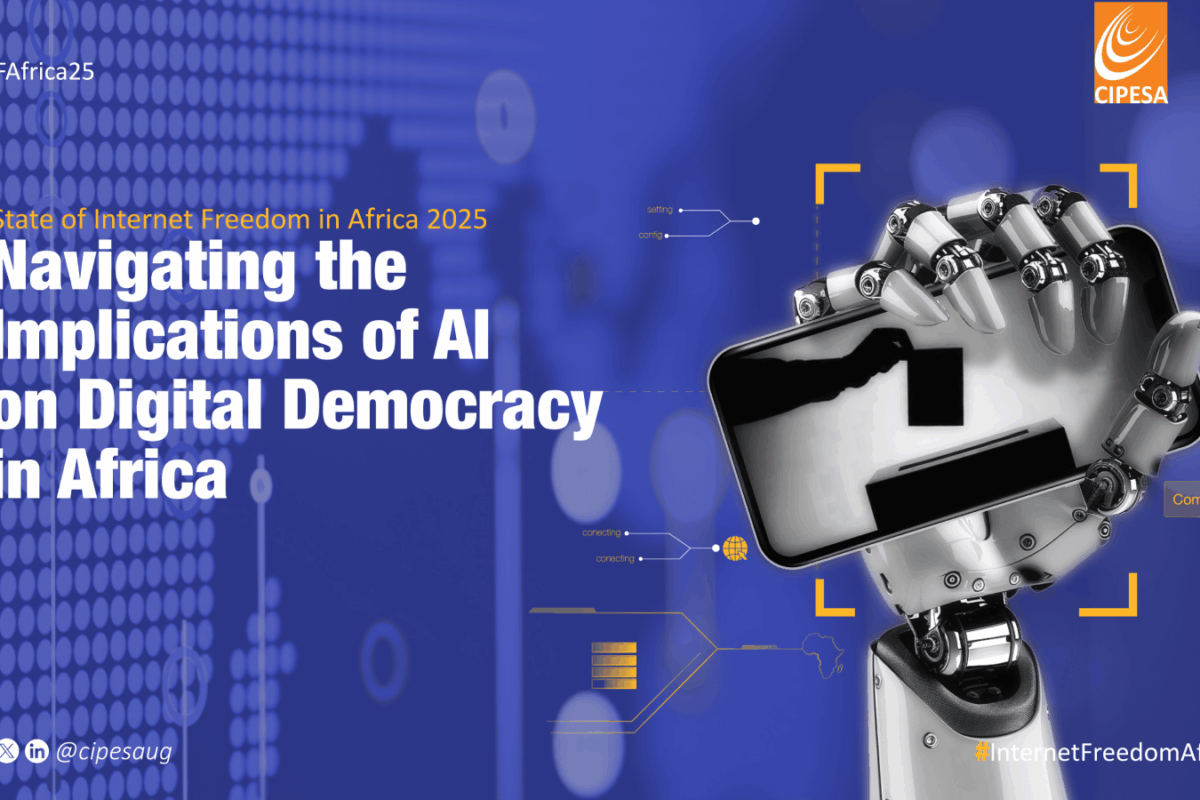

State of Internet Freedom In Africa Report

2025 State of Internet Freedom In Africa Report Documents the Implications of AI on Digital Democracy in Africa

By Juliet Nanfuka | 

The 2025 edition of the Forum on Internet Freedom in Africa (FIFAfrica25) concluded on a high note with the unveiling of the latest State of Internet Freedom in Africa (SIFA) report. Titled Navigating the Implications of AI on Digital Democracy in Africa, this landmark study unpacks how artificial intelligence is shaping, disrupting, and reimagining civic space and digital rights across the continent.

Drawing on research from 14 countries (Cameroon, Egypt, Ethiopia, Ghana, Kenya, Mozambique, Namibia, Nigeria, Rwanda, Senegal, South Africa, Tunisia, Uganda, and Zimbabwe), the report documents both the immense promise and the urgent perils of AI in Africa. It highlights AI’s potential to strengthen democratic participation, improve public services, and drive innovation, while also warning of its role in amplifying surveillance, disinformation, and exclusion. 

Using a qualitative approach, including literature review and key informant interviews, the report shows that AI is rapidly transforming how Africans interact with technology, yet AI also amplifies existing vulnerabilities, introduces new challenges that undermine fundamental freedoms, and deepens existing inequalities.

The report notes that the political environment is a crucial determinant of AI’s trajectory, with strong democracies generally enabling a positive outcome. Top performers in freedom and governance indices such as South Africa, Ghana, Namibia, and Senegal are more likely to set the standard to AI rollout in Africa. Conversely, countries with lower democratic credentials such as Cameroon, Egypt, Ethiopia, and Rwanda risk constraining AI’s potential or deploying it to amplify digital authoritarianism and political repression.  

Countries such as South Africa, Tunisia and Egypt that have a higher internet access and technological development, Gross Domestic Product (GDP) per capita, and score highly on the Human Development Index (HDI), are more likely to lead in AI. Meanwhile, countries with lower or weaker levels of digital infrastructure face greater challenges and higher risks of AI replicating and worsening existing divides. Such countries include Cameroon, Mozambique and Uganda.

The political environment is a crucial determinant of AI’s trajectory, with strong democracies generally enabling a positive outcome. Economic and developmental status also dictates the capacity for AI development and adoption. 

Despite these challenges, the report documents that AI offers substantial value to the public sector by improving service delivery and enhancing transparency. Governments are leveraging AI tools for efficiency, such as the South African Revenue Services (SARS) AI Assistant for tax assessments and Nigeria’s Service-Wise GPT for streamlined governance document access. In Kenya, the Sauti ya Bajeti (Voice of the Budget) platform fosters fiscal transparency by allowing citizens to query and track government expenditures. Furthermore, countries like Tunisia and Uganda are using AI models within tax bodies to detect fraud, while Rwanda is deploying AI for judicial system improvements and identity management at borders.

The private sector and academic institutions are driving AI-inspired innovation, particularly in the areas of FinTech, AgriTech, and Natural Language Processing (NLP). For the latter, notable efforts to localise AI include Tunisia’s TUNBERT model for Tunisian Arabic, and Ghana’s Khaya, an open-source AI-powered translator tailored for local languages. In Ghana, the DeafCanTalk, is an AI-powered app that enables bidirectional translation between sign language and spoken language, and has enhanced accessibility for deaf users. Rwanda has integrated AI into healthcare using drone delivery systems for medical supplies, while Cameroon and Uganda use AI to assist farmers with pest identification. 

However, despite increasing investment, such as the ongoing USD 720 million investment in compute power by Cassava Technologies across hubs in South Africa, Egypt, Kenya, Morocco, and Nigeria, Africa receives  significantly lower AI funding than global counterparts.

Moreover, while AI is gaining traction across many sectors, the proliferation of AI-generated misinformation and disinformation is a pervasive and growing challenge that poses a critical threat to electoral integrity. During South Africa’s 2024 elections, deepfake videos were circulated to manipulate perceptions and endorse political entities. Similarly, during elections and protests in Kenya and Namibia, deepfake technology and automated campaigns were used to discredit opponents. 

The report also documents that governments are deploying AI-powered surveillance technologies, which has led to widespread privacy violations and a chilling effect on freedoms. For example, pro-government propagandists in Rwanda utilised Large Language Models (LLMs) to mass-produce synthetic messages on social media, simulating authentic support and suppressing dissenting voices. Meanwhile, algorithmic bias and exclusion are producing discriminatory outcomes, particularly against low-resource African languages. Also, AI-based content moderation is often ineffective because it lacks contextual understanding and fails to capture local nuance.

A key finding in the report is that across the continent, the pace of AI development far outstrips regulatory readiness. None of the 14 study countries has AI-specific legislation. Instead, fragmented laws on data protection, cybercrime, and copyright are stretched to cover AI, but remain inadequate. Data protection authorities are under-resourced, under-staffed, and often lack the technical expertise required to audit or govern complex AI systems.

Although many national AI strategies are emerging, they prioritise economic growth while neglecting human rights and accountability. This is also fuelled by policy processes that are often opaque and dominated by state actors, with limited multistakeholder participation.

The report  stresses that without deliberate, inclusive, and rights-centred governance, AI risks entrenching authoritarianism and exacerbating inequalities. 

To avoid the current trajectory that AI is taking in Africa, in which AI risks entrenching authoritarianism and exacerbating inequalities, the report calls for a human-centred AI governance framework built on inclusivity, transparency, and context. 

It also makes recommendations, including enacting comprehensive AI-specific legislation, instituting mandatory human rights impact assessments, establishing empowered AI and data governance institutions, and promoting rights-based advocacy. Others are building technical capacity across governments, civil society and media, and developing policies that prioritise equity and human dignity alongside innovation.

AI offers Africa the opportunity to foster innovation, strengthen democracy, and drive sustainable development. This edition of the State of Internet Freedom in Africa report provides an evidence-based roadmap to ensure that Africa’s digital future remains open, inclusive, and rights-respecting.Find the report here.

Elevating Children’s Voices and Rights in AI Design and Online Spaces in Africa

By Patricia Ainembabazi

As Artificial Intelligence (AI) reshapes digital ecosystems across the globe, one group remains consistently overlooked in discussions around AI design and governance: Children. This gap was keenly highlighted at the Internet Governance Forum (IGF) held in June 2025 in Oslo, Norway, where experts, policymakers, and child-focused organisations called for more inclusive AI systems that protect and empower young users.

Children today are not just passive users of digital technologies; they are among the most active and most vulnerable user groups. In Africa, internet use among youths aged 15 to 24 was partly fuelled by the Covid-19 pandemic, hence their growing reliance on digital platforms for learning, play, and social interaction. New research by the Digital Rights Alliance Africa (DRAA), a consortium hosted by the Collaboration on International ICT Policy for East and Southern Africa (CIPESA), shows that this rapid connectivity has amplified exposure to risks such as harmful content, data misuse, and algorithmic manipulation that are especially pronounced for children.

The research notes that AI systems have become deeply embedded in the platforms that children engage with daily, including educational software, entertainment platforms, health tools, and social media. Nonetheless, Africa’s emerging AI strategies remain overwhelmingly adult-centric, often ignoring the distinct risks these technologies pose to minors. At the 2025 IGF, the urgency of integrating children’s voices into AI policy frameworks was made clear through a session supported by the LEGO Group, the Walt Disney Company, the Alan Turing Institute, and the Family Online Safety Institute. Their message was simple but powerful: “If AI is to support children’s creativity, learning, and safety, then children must be included in the conversation from the very beginning”.

The forum drew insights from recent global engagements such as the Children’s AI Summit of February 2025 held in the UK and the Paris AI Action Summit 2025. These events demonstrated that while children are excited about AI’s potential to enhance learning and play, they are equally concerned about losing creative autonomy, being manipulated online, and having their privacy compromised. A key outcome of these discussions was the need to develop AI systems that children can trust; systems that are safe by design, transparent, and governed with accountability.

This global momentum offers important lessons for Africa as countries across the continent begin to draft national AI strategies. While many such strategies aim to spur innovation and digital transformation, they often lack specific protections for children. According to DRAA’s 2025 study on child privacy in online spaces, only a handful of African countries have enacted child-specific privacy laws in the digital realm. Although instruments like the African Charter on the Rights and Welfare of the Child recognise the right to privacy, regional frameworks such as the Malabo Convention, and even national data protection laws, rarely offer enforceable safeguards against AI systems that profile or influence children.

Failure to address these gaps will leave African children vulnerable to a host of AI-driven harms ranging from exploitative data collection and algorithmic profiling to exposure to biased or inappropriate content. These harms can deprive children of autonomy and increase their risk of online abuse, particularly when AI-powered systems are deployed in schools, healthcare, or entertainment without adequate oversight.

To counter these risks and ensure AI becomes a tool of empowerment rather than exploitation, African governments, policymakers, and developers must adopt child-centric approaches to AI governance. This could start with mainstreaming children’s rights such as privacy, protection, education, and participation, into AI policies. International instruments like the UN Convention on the Rights of the Child and General Comment No. 25 provide a solid foundation upon which African governments can build desirable policies.

Furthermore, African countries should draw inspiration from emerging practices such as the “Age-Appropriate AI” frameworks discussed at IGF 2025. These practices propose clear standards for limiting AI profiling, nudging, and data collection among minors. Given that only 36 out 55 African countries currently have data protection laws, with few of them containing child-specific provisions, policymakers must take efforts to strengthen these frameworks. Such reforms should require AI tools targeting children to adhere to strict data minimisation, transparency, and parental consent requirements.

Importantly, digital literacy initiatives must evolve beyond basic internet safety to include AI awareness. Equipping children and caregivers with the knowledge to critically engage with AI systems will help them navigate and question the technology they encounter. At the same time, platforms similar to the Children’s AI Summit 2025 should be replicated at national and regional levels to ensure that African children’s lived experiences, hopes, and concerns shape the design and deployment of AI technologies.

Transparency and accountability must remain central to this vision. AI tools that affect children, whether through recommendation systems, automated decision-making, or learning algorithms, should be independently audited and publicly scrutinised. Upholding the values of openness, fairness, and inclusivity within AI systems is essential not only for protecting children’s rights but for cultivating a healthy, rights-respecting digital environment.

As the African continent’s digital infrastructure expands and AI becomes more pervasive, the choices made today will define the digital futures of generations to come. The IGF 2025 stressed that children must be central to these choices, not as an afterthought, but as active contributors to a safer and more equitable AI ecosystem. By elevating children’s voices in AI design and governance, African countries can lay the groundwork for an inclusive digital future that truly serves the best interests of all.