Digitalizing Democracy: Initiatives in East Africa

By: Caroline Wamala
A number of organizations in east Africa are using ICT to hold leaders accountable, fight corruption, monitor service delivery, and contribute to building a democratic culture. The East Africa ICT4Democracy Network, supported by Spider, was launched in June 2011 to enable the participating organisations to have stronger impact, build a more sustainable initiative, and further enhance people’s capacity to act and participate in democratic processes.
Participating organisations are:

  • iHub, Kenya
  • Women of Uganda Network,
  • Kenya Human Rights Commission,
  • Transparency International, Uganda
  • Commission for Human Rights and Good Governance
  • Collaboration on International ICT Policy for Eastern and Southern Africa, Uganda

For further information about the projects, visit www.ict4democracy.org.
The core problem is that despite the concerted efforts by international agencies, governments and local donors, ignorance prevails about human and citizen rights among the majority of communities. This perpetuates a culture of poor or bad service delivery across all sectors.
In the developed world generally everyone is aware that water is a human right, health is a human right, in sub-Saharan Africa, or east Africa, people are unaware of these rights, clean water, or access to health is seen as a favour.”

Ashnah – CIPESA at M4D2012 New Delhi

Informing people about their rights to government services is the first step to engaging communities in holding their government accountable to better service delivery.
“So we are not just demanding accountability, we are making communities aware that you are entitled to freedom of expression, entitled to clean water, health etc. so we are engaging them, and they are participating, they are knowledgeable…we are going beyond survellieng and hold someone accountable.

Ashnah – CIPESA  at M4D2012 New Delhi

 Are ICTs the road to democracy?
 While ICT can raise awareness on good governance, spread information on human and citizen rights and help monitor service delivery, it is “merely an amplifier, that acts within the environment it is embedded in. ICT is not the panacea none of our projects think or say that technology is the answer, technology is probably solving 5% of the problem, the other 95% requires us as a people to come together. As long as the cohesion and symbiotic relationships in this network continue these projects will explode into some serious change and become sustainable, we are working together and mobile technology is creating effective change and the same model can be applied in other places, we are building something by learning from each other.

Angela and Hilda – iHub at the M4D2012 Conference in Delhi

 Caroline Wamala is Project officer at Spider and post-doc researcher at Karlstad University.
This article was published by the Swedish Programme on ICTs for Developing regions (SPIDER) on April 18, 2012, about the ICT4Democracy in East Africa project, which brings together various partners in the region – among them CIPESA – Editor
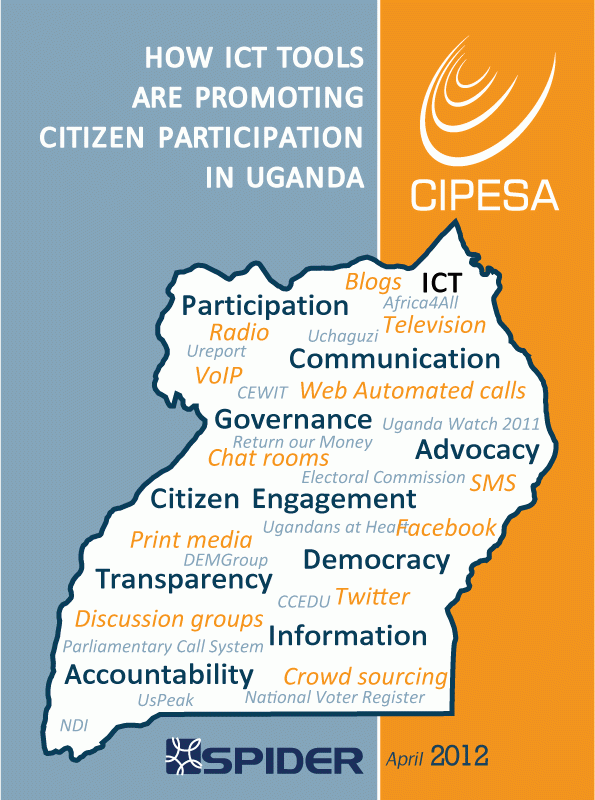
New Report Shows How ICT is Aiding Citizen Participation in Uganda

A new report by the Collaboration on International ICT Policy in East and Southern Africa (CIPESA) illustrates how Information and Communication Technologies (ICT) are aiding citizen participation in Uganda, but also points to the challenges that need to be overcome for these technologies to have a wider impact on governance.
The report reviews various ICT tools being used to promote transparency, accountability, and citizen participation in Uganda. It examines the utility and shortcomings of these tools, the challenges they face, and the factors contributing to their success. Furthermore, it offers suggestions for improving the utility, reach, and, hopefully, the success of initiatives that utilise ICT to improve citizen participation.Based on the 24 ICT tools assessed, seven main categories of uses of tools were identified: Information provision; Election monitoring; Lobbying and activism; Voter registration; Elections reporting; Citizen policing; and Civic participation in the post-election period.Innovations especially with mobile telephony and interactive mapping have showcased how ICT can help improve transparency and accountability in the delivery of public services. In the run up to Uganda’s 2011 general elections, ICT tools were used broadly, for campaigning, tallying results, monitoring the actions of political groups and the electoral body, for civic education, and for activism. The tools included mobile phones, automated calls, and crowd sourcing platforms, radio and television, as well as social media. They contributed to transparency of the polls – but probably not to voter turn-out.However, the most immediate challenge to the adoption of these tools is that few Ugandans are embracing them. In Uganda, market penetration for voice stands at 45% with a population coverage of close to 100%. Mobile accounts for more than 90% of new connections, with 910,000 new subscribers being added each year. While this is providing a solid base in terms of numbers of those who can use the ICT, the figures do not tell the whole story. For example, studies show that nearly half of mobile phone subscribers own at least two SIM cards. Moreover, even among the phone-owning class, for many usage beyond voice (and, well, Facebook and radio) remains limited.And there are yet more challenges. Limitations such as the cost of accessing and using the ICT, language barriers and low literacy levels mainly for the internet and mobile based platforms – as well as minimal attention by government to boosting usage of ICT in governance all hinder the effective use of these tools. This study finds that it is therefore crucial for organisations using ICT for participation and democracy to carry out extensive assessments before deploying the technology, to work with others rather than duplicate efforts, to create awareness and capacity among users, and to continuously assess the impacts the ICT initiatives are creating.This research was made possible by funding from the Swedish Program for ICT in Developing Regions (Spider), which is supporting projects in Kenya, Tanzania, and Uganda, in the areas of education, health, and governance. The results shall directly inform some wider actions in catalysing civic participation and democracy monitoring using ICT, which CIPESA and other SPIDER partners are undertaking in East Africa. Spider has provided seed-funding to a range of organisations that form the ICT4Democracy in East Africa Network (www.ict4democracy.org), who will benefit from this study.
Download the full report here