
By Brian Byaruhanga |
In May 2026, CIPESA joined the World Organisation Against Torture (OMCT) and partners to conduct a three-day workshop on digital security and Open-Source Intelligence (OSINT) for Congolese human rights defenders and journalists in exile in Uganda.
The workshop addressed the various threats this community continues to navigate daily including account compromise, phishing-borne malware, surveillance by state and non-state actors, device confiscation, and exposure to coordinated disinformation operating across both home-country and diaspora information spaces.
The 23 participants were drawn from women’s rights organisations, community documentation initiatives, justice and accountability groups, and broader human rights defender (HRD) support structures. A pre-workshop participant assessment found that one in three respondents had received no prior digital security training, highlighting a significant gap between the threats faced and necessary skills and knowledge to mitigate them.
The findings underscored the need to begin with foundational digital security practices before moving on to more advanced verification and documentation techniques.
Reported incidents within the cohort included hacked accounts, phishing attempts, confiscation of phones by security agents, surveillance of digital communications, and impersonation. One respondent described documentation work conducted in close proximity to alleged perpetrators of human rights violations, with no possibility of relocating, and elevated personal risk attached to ordinary data collection. These conditions, common across conflict-affected zones as is the case in the Democratic Republic of Congo (DRC), shape the technical and ethical constraints under which any digital security training must be designed.
CIPESA’s contribution builds on the organisation’s broader work supporting at-risk communities across the region, including through the Level-Up programme, which has provided digital security support to HRD organisations in Kenya, Ethiopia, Tanzania, South Sudan, and Uganda.
It also draws on CIPESA’s wider efforts to strengthen the capacity of civil society actors to advance digital rights in Africa. Across these engagements, a consistent key insight is that defenders rarely need more tools than they already have. More often, they need a clearer understanding of how those tools work, where the vulnerabilities lie, and which everyday habits can expose them to risks.
The workshop therefore began with the fundamentals of digital security: how information travels online, where vulnerabilities emerge, how accounts are compromised, and why stronger authentication practices matter. Participants explored common attack pathways and practical measures for reducing exposure in their day-to-day work. The tools and exercises were selected for compatibility with the devices and operating systems that participants already relied on.
Foundations of digital safety
Participants installed secure communication tools like Tor and Orbot on their devices, worked through phishing recognition exercises based on scenarios familiar to the cohort, and tested safer-browsing configurations. The goal was not to introduce defenders to a long list of tools but to build working familiarity with a few, including practices of opening, inspecting, and configuring in ways they could transfer the acquired skills and knowledge onto their communities’ and colleagues’ devices.
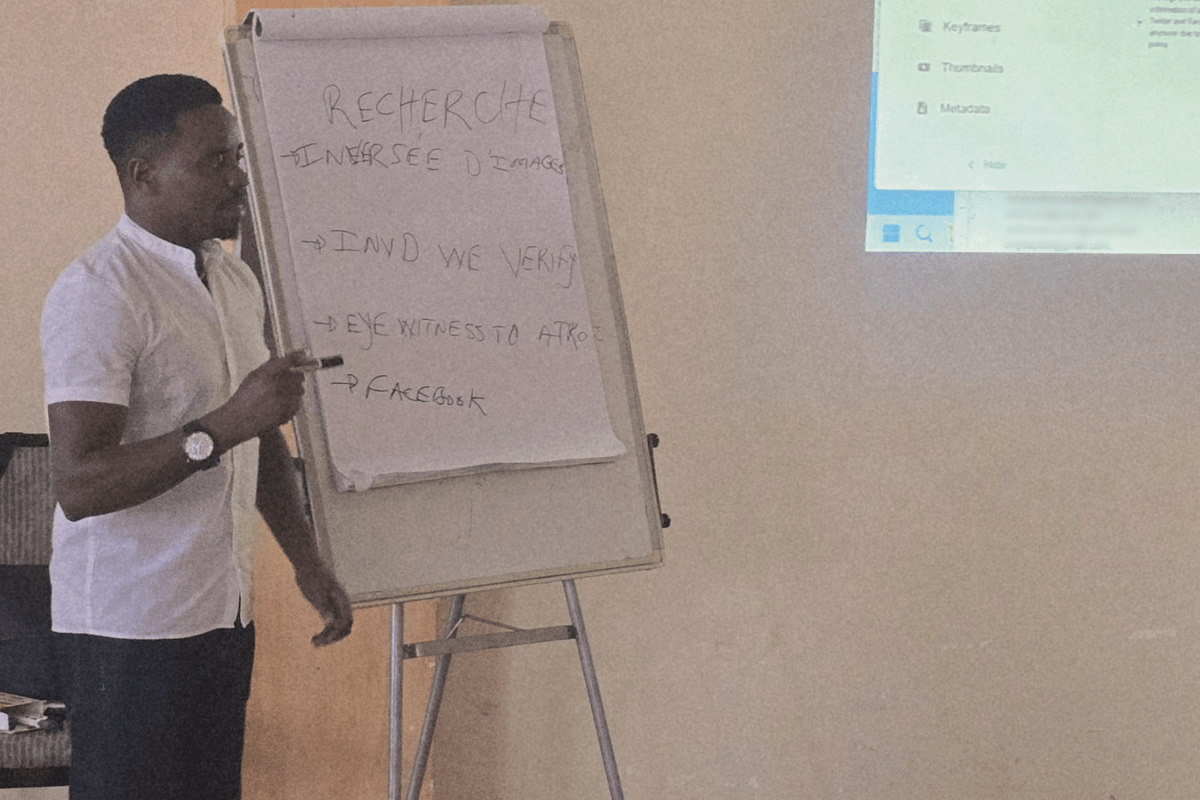
Building on these foundations, the workshop moved onto OSINT and verification techniques that help defenders assess contested information and strengthen the credibility of human rights documentation. Participants practised reverse image searching against cases of recycled imagery presented as fresh evidence; used ExifTool to extract and read image metadata; and verified short-form video using the InVID-WeVerify verification plugin, parsing keyframes and tracing material across platforms.
Secure OSINT Documentation
Effective documentation and digital security are increasingly interconnected skills. The session on secure documentation walked participants through eyeWitness to Atrocities, the camera application developed by the International Bar Association that embeds metadata to support evidentiary chain of custody. In 2018, footage captured with eyeWitness was admitted as evidence before a military tribunal in Bukavu town, which subsequently convicted two armed group commanders of murder and torture, constituting crimes against humanity. It was the first time eyeWitness footage had been used in court proceedings in the DRC. The session also demonstrated structured data collection and management using Uwazi and KoBoToolbox, both open-source platforms widely adopted for field research and human rights documentation.
These tools strengthened participants’ capacity to document and verify human rights abuses while also helping them to understand how their digital footprints can be exploited by adversaries. They also helped participants assess potentially misleading or manipulated content without inadvertently amplifying false information.
Outcomes
The training was grounded in the recognition that participants understand their own operating environments better than external facilitators ever can. The sessions were designed to strengthen existing knowledge and support locally informed security practices.
According to pre- and post-workshop evaluations, participant capacity increased from a composite score of 2.27 to 3.69 on a five-point scale. The results reflected a shift from limited familiarity with core concepts to practical competence in applying digital security and verification tools within their own documentation and advocacy work.
To extend the impact of the workshop beyond the participants in the room, CIPESA adopted a Training of Trainers (ToT) approach. Participants were encouraged to cascade the knowledge, tools, and practices acquired during the training within their organisations and communities. The approach supports the development of locally embedded digital security capacity and reduces reliance on external technical support.
Beyond the training
CIPESA’s work with refugee and exiled defender communities will continue, in collaboration with OMCT and other partners with adjacent mandates. The next phase will build on this foundation through sequenced follow-up modules, applied casework on documented matters, and ongoing technical support for the organisations represented in the cohort.
The aim is not simply to transfer skills during a workshop, but to strengthen the long-term resilience of organisations and networks engaged in human rights documentation, advocacy, and accountability work in increasingly complex digital environments.